Self Directed Fidelity Retirement Plans and Educational Savings Accounts

A global leader in financial services, Fidelity Investments headquartered in Boston, MA, manages several hundreds of Fidelity funds.

Fidelity also provides access to several thousands of mutual funds managed by other fund companies through Fidelity FundsNetwork. Fidelity customers can trade some of BlackRock’s iShares ETFs commission free through Fidelity Brokerage Services LLC.

Whether you are a self directed investor or using the services of an investment advisor, AlphaProfit Newsletter is for you. AlphaProfit Newsletter helps you add significant value to your account with little risk, time, or effort.

You can use AlphaProfit’s recommendations to manage your assets in:

  • Employer sponsored retirement plans like Fidelity 401k Plan, Fidelity 403b Plan, or Fidelity 457 Plan
  • Retirement plans for employees and owners of small businesses like SIMPLE IRA Plan, SEP IRA Plan, Self Employed 401k Plan, or Keogh Plan
  • Fidelity IRAs like Traditional IRA, Rollover IRA, or Roth IRA
  • Custodial accounts or educational savings accounts like UTMA accounts or UGMA accounts

To maximize your return and minimize risk, we recommend the best investments by researching hundreds of Fidelity mutual funds and thousands of non-Fidelity mutual funds offered in Fidelity Funds Network. AlphaProfit provides mutual fund, ETF, and sector model portfolios.

We emphasize no-load, no-transaction-fee (NTF) funds to minimize your fees and expenses.

Our low-maintenance investing approach minimizes the time you spend trading. It also eliminates brokerage commission costs and short-term redemption fees.

AlphaProfit model portfolios are tracked by and have been top ranked by Hulbert Financial several times.

In short, AlphaProfit’s investment selection process enables you to achieve market-beating returns with little time and effort.

Subscribe to the AlphaProfit Investment Newsletter now!

Here is a quick overview of the different accounts and plans offered by Fidelity Investments to help you achieve your investment objectives.

Saving for Retirement

Fidelity Investments offers self-directed investors several types of individual retirement accounts and plans that qualify for tax benefits under the Internal Revenue code.

A. Employer Sponsored Retirement Plans

Employees of large corporations, educational institutions, and government organizations can invest in the following types of retirement accounts:

Fidelity 401k Retirement Plan

Fidelity 401k plan is a defined contribution retirement plan for corporate employees with maximum contribution limits, automatic payroll deduction, and selected investment options.

Fidelity 403b Retirement Plan

Fidelity 403b plan is a defined contribution retirement plan for employees of educational institutions and non-profit organizations with maximum contribution limits, automatic payroll deduction, and selected investment options.

Fidelity 457 Retirement Plan

Self-directed Fidelity investors add value by using the AlphaProfit newsletter to manage assets in their 401k, Roth IRA, Rollover IRA, and Traditional IRA accounts.

Fidelity 457 plan is a defined contribution retirement plan for employees of state and local governments and tax-exempt organizations with features similar to 401k and 403b plans.

B. Retirement Plans for Employees and Owners of Small Businesses

Self-employed persons and employees of small business firms can invest in the following types of retirement accounts:

Savings Incentive Match Plan for Employees or SIMPLE IRA Plan

SIMPLE IRA is a low cost retirement plan for employees in a small business with less than 100 employees offering a full range of investment choices and potentially higher limits of contribution than a SEP IRA.

Simplified Employee Pension Plan or SEP IRA Plan

SEP IRA is a retirement plan for a self-employed person or small business owner with employees, offering a wide range of investment choices and flexible funding requirements.

Self Employed 401k Plan

Self-employed 401k plan is a retirement plan for self-employed individual or business owner with spouse as employee, offering a full range of investment choices and higher contribution limits.

Keogh Plan

Keogh Plan is a more complicated retirement plan for a sole proprietor or partnership with a small number of employees, offering high tax deductible contribution limits and a full range of investment options.

C. Other Types of Individual Retirement Accounts (IRAs)

Self-directed individuals can use individual retirement accounts or rollover assets accumulated in qualified retirement accounts to grow assets tax-deferred.

Fidelity Rollover IRA Account

Fidelity Rollover IRA offers individuals who change jobs or retire tax-deferred growth and more investment options than in employer sponsored retirement plans.

Fidelity IRA or Traditional IRA Account

Fidelity IRA or Traditional IRA is an individual retirement account held by individuals with Fidelity Investments as custodian. The account carries specific annual contribution limits and provides full range of investment options.

Fidelity Roth IRA Account

Fidelity Roth IRA is an individual retirement account funded with after-tax monies offering tax-free withdrawal in retirement.

Saving for College Education

A. 529 Education Plan

Fidelity UTMA & UGMA accounts for college education
The AlphaProfit Newsletter helps to effectively manage assets in Fidelity UTMA & UGMA accounts for the beneficiary’s college education.

529 Education Plan is a tax-advantaged, professionally managed account with a limited range of investment options for a donor allowing beneficiary tax-free withdrawal for college education.

B. Custodial Accounts for Minors

Uniform Transfer to Minors Act or UTMA Account

Uniform Transfer to Minors Act or UTMA Account is a custodial account for the benefit of a minor maturing at 21 years or higher and offering high contribution limit, exclusion from gift tax and a full range of investment options for the custodian.

Uniform Gifts to Minors Act or UGMA Account

Uniform Gifts to Minors Act or UGMA Account is a custodial account for the benefit of a minor maturing at 18 years and offering high contribution limit, exclusion from gift tax, and a full range of investment options for the custodian.

Saving to Build Wealth

Individual as well as joint accounts are available to build wealth through equity investments
Not Sector Investing? New Study Proves You are Missing Opportunities

Some investors are reluctant to engage in sector investing, as they view it to be riskier than index investing. Active investors now have the means to lessen the risk associated with sector investing and earn greater rewards than with index investing.

Investors often perceive sector investing as risky. Sector funds or sector ETFs that confine their investments to a specific sector or industry are often more volatile than diversified funds or ETFs.

Stocks in a specific sector often tend to move together. Economic, regulatory, or political developments can affect the prospects of many companies in a sector positively or negatively. For example, medical delivery companies in general benefit from insurance subsidies and improving accessibility to health care.

Countering the perception of sector investing being risky, a recent study by Archan Basu and Dirk Hofschire at Fidelity Investments shows investors can improve their portfolios from diversification and risk-adjusted return considerations by thinking cyclically and adopting sector investing.

They say diversification and return benefits of sector investing stem from three factors:

Wide difference in performance: The difference in performance between the best and worst performing sectors is often large. AlphaProfit’s analysis of Fidelity Select Funds shows the year’s best Fidelity Select Fund outperformed the year’s worst Fidelity Select Fund by 80% or 8000 basis points on average since 1991. This wide difference in performance across sectors enhances the potential for diversification and provides opportunity for investors to add value to their portfolios.

Enduring volatility patterns: Some sectors are consistently more risky than other sectors. For example, information technology is reliably more volatile than consumer staples. AlphaProfit’s analysis shows Fidelity Select Technology’s (FSPTX) standard deviation in quarterly returns is higher than Fidelity Select Consumer Staples’ (FDFAX) standard deviation in all rolling five-year periods from 1991 to 2014.

Stable classification: The makeup of companies within a sector tends to be stable compared to style and size based classifications. Growth stocks for example can become value stocks when they fall out of favor. Likewise, small-cap stocks can become mid-cap or large-cap stocks from price appreciation. In contrast, changes to a company’s sector classification are relatively rare.

Fidelity’s research shows sectors explain 22% of the difference in return across U. S. stocks. Style and size in comparison explain only 13% and 4%, respectively. In other words, sectors account for return differences more than style and size combined.

Investment Process to Harness the Potential of Sector Investing while Mitigating Risks

Basu and Hofschire recommend using insights on cycles and sectors to construct portfolios. They also urge investors to ensure the resilience of portfolios to a wide range of potential economic scenarios over an intermediate-time horizon. They however do not offer guidance on how to construct such portfolios.

To put cycles and sectors to work, investors need processes and tools to determine the mix of attractive sectors in the context of the business cycle. Investors need answers to questions like:

  • What stage of the business cycle is the economy currently in? Is the economy contracting, bottoming, expanding, or peaking?
  • What will drive growth in revenues and earnings in a specific sector?
  • How cheap or expensive are stocks in a specific sector from a historical perspective and relative to the market?
  • What are the risks of investing in this sector?
  • How are stocks in this sector faring currently?

AlphaProfit’s Sector Investing System

AlphaProfit’s sector investing system includes a process for sector selection and a strategy for sector rotation.

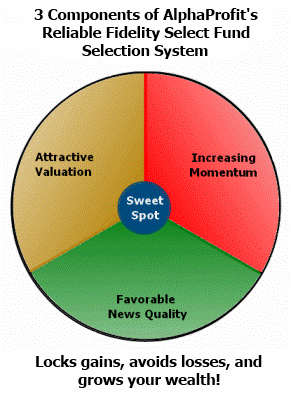
AlphaProfit’s sector selection process evaluates sectors on valuation, momentum, and news quality measures.

Using sectors favorably ranked by this selection process, AlphaProfit constructs different model portfolios for its Premium Service subscribers. AlphaProfit provides the ETF Core and Fidelity Core model portfolios for long-term capital appreciation and the ETF Focus and Fidelity Focus model portfolios for aggressive growth.

AlphaProfit’s sector rotation strategy introduces or retains prospective leaders and eliminates or reduces prospective laggards from the model portfolios in a timely manner.

AlphaProfit’s sector investing system has navigated through both favorable and unfavorable market environments with a 75% success rate in picking winners.

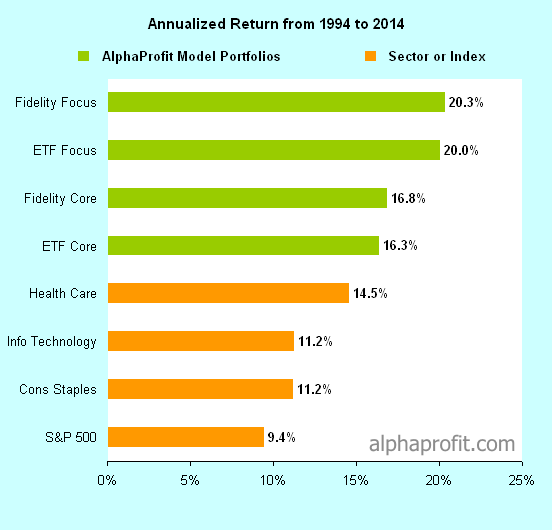
This success rate has helped the ETF Core, Fidelity Core, ETF Focus, and Fidelity Focus model portfolios to gain at annualized rates of 16.3%, 16.8%, 20.0%, and 20.3%, respectively from 1994 to 2014. For comparison purposes, the S&P 500 has advanced at a 9.4% annual rate during the same period.

not-sector-investing-new-study-proves-you-are-missing-opportunities

Source: Morningstar, AlphaProfit

Timely sector selection and sector rotation has enabled AlphaProfit’s Fidelity Focus, ETF Focus, Fidelity Core, and ETF Core model portfolios to beat leading Fidelity sector funds in health care, information technology, and consumer staples as well as the S&P 500.

AlphaProfit’s Premium Service has consistently ranked #1 among mutual fund investment newsletters by Hulbert Financial Digest, a Dow Jones publication that serves as de facto Consumer Reports of investment newsletters.

AlphaProfit’s Free Investment Newsletter MoneyMatters

Get two special reports Five Smart Ways of Using Fidelity Select Funds and Avoid Three Common Mistakes ETF Investors Make when you sign up for AlphaProfit’s FREE investment newsletter MoneyMatters

Vanguard Sector ETFs: Invest in Best Vanguard Sector ETFs

Vanguard Sector ETFs are administered by The Vanguard Group, a leading mutual fund company that manages several index mutual funds. Vanguard sector ETFs are set up as a separate class of shares of selected Vanguard index funds.

Vanguard index funds that offer ETF shares have two classes of shares. The first class of shares is called Admiral Shares. The Admiral Shares are conventional mutual fund shares that can be bought from or redeemed with the issuing index fund. The ETF shares are the other class of shares and they trade on the American Stock Exchange.

Breadth of Vanguard Sector ETFs

Vanguard offers ten sector ETFs and one industry group ETF. The sector ETFs span the ten sectors of the Global Industry Classification Standard jointly developed by Morgan Stanley Capital International (MSCI) and Standard & Poor’s. The sole industry group ETF focuses on real-estate investment trusts (REITs).

Investment Approach of Vanguard Sector ETFs

The Vanguard ETFs as well as sector and industry group index funds are designed to track a target index. The target index is the MSCI US Investable Market Index for the corresponding sector or industry group. The MSCI sector indexes are subsets of the MSCI US Investable Market 2500 Index. The MSCI US REIT Index is the target index for the Vanguard REIT Index Fund.

Expense Ratio of Vanguard Sector ETFs

The expense ratio for all Vanguard sector ETFs except the Vanguard REIT ETF is 0.10%. The expense ratio for the Vanguard REIT ETF is 0.12%.

Trading Vanguard Sector ETFs

Vanguard Sector ETFs may be purchased in ’round lots’ of 100 shares or smaller with the minimum number being one share. Subject to certain restrictions, Vanguard allows existing Admiral Class shareholders to convert their shares into shares of the corresponding ETF.

AlphaProfit Take on Vanguard Sector ETFs

Vanguard ETFs are based on benchmark indexes provided by MSCI. The MSCI indexes are reconstituted quarterly and reflect changes in equity markets in a relatively timely manner. The MSCI sector indices tend to be more broadly diversified. As such, Vanguard sector ETFs generally include a greater number of stocks and cover more market capitalization segments than sector ETFs offered by other ETF families.

The expense ratios of Vanguard ETFs are generally lower than those of most competing ETFs. The expense ratios of Vanguard ETFs are also generally a tad lower than those of the Admiral Shares offered by the corresponding Vanguard index fund.

The liquidity of Vanguard ETFs has generally been lower than those of SPDR ETFs. This in turn may translate into higher bid-ask spreads.

Since Vanguard ETFs are set up as a class of index fund shares, significant net redemptions of the Admiral Class mutual fund shares may adversely affect the tax efficiency of the ETF shares.

With just one industry group offering, Vanguard ETFs offer slim pickings for investors seeking industry group ETFs.

For most retail investors, Vanguard ETFs offer a less-onerous means to own shares in Vanguard sector index funds. ETF investors do not have to come up with the relatively large minimum initial investment required to own Admiral Shares. Unlike Admiral Share investors, ETF investors are not required to hold their shares for one year to avoid the short-term redemption fee.

Vanguard Sector ETF Recommendations

AlphaProfit Sector Investors’ Newsletter is the premier resource for sector investors. The Newsletter offers recommendations on Vanguard sector ETFs. The Newsletter and its model portfolios have frequently been ranked #1 by Hulbert Financial Digest.

About AlphaProfit MoneyMatters

AlphaProfit MoneyMatters is a free e-letter distributed to registered users of AlphaProfit’s website. The e-letter analyzes the economy, markets, and sectors and provides money-making insights on stocks, exchange-traded funds, and mutual funds. AlphaProfit MoneyMatters is edited by Dr. Sam Subramanian acclaimed for his financial acumen and analytical skills. Sign Up for ETF Newsletter.

List of Vanguard Sector ETFs

Vanguard ETFSymbolInception DateVanguard Index Fund Offering ETF, Admiral Shares TickerUnderlying MSCI-US-IM IndexFocus Area of ETF
Vanguard Consumer Discretionary ETFVCR01/26/2004Vanguard Consumer Discretionary Index Fund, VCDAXConsumer DiscretionaryMedia, Entertainment, Home Improvement Retail, Restaurants
Vanguard Consumer Staples ETFVDC01/26/2004Vanguard Consumer Staples Index Fund, VCSAXConsumer StaplesFood Products, Beverages, Tobacco, Household Products
Vanguard Energy ETFVDE09/23/2004Vanguard Energy Index Fund, VENAXEnergyIntegratedOil, Oil & Gas Exploration & Production, Energy Service
Vanguard Financials ETFVFH01/26/2004Vanguard Financials Index Fund, VFAIXFinancialsDiversified Banks, Property & Casualty Insurance, Regional Banks, REITs
Vanguard Health Care ETFVHT01/26/2004Vanguard Health Care Index Fund, VHCIXHealth CarePharmaceuticals, Biotechnology, Health Care Equipment
Vanguard Industrials ETFVIS09/23/2004Vanguard Industrials Index Fund, VINAXIndustrialsIndustrial Conglomerates, Aerospace & Defense, Heavy Equipment & Machinery
Vanguard Information Technology ETFVGT01/26/2004Vanguard Information Technology Index Fund, VITAXInformation TechnologyComputer Hardware, Communication Equipment, Semiconductors, Software
Vanguard Materials ETFVAW01/26/2004Vanguard Materials Index Fund, VMIAXMaterialsDiversified Chemicals, Steel, Specialty Chemicals
Vanguard REIT ETFVNQ09/23/2004Vanguard REIT Index Fund, VGSLXREITRetail REITs, Specialized REITs, Residential REITs, Office REITs
Vanguard Telecom. Services ETFVOX09/23/2004Vanguard Telecommunication Services Index Fund, VTCAXTelecom. ServicesIntegrated Telecommunication Services, Wireless Telecommunication Services
Vanguard Utilities ETFVPU01/26/2004Vanguard Utilities Index Fund, VUIAXUtilitiesElectric Utilities, Multiutilities, Independent Power Producers, Gas Utilities

SPDR ETF – Select Sector SPDR – SPDR Gold Shares

A Sector Investing Perspective on SPDR ETF, Select Sector SPDR ETF, and SPDR Gold Shares

State Street is involved in the management and marketing of several exchange-traded funds (ETFs) through its subsidiary, State Street Global Advisors (SSgA). Sector ETFs, industry-group ETFs, and a commodity trust are offered.

Breadth of Sector ETFs

Ten sector ETFs are offered, nine under the Select Sector SPDR series. Fourteen industry-group ETFs are available, eight under the SPDR S&P series and four under the KBW series. SPDR Gold Shares is the sole commodity trust.

Investment Approach

The State Street ETFs and the SPDR Gold commodity trust take an indexed or ‘passive’ approach to investing. The benchmark index used depends on the type of exchange traded entity.

Select Sector SPDR

The Select Sector SPDRs are ETFs that result from the division of the Standard & Poor’s 500 index into nine sector indexes. All stocks within each sector are allocated to the corresponding Select Sector SPDR ETF. Each Select Sector SPDR ETF is designed to track the total return performance of the corresponding S&P Select Sector index.

SPDR S&P ETF

The eight industry-group SPDR S&P ETFs are designed to track the total return performance of the corresponding S&P Select Industry Index. Each S&P Select Industry Index represents the industry’s portion of the S&P Total Market Index. The S&P Total Market Index includes companies of all market capitalizations.

Other ETFs

State Street offers ETFs in the financial and technology sectors that use benchmarks developed by Keefe, Bruyette, & Woods (KBW), Dow Jones & Co., and Morgan Stanley.

SPDR Gold Shares

SPDR Gold Shares represent units of fractional undivided beneficial ownership of the SPDR Gold Trust. The London PM fix for gold is used as the basis for determining the net asset value of the SPDR Gold Shares.

Expense Ratio

The State Street exchange traded entities have expense ratios ranging up to 0.6%. The Select Sector SPDR ETFs typically have an expense ratio of 0.24% while the SPDR S&P and KBW industry-group ETFs typically have a 0.35% expense ratio. The SPDR Gold Trust’s expense ratio is 0.4%.

Trading Size

The State Street exchange traded entities may be purchased in ’round lots’ of 100 shares or smaller with the minimum number being one share.

AlphaProfit Take

Exchange-traded funds and commodity trust managed or marketed by entities of State Street Bank, the largest custodian and investment manager of institutional assets worldwide, have carved out a major share for themselves. As evident from the trading volumes, the Select Sector SPDR ETFs launched in late 1998 are popular with sectors investors. Comprising of S&P 500 member companies, the Select SPDR ETFs have low expense ratios and are a suitable option for investors seeking exposure to broad sectors.

Launched in late 2004, the SPDR Gold Shares are a hit with investors. This exchange traded commodity trust allows investors to profit from changes in the price of gold without venturing into the spot or futures markets.

State Street entities have also introduced a limited number of industry-group ETFs under the SPDR S&P and the KBW series. Like Select Sector SPDR ETFs, the SPDR S&P ETFs and the KBW ETFs tend to have relatively low expense ratios. The popularity of the industry group ETFs is likely to grow over time.

AlphaProfit Newsletter and SPDR ETF Recommendations

AlphaProfit Sector Investors’ Newsletter is the premier resource for sector investors. The Newsletter offers SPDR exchange traded fund recommendations. The Newsletter and its model portfolios have frequently been ranked #1 by Hulbert Financial Digest.

About AlphaProfit MoneyMatters

AlphaProfit MoneyMatters is a free e-letter distributed to registered users of AlphaProfit’s website. The e-letter analyzes the economy, markets, and sectors and provides money-making insights on stocks, exchange-traded funds, and mutual funds. AlphaProfit MoneyMatters is edited by Dr. Sam Subramanian acclaimed for his financial acumen and analytical skills. Sign Up for ETF Newsletter.

Fidelity Select Funds: Choose the Best Fidelity Sector Fund Consistently

Few investment products have as many fanatics as Fidelity Select funds do. Why? The Fidelity Select fund aficionados know that they can beat the market by judiciously selecting such funds.

Here are the facts: The average Fidelity Select fund has outperformed the S&P 500 by 4.7% per year over the past 20 years.

The stats get even better.

Each year’s best Fidelity Select fund has on average outperformed the S&P 500 by a whopping 51.2%.

Clearly, Fidelity Select funds are high potential sector funds that provide great returns IF you get the selections right.

The trick to benefiting from Fidelity Select funds is to capture the rewards they provide while mitigating the risks they carry.

Here is how AlphaProfit helps you do just that … make money by investing in the right Fidelity Select funds at the right time.

Select Best Sectors and Top Fidelity Select Funds

You have the choice of over 40 Fidelity Select and sector funds that span different sectors of the stock market.

Fidelity Select funds: System for Choosing Best Fidelity Select Funds

AlphaProfit reliably selects winning Fidelity Select funds by combining fundamental and technical evaluation factors
Sign up for AlphaProfit’s FREE Fidelity Newsletter

Different Fidelity Select funds tend to perform well during different stages of the business and interest rate cycles. Fidelity Select funds in the Consumer Discretionary sector for example can perform well as interest rates fall and the economy starts to recover from a recession while Fidelity Select funds in the Information Technology sector can perform well during expansion phases.

All too often, investors make the mistake of selecting sectors or industries based on one factor … price trend. Such selection methods are prone to high failure rates.

To help you consistently invest in the right sectors and time entries & exits, AlphaProfit analyzes sectors using a combination of fundamental and technical factors within the context of the business cycle.

By using a combination of criteria such as valuation, momentum, and news quality to holistically analyze sectors, AlphaProfit ascertains winning sectors while minimizing negative surprises.

AlphaProfit then blends the above top-down analyses with bottom-up analyses of top holdings in Fidelity Select funds to determine the best Fidelity Select funds in the best sectors.

Diversify across Top Fidelity Select Funds

Despite the rigor of the evaluation and selection process, there can be occasions where investment in Fidelity Select funds may not pan out exactly as expected. The performance of a specific Fidelity Select fund can at times be affected by exogenous events like the earthquake in Japan or unanticipated industry developments like the ban on oil drilling in Gulf of Mexico.

Popular Fidelity Select and Sector Funds

Sector NameFund Name, Ticker
Consumer DiscretionaryFidelity Select Automotive, FSAVX
Fidelity Select Leisure, FDLSX
Consumer StaplesFidelity Select Consumer Staples, FDFAX
EnergyFidelity Select Energy, FSENX
Fidelity Select Natural Resources, FNARX
FinancialsFidelity Select Banking, FSRBX
Fidelity Real Estate Investment, FRESX
Health CareFidelity Select Biotechnology, FBIOX
Fidelity Select Health Care, FSPHX
IndustrialsFidelity Select Defense & Aerospace, FSDAX
Fidelity Select Industrials, FCYIX
Information TechnologyFidelity Select Electronics, FSELX
Fidelity Select Technology, FSPTX
MaterialsFidelity Select Chemicals, FSCHX
Fidelity Select Gold, FSAGX
UtilitiesFidelity Select Utilities, FSUTX
Fidelity Telecom & Utilities, FIUIX

To mitigate your risks, AlphaProfit brings together the best Fidelity Select funds from top sectors to construct Fidelity Select fund-based model portfolios for different investment objectives. AlphaProfit provides weightings for the individual Fidelity Select funds with a view to minimize portfolio volatility.

Ensure Top Fidelity Select Fund Selections at all Times through Timely Sector Rotation

AlphaProfit uses its time-tested sector rotation strategy to ensure Fidelity Select funds with outstanding return potential are included in the model portfolios at all times. By the same token, the sector rotation strategy works to weed out Fidelity Select funds with unappealing return potential in a timely manner.

Beat the Market with Fidelity Select Fund Model Portfolios

AlphaProfit’s proven Fidelity Select fund selection process enables thousands of investors to thrive in turbulent markets.

AlphaProfit provides two market-beating Fidelity Select fund-based model portfolios you can use in your regular and retirement accounts.

The AlphaProfit Focus model portfolio pursues aggressive growth while the AlphaProfit Core model portfolio is tailored for investors seeking long-term capital appreciation.

A dollar invested in the Fidelity Aggressive Growth (Focus) and Fidelity Capital Appreciation (Core) model portfolios is worth $178.51 and $77.31, respectively. This implies annualized returns of 17.6% and 14.6%, respectively.

A comparable investment in the S&P 500 benchmark is worth $26.77, implying an annualized return of 10.8%.

Performance of Fidelity mutual funds model portfolios driven by disciplined investment process

Performance of Fidelity Focus and Fidelity Core mutual fund model portfolios as of December 31, 2025. Sign up for Fidelity Newsletter.

Dow Jones & Company’s Hulbert Financial unit has ranked the AlphaProfit Focus and Core model portfolios #1 rank numerous times.

Here are just a few examples of actual returns earned by AlphaProfit readers from individual Fidelity Select fund selections:

  • 272.9% gain from Fidelity Select Technology (FSPTX)
  • 103.4% gain from Fidelity Select Health Care (FSPHX)
  • 102.1% gain from Fidelity Select Retailing (FSRPX)

Learn 5 Smart Ways of Using Fidelity Select and Sector Funds

Receive a copy of the Special Report titled ‘5 Smart Ways of Using Fidelity Select and Sector Funds’ by signing up for AlphaProfit’s Free Fidelity Fund Newsletter MoneyMatters.

Fidelity Real Estate and Real Estate ETF Outlook

Investments in the real estate group have not been following the broad stock market in recent months. They have been taking their cue from bonds instead.

The broad market sold off in January on concerns of slowing global growth. As bond yields fell, shares of Real Estate Investment Trusts (REITs) rose.

Growth concerns eased in February. Stocks recouped their January losses and rose to new all time highs. Bond yields surged and REIT shares declined 3% on average. Investors pulled out money from the ETFs like Vanguard REIT (VNQ) and iShares U.S. Real Estate (IYR).

REITs have surged in March after the Federal Reserve lowered the odds of an increase in interest rates near-term by acknowledging a slowdown in growth from the strong U. S. dollar.

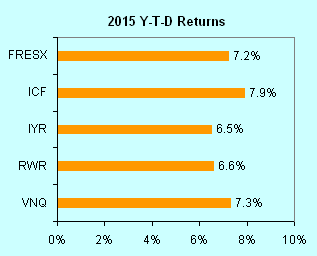
Following this rollercoaster ride, Fidelity Real Estate (FRESX) is up 7.2% for the year. Among REIT ETFs, Vanguard REIT, iShares U. S. Real Estate, SPDR Dow Jones REIT (RWR), and iShares Cohen & Steers (ICF) are up between 6.7% and 7.9% with iShares Cohen & Steers leading the way.

What’s Ahead for Fidelity Real Estate and Real Estate ETFs

fidelity-real-estate-and-real-estate-ETF-outlookThe outlook is mixed.

The fear of rising interest rates is somewhat overplayed in the context of REITs investments.

For one, the Fed has said it will be appropriate to tighten “when it has seen further improvement in the labor market and is reasonably confident that inflation will move back to its 2% objective over the medium term”.

With the rise in the dollar already pressuring U. S. export competitiveness and corporate profits, the Fed is likely to defer raising interest rates to the extent possible.

When the Fed does raise rates, it would be due to an improving economy. An improving economy means more jobs, higher consumer spending, and greater health care demand from which office, apartment, retail, and health care REITs can benefit.

Offsetting these positives, valuation of REIT shares is relatively rich particularly from funds from operations and dividend yield perspectives.

According to Citigroup, REITs are trading at about 17-times FFO, near the upper end of the 8-to-18 times range seen since 1996.

Likewise, REIT shares on average currently yield 3% to 3.5%, just half of their 6% to 7% long-term historical average dividend yield.

REITs shares are likely to offer a more volatile ride going forward and provide middle-of-the-road returns in 2015. Longer term, valuation can become a headwind for REITs, particularly if interest rates rise at a rapid clip.

Best Real Estate Mutual Funds and Best Real Estate ETFs

Investors seeking exposure to real estate investments with modest expense ratios for diversification purposes can look to some of the best real estate mutual funds like Cohen & Steers Realty Shares (CSRSX), Fidelity Real Estate, Vanguard Real Estate Index (VGSIX) and best real estate ETFs like Fidelity MSCI Real Estate (FREL), SPDR Dow Jones REIT, and Vanguard REIT.

AlphaProfit Fidelity and ETF model portfolios

AlphaProfit’s ValuM investment process combines fundamental and technical factors to consistently choose the best Fidelity Select funds and the best sector ETFs.

Compounding at an annual rate of 20.3%, a dollar invested in AlphaProfit’s selection process in 1994 is now worth $50.89 while a comparable investment in the S&P 500 is worth just $6.80.

Consistent selection of winning mutual fund picks has enabled AlphaProfit’s Premium Service to rank #1 consistently in Hulbert Financial’s investment newsletter rankings.

AlphaProfit will reposition its Fidelity and ETF model portfolios with best sector funds and best ETFs for the current market environment on March 31.

Premium Service Investment Newsletter

Premium Service Investment Newsletter

Clear, Actionable Advice on Sectors, Funds, ETFs, & Stocks

  • Specific guidance on what and when to buy or sell
  • Long-term investing and short-term trading recommendations
  • Proven strategies for all markets
  • 75% win-rate including 2008 crash and dot-com bust

Market-beating model portfolios

  • Suitable for small and large accounts sizes
  • Appropriate for different investment objectives and account types
  • Results verifiable in login area with free account
  • Track record of smashing market 7-to-1

Priceless intangibles

  • All recommendations provided ahead of time with ample notice
  • Unbiased, independent advice with no axes to grind
  • 24/7 access to premium service and its archives
  • Access to Dr. Sam Subramanian via e-mail

THE GOOD NEWS JUST BEGINS!

START TO ENJOY THE JOYS OF LIFE AND AVOID THE PAINS OF INVESTING!

More on Premium Service

Free Investment Newsletter MoneyMatters

Free Investment Newsletter MoneyMatters

  • Independent analysis of the economy, markets, and sectors
  • Unbiased ETF, stock, and mutual fund advice and evaluations
  • Unique insights on emerging profit opportunities and must-know threats
  • Complimentary access to premium service
  • Subscription discounts for premium service

special_report

  • Five Smart Ways of Using Sector Funds and ETFs with inside scoop on sector investments
  • Three Key Mistakes to Avoid when Investing in Sector ETFs

sidebarsignup

Receive Free Reports

Sign up for the FREE investment newsletter AlphaProfit Money Matters and immediately receive Two Special Reports

  • Five Smart Ways to Profit from Sector Funds and ETFs
  • Avoid Three Common Mistakes ETF Investors Make

Don’t miss timely investment tips. Stay ahead of the market with AlphaProfit MoneyMatters in your inbox