Retailing Holds the Key to Stocks This Week

Inflation continued to moderate. Falling consumer sentiment, rising unemployment claims, and continued uncertainties about the banking system and the debt ceiling raised recession worries. This week brings more insight into the consumer, including aggregate retail sales and retailer profit reports.

The preliminary reading on the University of Michigan’s consumer sentiment index fell to a six-month low of 57.7 in May from 63.5 in April. Economists polled by Dow Jones expected a 63.0 reading in May. More disturbingly, consumers’ inflation expectations over the next five years rose to 3.2%, the highest since 2011. The May reading reflected a 0.2% increase in inflation expectations from April.

Initial claims for unemployment benefits increased to 264,000, the highest since Oct. 30, 2021.

Shares of regional banks remained under pressure after PacWest said its deposits fell sharply last week. The April Senior Loan Officer Opinion Survey on Bank Lending Practices confirmed lending standards have tightened, and banks expect to tighten standards across all loan categories over the remainder of 2023.

Angst over the risk of the U.S. defaulting on payment obligations continued as negotiations between President Biden and congressional leaders on the debt ceiling and spending cuts failed to show signs of a deal.

The April reports on consumer and producer price indexes showed inflation moderating, with the latter more encouraging. The year-over-year increase in the core producer price index (excluding food and energy) moderated to a two-year low of 3.4% in April from 3.7% in March. Likewise, the year-over-year increase in the core consumer price index moderated to 5.5% from 5.6%.

For the week ending May 12, the S&P 500 (SPY) fell 0.3%. Three of the 11 sectors advanced. Communication services (XLC) gained the most, while energy (XLE) lost the most.
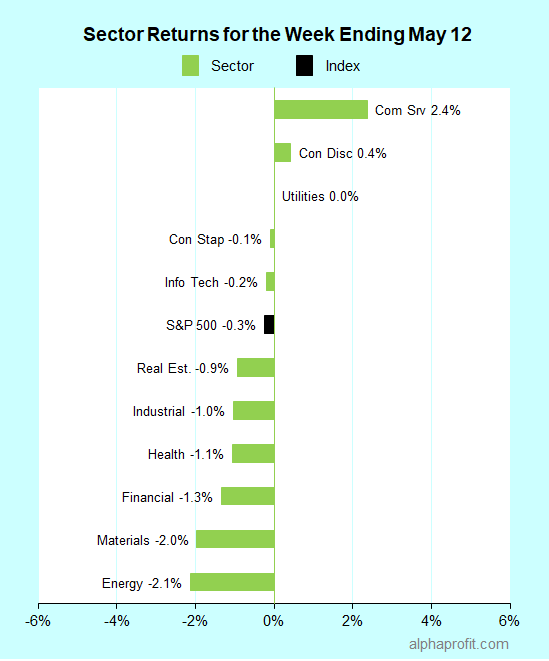
Sector returns for the week ending May 12, 2023

Leading and lagging sectors for the week ending May 12, 2023.

The S&P 500’s top 10 winners included the following:

1. Information Technology Sector

  • First Solar (FSLR) +30% – The week’s top performer in the S&P 500.
  • Akamai Technologies (AKAM) +9%
  • Advanced Micro Devices (AMD) +6%

2. Health Care Sector

  • STERIS plc (STE) +11%
  • McKesson Corp. (MCK) +7%
  • DaVita (DVA) +6%

3. Communication Services Sector

  • Alphabet (GOOGL) +11%
  • News Corp. (NWS) +6%

4. Materials Sector

  • Albemarle Corp. (ALB) +9%

Top ETFs for the week

The following ETF themes worked well: natural gas, Latin America, Chile, Brazil, strategic metals, and cloud computing. The top ETFs for the week include:

  • United States Natural Gas Fund, LP (UNG) +7.6%
  • iShares MSCI Chile ETF (ECH) +4.0%
  • VanEck Rare Earth/Strategic Metals ETF (REMX) +3.9%
  • iShares MSCI Brazil ETF (EWZ) +3.6%
  • First Trust Cloud Computing ETF (SKYY) +3.4%

Retailing Holds the Key to Stocks This Week

* The decline in consumer sentiment increased fears of a recession and pressured stocks last week. More data on consumer financial well-being, including aggregate retail sales and earnings reports from major retailers, is due this week. The state of the retail landscape and consumer spending could determine how stocks do this week.

* The U.S. Census Bureau will report April retail sales. Economists surveyed by Dow Jones forecast a 0.4% increase in retail sales in April, reversing a 1.0% decline in March.

* Earnings season continues, with nearly a dozen S&P 500 members due to report. Earnings reports from major retailers like Walmart, Target, and Home Depot will bring consumer spending into the spotlight.

* Several Federal Reserve officials are scheduled to speak this week. Investors will look to the conversation between Fed Chairman Jerome Powell and former Chairman Ben Bernanke for clues on the next move in interest rates. Additionally, Fed Vice Chair for Supervision Michael Barr testifies before Congress.

* The Conference Board reports the April update of its U.S. leading economic index. Economists expect the U.S. LEI to fall 0.6% in April, extending its 1.2% decline in March.


Stay on top of the stock market with ‘Looking Back, Looking Forward’

Sign up free to receive Looking Back, Looking Forward in your Inbox.


Learn more:

How AlphaProfit's investment strategy minimizes your risk
How AlphaProfit keeps your fees and expenses low
Performance of model portfolios & recommendations in AlphaProfit's Premium Service investment newsletter
AlphaProfit's free and premium investment newsletters
Will Inflation Data Pressure Stocks This Week?

The S&P 500 lost 0.8% last week. The Fed’s interest rate decision, regional bank failures, and debt ceiling worries impacted stocks. The April jobs report and Apple’s earnings report partly offset the growth worries. Things are on the slower side this week. The updates on inflation in retail and wholesale prices are the main events of a less-busy week.

The Federal Reserve’s interest rate policy-setting committee voted to raise the target range for the federal funds rate by 0.25% to the 5.00–5.25% range, marking the tenth interest rate increase of the tightening cycle that started in March 2022. Fed Chair Jerome Powell signaled a pause in the relentless rise in interest rates could come. He, however, ruled out cutting interest rates, stating that he does not expect inflation to come down to the Fed’s 2% long-term goal quickly.

Concerns about a banking contagion returned. At the outset of the week, the government seized First Republic Bank and facilitated the sale of the failed bank to JPMorgan Chase. Later in the week, another California-based lender, PacWest Bancorp, confirmed it was considering strategic options. Concerns over the health of other regional banks such as Western Alliance, Comerica, and Zions Bancorp pressured their shares.

Treasury Secretary Janet Yellen warned that the U.S. may hit the debt ceiling and run out of measures to pay its debts as early as June 1. On May 9, President Biden is due to meet with the two top Republican congressional leaders, Senate Minority Leader Mitch McConnell and House Speaker Kevin McCarthy, and attempt to resolve the impasse.

Higher-than-expected job creation and Apple’s earnings report helped to ease worries of a recession resulting from the Fed raising interest rates too much. The April employment report showed the U.S. economy added 253,000 jobs; the tally topped the 180,000 job additions forecast by economists in a Dow Jones survey. The report also showed wages rose at a robust 4.5% annual rate, and the unemployment rate dropped to 3.4%.

Apple raised its dividend by 4% and added $90 billion to its stock buyback program after beating analysts’ quarterly sales and EPS forecasts.

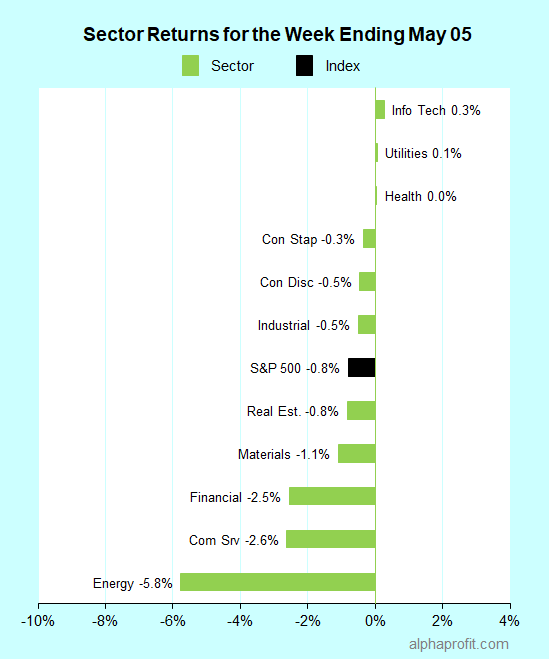
For the week ending May 05, the S&P 500 (SPY) fell 0.8%. Three of the 11 sectors advanced. Information technology (XLK) gained the most, while energy (XLE) lost the most.

Sector returns for the week ending May 05, 2023

Leading and lagging sectors for the week ending May 05, 2023.

The S&P 500’s top 10 winners included the following:

1. Consumer Discretionary Sector

  • Royal Caribbean Cruises (RCL) +16% – The week’s top performer in the S&P 500.
  • Carnival Corp. (CCL) +9%

2. Communication Services Sector

  • Live Nation Entertainment (LYV) +14%

3. Information Technology Sector

  • ON Semiconductor (ON) +14%

4. Industrial Sector

  • Generac Holdings (GNRC) +12%

5. Materials Sector

  • Vulcan Materials (VMC) +11%
  • Ball Corp. (BALL) +10%
  • Martin Marietta Materials (MLM) +9%

6. Real Estate Sector

  • Host Hotels & Resorts (HST) +10%

7. Consumer Staples Sector

  • Molson Coors Beverage (TAP) +9%

Top ETFs for the week

The following ETF themes worked well: biotech, gold miners, fintech, innovation, high growth, silver miners. The top ETFs for the week include:

  • SPDR S&P Biotech ETF (XBI) +6.5%
  • VanEck Gold Miners ETF (GDX) +5.4%
  • ARK Fintech Innovation ETF (ARKF) +5.0%
  • ARK Innovation ETF (ARKK) +4.1%
  • Global X Silver Miners ETF (SIL) +3.6%

Will Inflation Data Pressure Stocks This Week?

* Last week, the April jobs report showed that job creation is robust enough to withstand the impact of higher interest rates. The acceleration in wage growth to 0.5% in April from 0.3% in March suggests the Fed could be correct to worry about inflation. Data on inflation at the retail and wholesale levels is due this week. The Bureau of Labor Statistics will release the Consumer Price Index (CPI) and Producer Price Index (PPI) for April on Thursday and Wednesday, respectively. Higher-than-expected inflation can rekindle inflation fears and pressure stocks.

* TradingEconomics.com forecasts the CPI to show a 0.4% increase in April for a year-over-year increase of 5.0%. TradingEconomics expects the core CPI, which excludes volatile food and energy costs, to rise 0.3% for the month and 5.6% year-over-year.

* TradingEconomics forecasts the PPI to rise 0.1%, partially reversing the 0.5% decline in March. TradingEconomics expects the PPI to rise 2.4% year-over-year, less than the 2.7% increase in March.

* Earnings season continues at a slower pace this week. Nearly 30 S&P 500 members are due to report. The reporting companies include Disney, Duke Energy, Electronic Arts, Occidental Petroleum, and PayPal.


Stay on top of the stock market with ‘Looking Back, Looking Forward’

Sign up free to receive Looking Back, Looking Forward in your Inbox.


Learn more:

How AlphaProfit's investment strategy minimizes your risk
How AlphaProfit keeps your fees and expenses low
Performance of model portfolios & recommendations in AlphaProfit's Premium Service investment newsletter
AlphaProfit's free and premium investment newsletters
Will the May 3 Rate Hike Be Time to Buy or Sell?

The S&P 500 ended last week higher by 0.9%. Robust earnings reports from Microsoft and Meta Platforms offset concerns about the health of the U.S. banking system. The first-quarter earnings reporting season is near its midway point. Earnings reports from over a third of S&P 500 members are due this week. Yet these earnings reports could take a back seat to macro issues as investors focus on the Fed’s interest rate decision and the April jobs report.

U.S. stocks overcame a midweek sell-off last week. Worries about the state of the banking industry returned after First Republic Bank reported a 40% drop in deposits during the first quarter. Weak earnings reports from transportation titan UPS added to the downward pressure.

Robust earnings reports from Microsoft and Facebook’s parent, Meta Platforms, lifted stock prices later in the week.

FactSet reported that S&P 500 companies are recording their best performance relative to analysts’ expectations since the fourth quarter of 2021. Approximately 79% of S&P 500 members have beaten analysts’ EPS estimates midway through the first quarter reporting season. Nearly 74% of them have topped analysts’ revenue forecasts.

On Friday, the Bureau of Economic Analysis reported the U.S. gross domestic product expanded at a 1.1% annual rate in the first quarter, less than the 2.0% economists forecast in a Dow Jones survey.

The Federal Reserve’s preferred inflation metric, core personal consumption expenditures (PCE), rose 0.3% in March, in line with consensus economists’ forecast. The core PCE rose 4.6% year-over-year in March, compared to economists’ forecast for a 4.5% increase and 4.7% in February.

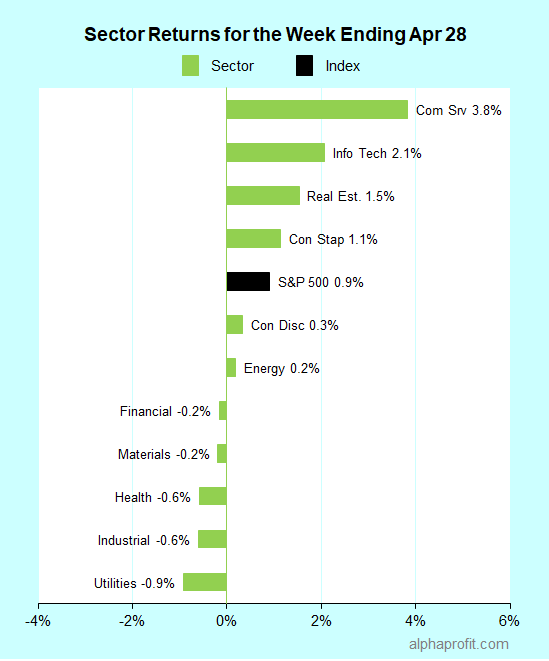
For the week ending April 28, the S&P 500 (SPY) rose 0.9%. Six of the 11 sectors advanced. Communication services (XLC) gained the most, while utilities (XLU) lost the most.

Sector returns for the week ending April 28, 2023

Leading and lagging sectors for the week ending April 28, 2023.

The S&P 500’s top 10 winners included the following:

1. Consumer Discretionary Sector

  • Chipotle Mexican Grill (CMG) +15% – The week’s top performer in the S&P 500.
  • Hasbro (HAS) +15%
  • Mohawk Industries (MHK) +9%

2. Communication Services Sector

  • Meta Platforms (META) +13%
  • Charter Communications (CHTR) +11%
  • Comcast Corporation (CMCSA) +10%

3. Health Care Sector

  • Catalent (CTLT) +11%
  • Molina Healthcare (MOH) +8%

4. Real Estate Sector

  • CoStar Group (CSGP) +10%

5. Industrial Sector

  • Pentair plc (PNR) +9%

Top ETFs for the week

The following ETF themes worked well: cryptocurrency, bitcoin, uranium, communication services, India, and Chile. The top ETFs for the week include:

  • ProShares Bitcoin Strategy ETF (BITO) +7.3%
  • Sprott Uranium Miners ETF (URNM) +5.7%
  • Communication Services Select Sector SPDR Fund (XLC) +3.8%
  • iShares MSCI India ETF (INDA) +3.1%
  • iShares MSCI Chile ETF (ECH) +3.1%

Will the May 3 Rate Hike Be Time to Buy or Sell?

* May has started a six-month weak period in stock prices frequently enough for the saying “Sell in May and go away” to be popular. The Federal Open Market Committee (FOMC), the central bank’s rate-setting committee, meets May 2 and 3. Market participants expect the FOMC to raise the benchmark federal funds rate by 0.25% to the 5.00–5.25% range in what could be the final rate hike of the Fed’s tightening cycle to fight inflation. Fed Chair Jerome Powell’s interest rate outlook will set the tone for trading after the FOMC meeting.

* The Labor Department’s April jobs report is due on Friday. Economists surveyed by Dow Jones expect 180,000 job additions in April, the smallest monthly gain since December 2020. They also forecast job openings to fall to a two-year low of 9.6 million in March from 9.9 million in February.

* Earnings season rolls on this week with reports from Advanced Micro Devices, Apple, Booking Holdings, ConocoPhillips, Pfizer, Qualcomm, and Starbucks due.


Stay on top of the stock market with ‘Looking Back, Looking Forward’

Sign up free to receive Looking Back, Looking Forward in your Inbox.


Learn more:

How AlphaProfit's investment strategy minimizes your risk
How AlphaProfit keeps your fees and expenses low
Performance of model portfolios & recommendations in AlphaProfit's Premium Service investment newsletter
AlphaProfit's free and premium investment newsletters
Investors’ Wait for Mega-Cap Earnings is Over

Last week, investors looked for signs of weakening demand and profit pressures in first-quarter earnings reports as companies found it more challenging to outperform analysts’ revenue forecasts than profit forecasts. Investors did not reward companies for outperforming low-bar EPS estimates, preferring to wait for mega-cap earnings this week. Updates on economic growth and inflation are also due this week.

Investors looked for signs of weakening demand and profit pressures as the pace of first-quarter earnings reports picked up last week.

According to FactSet, 76% of S&P 500 companies reported first-quarter EPS above analysts’ forecasts, after 18% of S&P 500 companies reported results. This tally compares with the 5-year average of 77% of companies outperforming.

Companies found it more challenging to top analysts’ revenue forecasts. Only 63% of companies reported revenue above analysts’ forecasts, lagging behind the 5-year average of 69% of companies posting positive revenue surprises.

Economic data pointed to a deteriorating economy. The March reading of the Conference Board’s U.S. Leading Economic Index was the lowest since November 2020. The number of people collecting unemployment benefits reached the highest level since November 2021, suggesting the labor market is cooling.

China’s GDP rose by 4.5% in the first quarter of 2023, compared to economists’ forecast of 4.0% growth in a Reuters poll. The Chinese economy grew at its fastest rate in 12 months last quarter.

The debt ceiling debate in Congress showed signs of being highly contentious. House Speaker McCarthy said a “no strings attached” debt ceiling increase will not pass the House. A proposal with spending cuts or “strings attached” is unlikely to pass the Senate.

Stocks failed to make headway as investors watched for signs of an economic slowdown and waited for mega-cap company earnings to follow.

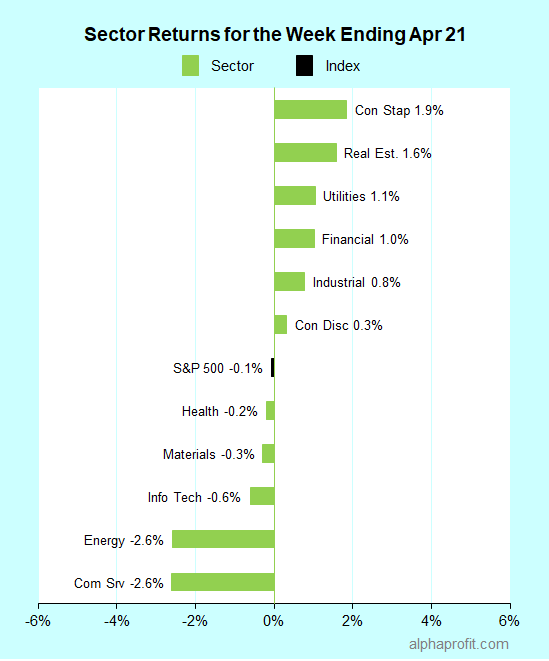
For the week ending April 21, the S&P 500 (SPY) fell 0.1%. Six of the 11 sectors advanced. Consumer Staples (XLP) gained the most, while communication services (XLC) lost the most.

Sector returns for the week ending April 21, 2023

Leading and lagging sectors for the week ending April 21, 2023.

The S&P 500’s top 10 winners included the following:

1. Health Care Sector

  • Intuitive Surgical (ISRG) +12% – The week’s top performer in the S&P 500.
  • Abbott Laboratories (ABT) +7%
  • DexCom (DXCM) +7%

2. Industrial Sector

  • Snap-on Inc. (SNA) +10%
  • United Airlines (UAL) +7%

3. Financial Sector

  • First Republic Bank (FRC) +9%

4. Consumer Discretionary Sector

  • D.R. Horton (DHI) +8%
  • Las Vegas Sands (LVS) +8%

5. Real Estate Sector

  • Digital Realty Trust (DLR) +8%

6. Information Technology Sector

  • Enphase Energy, Inc. (ENPH) +7%

Top ETFs for the week

The following ETF themes worked well: platinum, biotech, homebuilders, natural gas, and medical devices. The top ETFs for the week include:

  • abrdn Physical Platinum Shares ETF (PPLT) +7.7%
  • SPDR S&P Biotech ETF (XBI) +5.2%
  • iShares U.S. Home Construction ETF (ITB) +5.0%
  • United States Natural Gas Fund, LP (UNG) +4.6%
  • iShares U.S. Medical Devices ETF (IHI) +3.0%

Investors’ Wait for Mega-Cap Earnings is Over

* Although 76% of S&P 500 members have topped analysts’ first-quarter EPS estimates, investors have not rewarded them for outperforming low-bar estimates. Investors have preferred to wait for mega-cap earnings due this week. Nearly sixty S&P 500 members, including three of the four trillion-dollar companies, are due to report earnings this week. They are Microsoft, Google parent Alphabet, and Amazon. Other notable names include Coca-Cola, Eli Lilly, Exxon Mobil, McDonald’s, Meta Platforms, and United Parcel Service.

* The Bureau of Economic Analysis will release its preliminary estimate for the first-quarter gross domestic product. Economists surveyed by Dow Jones expect the U.S. economy to grow at an annual rate of 1.8% in the first quarter of the year, down from 2.6% in the fourth quarter of 2022.

* The Bureau of Labor Statistics will update the Personal Consumption Expenditures (PCE) Price Index. Economists forecast the core PCE, which excludes food and energy components, to rise 0.3% in March, matching February’s tally. They expect the core PCE to rise 4.5% year-over-year in March, down from 4.6% a month ago.


Stay on top of the stock market with ‘Looking Back, Looking Forward’

Sign up free to receive Looking Back, Looking Forward in your Inbox.


Learn more:

How AlphaProfit's investment strategy minimizes your risk
How AlphaProfit keeps your fees and expenses low
Performance of model portfolios & recommendations in AlphaProfit's Premium Service investment newsletter
AlphaProfit's free and premium investment newsletters
Will the S&P 500 Set a New 2023 High This Week?

Last week, investors digested mixed inflation reports, hawkish comments from Fed Governor Wallace, weak retail sales, and robust bank earnings. Investors will focus on corporate earnings reports and forecasts this week. The S&P 500 can break out of its 2023 trading range to set a new high if 2023 earnings forecasts from the reporting companies exceed analysts’ expectations.

Investors reacted to inflation data last week with cautious optimism. The producer price index (PPI) unexpectedly declined, bringing some cheer. Inflation in the consumer price index (CPI) remained stubbornly high, offsetting some of the excitement from the PPI data.

The core PPI, which measures wholesale prices excluding food and energy components, gained 0.1% in March, lower than economists’ 0.3% forecast and the 0.2% increase in February. In the 12 months through March, the core PPI advanced by 3.6%, compared to 4.5% in February. The core CPI, which measures wholesale prices, rose 5.6% year over year in March compared to its 5.5% increase in February.

After the CPI and PPI inflation data came out, Fed Governor Waller said interest rate policy needs to be tightened further and remain tight for a substantial period since the Fed hasn’t made much progress on its inflation goal.

Total retail sales fell 1.0% month-over-month in March, marking their fourth decline in five months. Economists had forecasted retail sales to fall 0.5%. The weakness in consumer spending seen in most retail categories exacerbated concerns about an economic slowdown.

The first quarter earnings season began with the nation’s largest banks, JPMorgan Chase, Citigroup, and Wells Fargo, reporting earnings above analysts’ estimates despite recent turmoil in the banking sector. The results showed that customers moved deposits to larger and better-capitalized banks after the collapse of Silicon Valley Bank and Signature Bank.

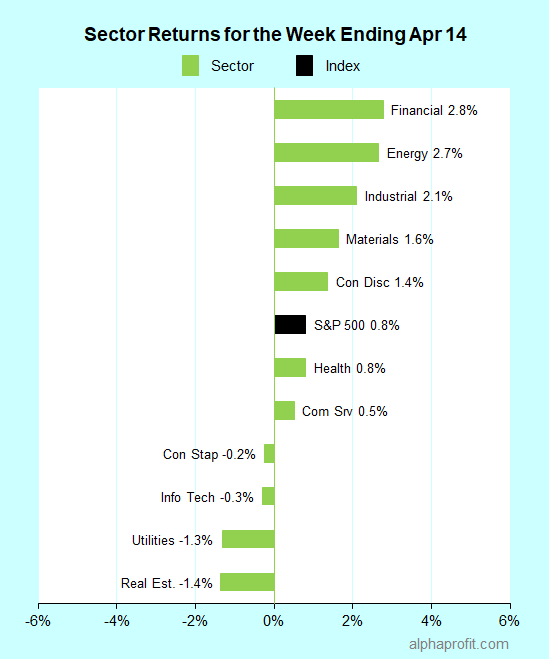
For the week ending April 14, the S&P 500 (SPY) rose 0.8%. Seven of the 11 sectors advanced. The financial sector (XLF) gained the most, while real estate (XLRE) lost the most.

Sector returns for the week ending April 14, 2023

Leading and lagging sectors for the week ending April 14, 2023.

The S&P 500’s top 10 winners included the following:

1. Health Care Sector

  • Bio-Techne Corporation (TECH) +13% – The week’s top performer in the S&P 500.

2. Energy Sector

  • Pioneer Natural Resources Company (PXD) +10%

3. Information Technology Sector

  • Enphase Energy, Inc. (ENPH) +9%

4. Financial Sector

  • JPMorgan Chase & Co. (JPM) +9%
  • Citigroup Inc. (C) +8%

5. Consumer Discretionary Sector

  • CarMax, Inc. (KMX) +8%

6. Materials Sector

  • CF Industries Holdings, Inc. (CF) +8%
  • The Mosaic Company (MOS) +8%
  • Freeport-McMoRan Inc. (FCX) +7%

7. Consumer Staples Sector

  • Molson Coors Beverage Company (TAP) +8%

Top ETFs for the week

The following ETF themes worked well: cryptocurrency, bitcoin, Latin America, Brazil, copper miners, and South Korea. The top ETFs for the week include:

  • Bitwise 10 Crypto Index Fund (BITW) +9.1%
  • iShares MSCI Brazil ETF (EWZ) +8.4%
  • Global X Copper Miners ETF (COPX) +7.6%
  • iShares Latin America 40 ETF (ILF) +7.0%
  • iShares MSCI South Korea ETF (EWY) +5.7%

Will the S&P 500 Set a New 2023 High This Week?

* Last week’s rally pushed the S&P 500 to the top of its 2023 trading range. The index closed last week at 4,138, just 1% below its year-to-date closing high of 4,180 set in early February. The first-quarter earnings reporting season picks up pace this week. Investors will get earnings reports from some of the top S&P 500 index members. The roster of reporting companies includes Johnson & Johnson, Morgan Stanley, Netflix, Procter & Gamble, and Tesla. While companies may easily exceed analysts’ watered-down forecasts, their 2023 guidance amid a slowing economy could determine if the S&P 500 sets a new 2023 high this week.

* China reports its first-quarter gross domestic product data on Monday. Economists expect the world’s second-largest economy to grow 2.2% in the first quarter, or 4.0% year-over-year.

* The U.S. housing industry is in the spotlight. Data on existing home sales, housing starts, building permits, and homebuilder confidence are due.

* S&P Global provides the flash measures of U.S. manufacturing and services sector activities from the purchasing manager surveys. Economists surveyed by Dow Jones expect both measures to lose ground.


Stay on top of the stock market with ‘Looking Back, Looking Forward’

Sign up free to receive Looking Back, Looking Forward in your Inbox.


Learn more:

How AlphaProfit's investment strategy minimizes your risk
How AlphaProfit keeps your fees and expenses low
Performance of model portfolios & recommendations in AlphaProfit's Premium Service investment newsletter
AlphaProfit's free and premium investment newsletters
Best ETFs, Funds, and Stocks of 1Q2023. A Preview to 2Q.

The Federal Reserve continued its battle against inflation in the first quarter of 2023, achieving limited success. Although inflation fell, it remained above the Fed’s 2% long-term goal. The fourth quarter earnings season was below par, with aggregate profits for the S&P 500 companies falling 4.6% from the year-ago quarter. In March, the banking crisis exacerbated investors’ worries about the economy and corporate earnings. In the face of these negatives, falling bond yields helped the S&P 500 advance in the opening quarter of 2023.

The Federal Reserve continued its battle against inflation in the first quarter of 2023. The central bank raised the federal funds rate to the 4.75–5.00% range from 4.25–4.50% at the start of the year. The Fed’s success in lowering inflation, however, proved limited.

Inflation fell. Yet it stayed above the Fed’s 2% long-term goal. Before the end of the first quarter, the Bureau of Economic Analysis reported that the Federal Reserve’s preferred inflation measure, the core Personal Consumption Expenditures (PCE) index, rose 4.6% year-over-year in February. The year-over-year increase in February was lower than 5.2% in September 2022 and 5.4% in March 2022.

The fourth quarter earnings season was below par. According to FactSet, aggregate profits for the S&P 500 companies fell 4.6% from the year-ago quarter. Only 69% of the reporting companies exceeded analysts’ EPS forecasts, compared to a five-year average of 77%.

Investors dealt with a banking crisis in March. Regional lenders Silicon Valley Bank and Signature Bank suddenly shuttered their operations after suffering massive losses in their bond portfolios. These two bank failures were the largest and second-largest since Washington Mutual in 2008.

The government’s backing of the deposits in troubled banks, the setup of a new lending facility, and the takeover of troubled banks helped to restore investor confidence.

The banking crisis triggered investors to seek safety in Treasury securities. The 10-year Treasury note yielded 3.48% at the end of March, 0.4% below where it started in 2023. The yield on the 2-year Treasury note dropped 0.35% to close the quarter at 4.06%.

During the first quarter, the S&P 500 index ranged between 3,750 and 4,200. The benchmark gained 7.5% for the quarter, closing at 4,109.31. Large-cap growth stocks led the rally.

Best ETFs of 1Q2023

ETFs focused on cryptocurrencies, Grayscale Bitcoin Trust (GBTC) and Grayscale Ethereum Trust (ETHE), topped the performance charts for the quarter, gaining 97% and 80%, respectively. Among non-crypto assets, shares of high-growth companies involved in internet, fintech, and semiconductor technologies posted robust gains.

  • ARK Next Generation Internet ETF, ARKW       +39.1%
  • ARK Fintech Innovation ETF, ARKF       +31.8%
  • VanEck Semiconductor ETF, SMH       +29.7%
  • ARK Innovation ETF, ARKK       +29.1%
  • iShares Semiconductor ETF, SOXX       +28.1%

Best Select Sector SPDR ETFs of 1Q2023

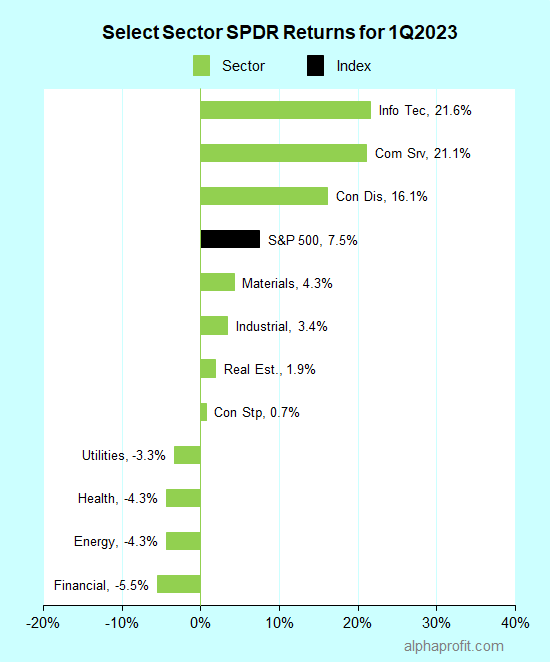
Technology Select Sector SPDR took the top position. Seven of the 11 Select SPDRs gained for the quarter. Three of the Select SPDRs outperformed the S&P 500.

  • Technology Select Sector SPDR Fund, XLK       +21.6%
  • Communication Services Select Sector SPDR Fund, XLC       +21.1%
  • Consumer Discretionary Select Sector SPDR Fund, XLY       +16.1%


Select Sector SPDR Returns for 1Q2023

Select Sector SPDR Returns for 1Q2023

See: Best Sectors for 2023

Best Fidelity Funds of 1Q2023

Fidelity Select Semiconductors was the top performer for the quarter. Fidelity sector funds focused on information technology and communication services claimed spots two through five.

  • Fidelity Select Semiconductors Portfolio, FSELX       +38.9%
  • Fidelity Select Technology Portfolio, FSPTX       +25.7%
  • Fidelity Disruptive Technology Fund, FTEKX       +22.4%
  • Fidelity Select Communication Services Portfolio, FBMPX       +21.2%
  • Fidelity Disruptive Communications Fund, FNETX      +20.4%

See: Best Fidelity funds for 2023

Best S&P 500 Stocks of 1Q2023

The top five performers in the S&P 500 included companies from the information technology, communication services, consumer discretionary, and health care sectors. Semiconductor chipmaker Nvidia claimed the top spot. Facebook parent company Meta Platforms from the communication services sector and orthodontic equipment maker Align Technology claimed the second and fifth spots, respectively. Tesla and Warner Brothers Discovery from the consumer discretionary sector took spots three and four.

  • Nvidia Corp., NVDA       +90%
  • Meta Platforms Inc. Class A, META       +76%
  • Tesla, TSLA       +68%
  • Warner Brothers Discovery, WBD       +59%
  • Align Technology, ALGN       +58%

See: Best Sectors and Stocks for Strongest Growth in 2023

Looking ahead to 2Q2023

The second quarter has kicked off amid signs the Federal Reserve’s interest rate policy is impacting the economy.

Recent economic data suggest that the labor market is slowing. The Labor Department has reported the number of job openings fell below 10 million for the first time in nearly two years. Nonfarm payrolls grew by 236,000 in March, 2,000 less than economists had forecast in a Dow Jones survey.

The service economy is cooling. The Institute of Supply Management’s U.S. service activity measure slipped closer to the contraction threshold of 50.0. The index fell to 51.2 in March from 55.1 in February.

Manufacturing remains in a slump. The ISM’s factory index fell to a three-year low of 46.3 in March from 47.7 in February.

There are some welcome signs on the inflation front. The ISM services and factory price indices declined in March, suggesting inflation may be slowing.

The banking crisis has brought about a change in investor thinking. Before the banking crisis, investors favored signals of an economic slowdown. They believed a slowing economy would dissuade the Federal Reserve from raising interest rates.

Investors are no longer sure. They worry whether the Fed has taken its fight against inflation too far, increasing the odds of a U.S. recession.

The first-quarter earnings reporting season starts this week, with leading banks reporting on Friday. The earnings reports should provide insights into the state of the economy, including the impact of the banking crisis.

Updates on inflation at retail and wholesale prices are also due this week. Investors’ inflation fears could ease if the March consumer and producer price data confirm the decline in inflation implied by the ISM measures.

Cooling inflation and easing recession fears can help stocks extend their advance into the second quarter.


Stay on top of the stock market with ‘Looking Back, Looking Forward’

Sign up free to receive Looking Back, Looking Forward in your Inbox.


Learn more:

How AlphaProfit's investment strategy minimizes your risk
How AlphaProfit keeps your fees and expenses low
Performance of model portfolios & recommendations in AlphaProfit's Premium Service investment newsletter
AlphaProfit's free and premium investment newsletters
U.S. Mega-caps versus European Financials

The Federal Reserve raised its benchmark interest rate by 0.25% to a target range of 4.75%–5.00%. Fed Chairman Powell noted that financial conditions have tightened due to the banking crisis. Investors sought safety in U.S. mega-caps amid rising bank liquidity concerns in Europe. Fed Governor Barr’s Congressional testimony on bank oversight and the inflation report on the Fed’s preferred measure are the key events this week.

Last Wednesday, the Federal Reserve raised its benchmark interest rate by 0.25% to a target range of 4.75%–5.00%. This 0.25% uptick in the federal funds rate marked the Fed’s ninth interest rate increase since 2022 and its first since the banking sector crisis.

The Fed’s summary of economic predictions indicated officials expect to end this interest rate hiking cycle after one more 0.25% increase.

Commenting on the banking crisis, Fed Chairman Jerome Powell noted that bank deposit flows have stabilized over the last week. Acknowledging that financial conditions have tightened due to the banking crisis, Powell said the Fed would closely monitor the situation and assess its implications for monetary policy.

Last week, Treasury Secretary Janet Yellen told the U.S. House of Representatives that the administration is ready to take additional actions to stabilize the U.S. banking system if needed. Yellen, however, stopped short of providing “blanket insurance” for bank deposits through the Federal Deposit Insurance Corporation.

Concerns with bank liquidity persisted in Europe even after the Swiss National Bank arranged the purchase of Credit Suisse by the UBS Group. European stocks closed the week on a weak note after Deutsche Bank’s cost of default insurance jumped to a four-year high.

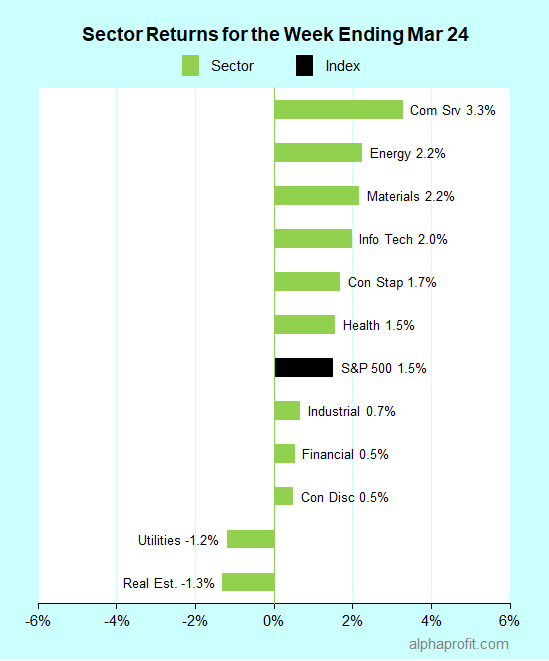
For the week ending March 24, the S&P 500 (SPY) rose 1.5%. Nine of the 11 sectors advanced. Communication Services (XLC) gained the most, while real estate (XLRE) lost the most.

Sector returns for the week ending March 24, 2023

Leading and lagging sectors for the week ending March 24, 2023.

The S&P 500’s top 10 winners included the following:

1. Health Care Sector

  • Regeneron Pharma (REGN) +10% – The week’s top performer in the S&P 500.
  • Intuitive Surgical (ISRG) +8%

2. Communication Services Sector

  • Match Group (MTCH) +9%
  • Netflix (NFLX) +8%

3. Information Technology Sector

  • Accenture (ACN) +9%
  • Micron Technology (MU) +8%

4. Energy Sector

  • APA Corporation (APA) +9%

5. Consumer Discretionary Sector

  • Carnival Corp. (CCL) +8%

6. Financial Sector

  • Truist Financial (TFC) +8%
  • Assurant (AIZ) +7%

Top ETFs for the week

The following ETF themes worked well: solar energy, foreign markets, Saudi Arabia, Asia, China, and Mexico. The top ETFs for the week include:

  • Invesco Solar ETF (TAN) +5.1%
  • iShares MSCI Saudi Arabia ETF (KSA) +5.1%
  • iShares Asia 50 ETF (AIA) +5.0%
  • KraneShares CSI China Internet ETF (KWEB) +4.8%
  • iShares MSCI Mexico ETF (EWW) +4.5%

U.S. Mega-caps versus European Financials

* Investors look for ‘safety’ in U.S. mega-cap firms while the financial sector struggles due to years of abnormally low short-term interest rates. Years of negative interest rates have exacerbated the problems facing European banks. The S&P 500 is up slightly in March as U.S. mega-caps have rebounded in the face of banking sector problems. Dropping bond yields have increased the appeal of U.S. mega-caps. The battle between the allure of U.S. mega-caps and concerns over the soundness of European financials will determine how equities end March.

* Federal Reserve Governor Michael Barr testifies before Congress on bank oversight this Tuesday and Wednesday. Additionally, several Fed officials have speaking engagements this week. The speakers include Fed Governors Cook, Jefferson, and Waller and the Presidents of the Boston and New York Federal Reserve banks.

* The Bureau of Economic Analysis (BEA) will release the February Personal Consumption Expenditures (PCE) Price Index on Friday. Economists surveyed by Dow Jones expect inflation to continue trending lower. They expect the core PCE price index, which excludes food and energy costs, to rise 4.7% year-over-year in February, matching the increase in January.

* Updates on the Conference Board’s consumer confidence index, the University of Michigan’s consumer sentiment index, and the S&P Case-Shiller home price index are also due.

* Six companies in the S&P 500 index are due to report earnings this week. They are Carnival, Cintas, McCormick, Micron Technologies, Paychex, and Walgreens Boots Alliance.


Stay on top of the stock market with ‘Looking Back, Looking Forward’

Sign up free to receive Looking Back, Looking Forward in your Inbox.


Learn more:

How AlphaProfit's investment strategy minimizes your risk
How AlphaProfit keeps your fees and expenses low
Performance of model portfolios & recommendations in AlphaProfit's Premium Service investment newsletter
AlphaProfit's free and premium investment newsletters

Is the Fed in a No-Win Situation? – March 19, 2023

Investors worried about the banking industry last week as attempts by the government and private sector to stabilize struggling institutions failed. Mega-cap technology stocks attracted buyers in a troubled market due to their perception as safe havens. Interest rate policy takes center stage this week, with market participants split on the Fed’s decision between leaving the fed funds rate unchanged or raising it by 0.25%.

Investors fretted about the banking industry last week as attempts by the government and the private sector to stabilize struggling institutions failed.

The efforts included assurances from the government that all depositors at the troubled Silicon Valley Bank and Signature Bank of New York would be fully protected.

Eleven large banks, including JPMorgan Chase, pledged $30 billion of uninsured deposits in troubled San Francisco bank First Republic to boost confidence.

The Federal Reserve also introduced a Bank Term Funding Program (BTFP) to help banks avoid selling Treasury securities at a loss.

News that banks increased their borrowing from the Federal Reserve from just $4.4 billion to a record $165 billion in one week undid the stabilization efforts. Investors saw this rise in borrowing as a warning that things may be worse than what the government was admitting.

Meanwhile, liquidity concerns at Credit Suisse added to banking sector worries. Credit Suisse received a lifeline from the Swiss National Bank, which lent nearly $54 billion.

By the end of the week, SVB Financial Group, the parent company of Silicon Valley Bank, filed for bankruptcy. Regional bank shares fell 14% after declining 16% the week before, extending their decline in March to 29%.

In measures of inflation, the core consumer price index rose 0.5% in February, marking a 5.5% year-over-year increase. Economists surveyed by Dow Jones expected a 5.5% year-over-year increase, down from 5.6% in January. The core producer price index rose 0.2% in February, lagging economists’ forecast of 0.4%.

U.S. Treasury security yields fell as investors sought safety. The 2- and 10-year note yields fell by 0.79% and 0.31%, respectively, to 3.81% and 3.39%.

Mega-cap technology stocks attracted buyers in a troubled market due to their perception as safe havens. The rally in mega-cap tech stocks lifted the S&P 500.

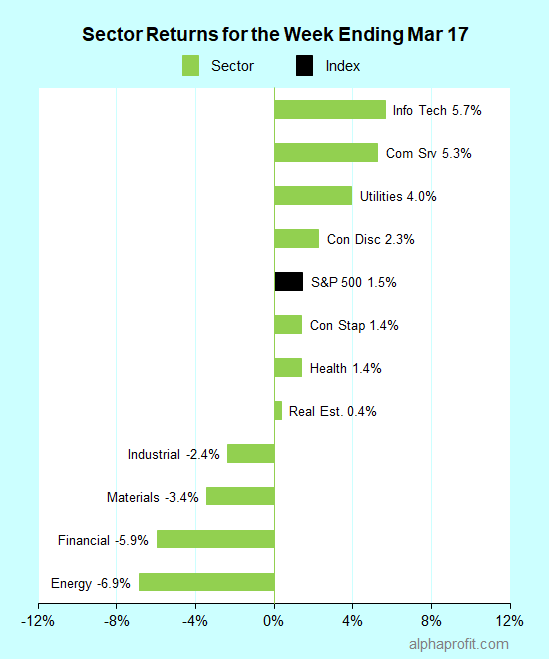
For the week ending March 17, the S&P 500 (SPY) rose 1.5%. Seven of the 11 sectors advanced. Information technology (XLK) gained the most, while energy (XLE) lost the most.

Sector returns for the week ending March 17, 2023

Leading and lagging sectors for the week ending March 17, 2023.

The S&P 500’s top 10 winners included the following:

1. Information Technology Sector

  • Advanced Micro Devices (AMD) +18% – The week’s top performer in the S&P 500.
  • Microsoft (MSFT) +12%
  • NVIDIA (NVDA) +12%
  • Arista Networks (ANET) +11%
  • Intel (INTC) +10%

2. Health Care Sector

  • Illumina (ILMN) +16%

3. Materials Sector

  • Newmont (NEM) +14%

4. Communication Services Sector

  • Alphabet (GOOG) +10%

5. Financial Sector

  • MarketAxess Holdings (MKTX) +12%

6. Industrial Sector

  • FedEx (FDX) +10%

Top ETFs for the week

The following ETF themes worked well: cryptocurrency, bitcoin, precious metals, gold, silver, mega-cap technology, and high-growth story stocks. The top ETFs for the week include:

  • ProShares Bitcoin Strategy ETF (BITO) +35.9%
  • VanEck Gold Miners ETF (GDX) +12.4%
  • ARK Next Generation Internet ETF (ARKW) +9.7%
  • iShares Silver Trust (SLV) +9.4%
  • iShares U.S. Technology ETF (IYW) +6.9%

Is the Fed in a No-Win Situation?

* The stress in the banking industry is at the forefront of investors’ minds as trading begins this week. Investors will monitor news indicating the pervasiveness of troubled banks.

* Federal Reserve policymakers meet on Tuesday and Wednesday to set the federal funds rate. Market participants have lowered their interest rate expectations after troubles in the banking industry surfaced. The likelihood of a 0.5% increase has fallen after 70% of market participants expected this outcome as recently as March 8. According to the CME FedWatch tool, the tossup is between leaving the fed funds rate unchanged (38% odds) and raising the fed funds rate by 0.25% (62% odds). The Fed may be in a no-win situation if market participants see unchanged interest rates as an admission of widespread banking troubles and a 0.25% increase as adding stress to a fragile economy.

* The economic calendar is light. Data on home sales, unemployment claims, and flash U.S. manufacturing and service activity measures are due.

* Five companies in the S&P 500 are due to report earnings this week. They are Accenture, Darden Restaurants, FactSet Research Systems, General Mills, and Nike.


Stay on top of the stock market with ‘Looking Back, Looking Forward’

Sign up free to receive Looking Back, Looking Forward in your Inbox.


Learn more:

How AlphaProfit's investment strategy minimizes your risk
How AlphaProfit keeps your fees and expenses low
Performance of model portfolios & recommendations in AlphaProfit's Premium Service investment newsletter
AlphaProfit's free and premium investment newsletters

Will Stocks Sink to a New 2023 Low This Week?

Silicon Valley Bank closed last week due to massive losses in its bond portfolio. The bank’s failure sparked fears of contagion. Federal Reserve Chairman Jerome Powell said the Fed would raise interest rates in higher steps to control inflation if needed. This week, investors will get updates on inflation, retail sales, and consumer sentiment before the Fed meets to set interest rates during the week of March 20.

Silicon Valley Bank, a regional lender focusing on the technology industry, closed last week due to massive losses in its bond portfolio, sparking fears of contagion. Silicon Valley Bank is the largest U.S. bank to fail since Washington Mutual in 2008.

Testifying to Congress this week, Federal Reserve Chairman Jerome Powell said the labor market is “extremely tight” despite the Fed’s efforts to cool economic growth. Powell said the Fed is prepared to raise interest rates rapidly to control inflation if needed.

The economy added 311,000 jobs in February, with average hourly wages rising by 0.2%. Economists surveyed by Dow Jones forecast 225,000 job additions, with average hourly wages rising 0.3%. The unemployment rate inched up to 3.6% from 3.4% in January.

For the week ending March 10, the S&P 500 (SPY) fell 4.5%. All 11 sectors declined. Consumer staples (XLP) lost the least, while financials (XLF) lost the most.

Sector returns for the week ending March 10, 2023

Leading and lagging sectors for the week ending March 10, 2023.

The S&P 500’s top 10 winners included the following:

1. Industrial Sector

  • General Electric (GE) +5.4% – The week’s top performer in the S&P 500.
  • C.H. Robinson Worldwide (CHRW) +1.3%

2. Information Technology Sector

  • Arista Networks (ANET) +4.1%
  • Intel Corp. (INTC) +3.1%
  • Advanced Micro Devices (AMD) +1.4%
  • Juniper Networks (JNPR) +0.4%

3. Consumer Discretionary Sector

  • Chipotle Mexican Grill (CMG) +2.7%
  • D.R. Horton (DHI) +1.4%

4. Consumer Staples Sector

  • The Kroger Co. (KR) +2.4%

5. Health Care Sector

  • Merck & Co. (MRK) +0.8%

Top ETFs for the week

The following ETF themes worked well: carbon credits and long-term treasury bonds. The top ETFs for the week include:

  • KraneShares Global Carbon ETF (KRBN) +5.6%
  • PIMCO 25+ Year Zero Coupon U.S. Treasury Index ETF (ZROZ) +4.6%
  • Vanguard Extended Duration Treasury Index Fund ETF Shares (EDV) +4.5%
  • iShares 20+ Year Treasury Bond ETF (TLT) +3.6%
  • Vanguard Long-Term Treasury Index Fund ETF Shares (VGLT) +3.6%

Will Stocks Sink to a New 2023 Low This Week?

* The S&P 500 broke below its 50- and 200-day moving averages last week to close within 2% of its 2023 low set in early January. The Dow Jones Industrial Average sank to a new 2023 low last Friday. Investors have plenty to digest this week, including banking industry risks and inflation data. Will the S&P 500 drop to a new 2023 low this week?

* Investors will get the latest inflation readings in consumer and producer prices on Tuesday and Wednesday, respectively. Economists expect the core Consumer Price Index (which excludes food and energy prices) to rise 0.4% in February, matching the rate in January. The core CPI is expected to reflect a 5.5% year-over-year increase in February, slightly lower than the 5.6% increase in January.

* Economists forecast the core Producer Price Index to rise 0.4% in February. The core PPI rose 0.6% in January.

* Other economic data due this week includes the Commerce Department’s retail sales report for February, the Conference Board’s U.S. Leading Economic Index for February, and the University of Michigan’s preliminary consumer sentiment reading for March.

* Four consumer companies in the S&P 500 will report earnings this week. They are Adobe, Dollar General, FedEx, and Lennar.


Stay on top of the stock market with ‘Looking Back, Looking Forward’

Sign up free to receive Looking Back, Looking Forward in your Inbox.


Learn more:

How AlphaProfit's investment strategy minimizes your risk
How AlphaProfit keeps your fees and expenses low
Performance of model portfolios & recommendations in AlphaProfit's Premium Service investment newsletter
AlphaProfit's free and premium investment newsletters

Top Performing Fidelity Funds for February 2023

Fidelity funds focusing on semiconductors, Nordic region, information technology, transportation, and environment & alternative energy were top performers in February.

Top Fidelity Funds for February 2023

Excludes closed Fidelity funds

* Fidelity Select Semiconductors Portfolio, FSELX +6.5%

* Fidelity Nordic Fund, FNORX +2.5%

* Fidelity Select Technology Portfolio, FSPTX +1.8%

* Fidelity Select Transportation Portfolio, FSRFX +0.8%

* Fidelity Environment and Alternative Energy Fund, FSLEX +0.6%

Stocks contributing to the performance of the above Fidelity funds likely include Analog Devices (ADI), Apple (AAPL), Broadcom (AVGO), Cummins (CMI), Eaton Corp. PLC (ETN), FedEx Corp. (FDX), GLOBALFOUNDRIES (GFS), Kirby Corp. (KEX), Linde plc (LIN), NVIDIA Corp. (NVDA), Scorpio Tankers (STNG), Tesla (TSLA), and Uber Technologies (UBER).


Stay on top of the stock market with ‘Looking Back, Looking Forward’

Sign up free to receive Looking Back, Looking Forward in your Inbox.


Learn more:

How AlphaProfit's investment strategy minimizes your risk
How AlphaProfit keeps your fees and expenses low
Performance of model portfolios & recommendations in AlphaProfit's Premium Service investment newsletter
AlphaProfit's free and premium investment newsletters