Sector ETFs: Invest in the Best Sector ETF Consistently
Sector ETFs are among the most potent investment vehicles that allow individual investors to exploit advantages previously available only to large institutions.
You can beat the market by investing in the right sector ETF at the right time. In fact, you can actually make money even when the overall market is tanking.
However, all too often, investors use sector ETFs inappropriately and get their fingers burnt.
The trick to benefiting from sector ETFs is to capture the rewards they provide while mitigating the risks they carry.
Here is how AlphaProfit helps you do just that … make money by investing in the right sector ETFs at the right time.
Select the Right Sector or Industry
All too often, investors make the mistake of selecting sectors or industries based on one factor … trend. Such selection methods are prone to high failure rates.
To help you consistently invest in the right sectors and time entries & exits, AlphaProfit analyzes sectors using a combination of fundamental and technical factors within the context of the business cycle.
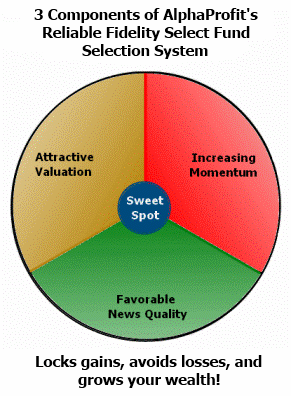
AlphaProfit reliably selects winning sector ETFs by combining fundamental and technical evaluation factors
Sign up for AlphaProfit’s FREE ETF Newsletter
By using a combination of criteria such as valuation, momentum, and news quality to holistically analyze sectors, AlphaProfit minimizes negative surprises.
Pick the Best Sector ETF in the Selected Sector or Industry
Several ETFs are often available within each top ranked sector or industry. The sector ETFs use different types of weighting strategies or may invest in specific market segments as defined by company size or geography.
AlphaProfit blends top-down and bottom-up analyses within the sector to ascertain the best sector ETF. Analysis of the overall market environment both in the U. S. and across the globe is complemented with analysis of the ETF’s top holdings.
AlphaProfit analyzes a host of factors such as ETF’s asset size, expense ratio, trading volume, bid-ask spreads, and tracking error to select the best ETF in a sector.
Diversify across Top Sector ETFs
Despite the rigor of the evaluation and selection process, there can be occasions where investment in a sector ETF may not pan out exactly as expected. The performance of specific sector ETFs can at times be affected by exogenous events like the earthquake in Japan or unanticipated industry changes.
Snapshot of Diversity in Energy Sector ETFs
| ETF Name (Ticker) | ETF Description |
|---|---|
| Energy Select Sector SPDR ETF (XLE) | Market cap weighted ETF investing in S&P 500 energy companies |
| iShares DJ US Oil Equipment & Services ETF (IEZ) | Market cap weighted ETF investing in DJ US energy service companies |
| Rydex S&P 500 Equal Weight Energy ETF (RYE) | Equal weighted ETF investing in S&P 500 energy companies |
| PowerShares Dynamic Energy (PXI) | Fundamentally weighted ETF investing in U. S. energy companies |
| PowerShares S&P SmallCap Energy (PSCE) | Market cap weighted ETF investing in small-cap U. S. energy companies |
| iShares S&P Global Energy (IXC) | ETF investing in energy subset of S&P Global 1200 index |
| Global X China Energy (CHIE) | ETF Investing in largecap energy companies in China |
To mitigate your risks, AlphaProfit brings together best ETFs from top sectors to construct sector ETF-based portfolios for different investment objectives. AlphaProfit provides weightings for the individual sector ETFs with a view to minimize portfolio volatility.
Ensure Top Sector ETFs Selections at all Times through Timely Sector Rotation
ETFs in different sectors tend to perform better in different stages of the business and interest rate cycles. Consumer discretionary ETFs like Vanguard Consumer Discretionary ETF (VCR) tend to perform well as interest rates fall and the economy starts to recover from a recession while tech sector ETFs like Vanguard Information Technology ETF (VGT) tend to perform well during expansion phases.
AlphaProfit uses its time-tested sector rotation strategy to ensure sector ETFs with outstanding return potential are included in the model portfolios at all times. By the same token, the sector rotation strategy works to weed out sector ETFs with unappealing return potential in a timely manner.
Beat the Market with Best Sector ETFs
AlphaProfit’s proven ETF selection process enables thousands of investors to thrive in turbulent markets.
A dollar invested in the ETF Aggressive Growth (Focus) and ETF Growth (Core) model portfolios is worth $170.37 and $73.69, respectively. This implies annualized returns of 17.4% and 14.4%, respectively.
A comparable investment in the S&P 500 benchmark is worth $26.77, implying an annualized return of 10.8%.
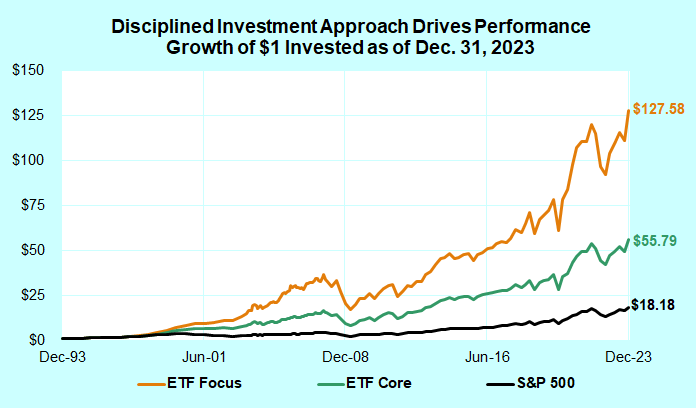
Performance of ETF Focus and ETF Core model portfolios as of December 31, 2025. Sign up for ETF Newsletter
The ETF model portfolios use AlphaProfit’s proven ValuM investment process for selecting investments. This process has enabled AlphaProfit model portfolios to bag Hulbert Financial’s #1 rank numerous times.
Here are just a few examples of actual returns earned by subscribers from individual ETF selections:
- 106.1% gain from SPDR S&P Retail Sector ETF (XRT)
- 57.3% gain from Consumer Discretionary Select Sector SPDR ETF (XLY)
- 30.2% gain from SPDR S&P Oil & Gas Equipment & Services ETF (XES)
Learn 5 Smart Ways of Using Sector ETFs
Sign up for AlphaProfit’s Free ETF Newsletter MoneyMatters and get two special reports: Five Smart Ways of Using Sector ETFs and Avoid Three Common Mistakes ETF Investors Make.
The chart above shows the actual performance of the ETF model portfolios since their launch in 2007. The performance shown before 2007 is the performance of AlphaProfit’s ValuM investment process selections.
Sector Mutual Funds: How to Pick Winning Sector Funds and Avoid Losers
If you are looking to earn great returns from the stock market sector mutual funds are right up your alley.
Sophisticated investors recognize the potential sector mutual funds offer and know how to make such funds work for them.
You can consistently beat the market by investing in the right sector mutual fund at the right time. In fact, you can make money even in bear markets.
The trick to benefiting from sector mutual funds is to capture the rewards they provide while mitigating the risks they carry.
And, that’s precisely what AlphaProfit helps you do … make money by smartly investing in the right sector mutual fund at the right time.
Select the Right Sector or Industry

AlphaProfit reliably selects winning sector mutual funds by combining fundamental and technical evaluation factors
Sign up for AlphaProfit’s FREE Mutual Fund Newsletter
Many investors make the mistake of choosing sectors or industries based on a single factor … trend. Such selection methods are prone to high failure rates.
To help you consistently invest in the right sectors and time entries & exits, AlphaProfit analyzes sectors on both fundamental and technical factors within the context of the business cycle.
AlphaProfit significantly enhances your sector selection success rate by holistically analyzing sectors using a wide range of criteria including valuation, momentum, and news quality.
Pick the Best Sector Mutual Fund in the Selected Sector or Industry
Sector mutual funds come in different colors and flavors. While many sector mutual funds are actively managed, sector index funds and leveraged sector funds are available too.
Some sector mutual funds invest primarily in the U. S. while others scout for opportunities around the globe. Sector mutual funds that limit their investments to specific industries or company sizes in a sector are available as well.
Selecting the right fund in the right sector can go a long way in enhancing returns.
AlphaProfit combines top-down and bottom-up analyses to ascertain the best sector mutual fund within the sector. Analysis of the overall market environment both in the U. S. and across the globe is complemented with analysis of the mutual fund’s top holdings, fund management style & consistency, fees & expenses, historical performance, and other factors.
Snapshot of Diversity in Sector Mutual Funds
| Sector Mutual Fund Name (Ticker) | Sector Mutual Fund Description |
|---|---|
| Vanguard REIT Index (VGSIX) | Sector index fund investing in real estate companies located in the U. S. |
| Fidelity Select Energy (FSENX) | Actively managed energy sector mutual fund investing in U. S. and foreign companies |
| Fidelity Select Chemicals (FSCHX) | Sector fund investing in the chemical industry within the materials sector |
| ING International Real Estate (IIRWX) | Actively managed real estate fund investing in companies outside the U. S. |
| FBR Small Cap Financials (FBRUX) | Actively managed financial sector mutual fund investing in smaller companies |
| Matthews Asia Sci and Tech (MATFX) | Actively managed technology sector mutual fund investing in companies in Asia |
| Oil & Gas UltraSector ProFund (ENPIX) | Leveraged sector fund investing in Dow Jones US oil & gas index companies |
| Alpine Emrg Mkts Real Estate (AEMEX) | Actively managed real estate fund investing in companies located in emerging markets |
Diversify across Top Sector mutual funds
Despite the rigor of the evaluation and selection process, there can be instances where investment in a sector mutual fund does not turn out to be exactly as expected. The performance of specific sector mutual funds can at times be affected by exogenous events like the earthquake in Japan or unanticipated industry changes like the ban on drilling in Gulf of Mexico.
To mitigate your risks, AlphaProfit brings together the sector mutual funds from top sectors to construct sector fund-based model portfolios for different investment objectives. AlphaProfit provides weightings for the individual sector funds with a view to minimize portfolio volatility.
Ensure Top Sector Mutual Funds Selections at all Times through Timely Sector Rotation
Mutual funds in different sectors tend to perform better in different stages of the business and interest rate cycles. Consumer discretionary sector funds like Fidelity Select Consumer Discretionary (FSCPX) tend to perform well as interest rates fall and the economy starts to recover from a recession while tech sector mutual funds like Allianz RCM Technology (DGTNX) tend to perform well during expansion phases.
AlphaProfit uses its time-tested sector rotation strategy to ensure sector mutual funds with outstanding return potential are included in the recommendations and model portfolios at all times. By the same token, the sector rotation strategy works to weed out sector mutual funds with inferior return potential in a timely manner.
Beat the Market with Sector Mutual Fund Recommendations and Model Portfolios
AlphaProfit’s proven sector mutual fund selection process enables thousands of investors to thrive in turbulent markets.
AlphaProfit provides two market-beating sector fund-based model portfolios you can use in your regular and retirement accounts. Starting out with just a few thousand dollars, you can use the model portfolios to grow your investments to secure your retirement.
The AlphaProfit Focus model portfolio pursues aggressive growth while the AlphaProfit Core model portfolio is tailored for investors seeking long-term capital appreciation.
A dollar invested in the Aggressive Growth (Focus) and Capital Appreciation (Core) model portfolios is worth $178.51 and $77.31, respectively. This implies annualized returns of 17.6% and 14.6%, respectively.
A comparable investment in the S&P 500 benchmark is worth $26.77, implying an annualized return of 10.8%.

Performance of Fidelity Focus and Fidelity Core mutual fund model portfolios as of December 31, 2025. Sign up for Fidelity Newsletter.
Dow Jones & Company’s Hulbert Financial unit has ranked the AlphaProfit Focus and Core model portfolios #1 rank numerous times.
Here are just a few examples of actual returns earned by AlphaProfit readers from individual sector mutual fund recommendations:
- 94.4% gain from Consumer Services ProFund, CYPIX
- 98.3% gain from Fidelity Select Wireless, FWRLX
- 77.1% gain from Rydex Retailing, RYRIX
Learn 5 Smart Ways of Using Sector mutual funds
Best ETFs
Best No-load Mutual Funds for 2016
Global stock markets appear poised to post lackluster returns in 2015. The Federal Reserve is contemplating raising interest rates for the first time since 2006. Will 2016 be a better year for global stock markets? What types of no-load mutual funds can fare well in 2016?
Year 2015 is turning out to be a ho-hum one for stocks.
Fidelity Spartan 500 Index Fund (FUSEX) that tracks the large-cap S&P 500 index ($SPX) is now up 3% for the year.
In comparison, Fidelity Spartan Small Cap Index Fund (FSSPX) that tracks the small-cap Russell 2000 index ($RUT) is up 1%.
The backdrop of low interest rates has helped growth mutual funds fare better than value mutual funds.
The average large-cap growth mutual fund is up 6% while the average large-cap value mutual fund is down 1%.
In foreign stock markets, quantitative easing measures adopted by the European Central Bank and the Bank of Japan have supported developed markets. The collapse in commodity prices has weighed on emerging markets.
Fidelity Spartan International Index Fund (FSIIX) that tracks the MSCI EAFE index is up 1% for year while the Fidelity Spartan Emerging Markets Index Fund (FPEMX) that tracks FTSE Emerging Index is down over 14%.
fig
Global markets have had a hard time gaining traction in 2015. As of November 30, the U. S. and developed markets as measured by the S&P 500 and MSCI EAFE benchmarks are up 3% and 1%, respectively. Emerging markets as measured by the FTSE Emerging Index benchmark are down 14%. What types of funds are likely to be the best no-load mutual funds for 2016?
Sign up for Fidelity Newsletter
What’s Ahead for No-load Stock Mutual Funds in 2016?
Lingering concerns of a hike in interest rates whipsawed U. S. stocks through 2015.
This is likely to change in December.
Federal Reserve Chair Janet Yellen has stated that the first rise in interest rates since 2006 is a “live possibility” in December.
A wide range of recent economic data … from job creation to core inflation … supports the Fed’s stance.
Some investors are concerned stocks would fare poorly in 2016 as interest rates rise.
History however does not suggest this is a foregone conclusion.
Reports compiled by Morningstar and Russell Research do not consistently show negative correlation between interest rates and stock market returns.
Studies conducted by Ned Davis Research and T. Rowe Price suggest the reason and pace of interest rate increase have a significant bearing on stock prices.
Stocks usually fare well if interest rates rise as the economy improves after a recession. They do not fare well if rates rise on inflation worries.
Ned Davis Research’s analysis of data from the late 1970s shows U. S. stocks do quite well when the Fed avoids raising interest rates at each meeting and instead, hikes them gradually. Stocks on average gain 11% in a year during such slow raise cycles.
Stocks however decline during fast raise cycles when the Fed raises interest rates at every meeting.
Things are now favorable on both counts. First, the Fed is contemplating a rate increase as the economy has recovered from the Great Recession. Second, the Fed has reassured investors that it anticipates raising interest rate gradually.
Best No-load Mutual Funds for 2016
Historically, value stocks have fared better than growth stocks during periods of rising rates.
Likewise, large-caps outperform small-caps nearly two-thirds of the time when rates rise.
The verdict on the performance of foreign stocks vis-à-vis U. S. stocks during periods of rising rates is less clear.
Unlike previous tightening cycles, the Federal Reserve contemplates raising rates from an abnormally low, near-zero level this time. This tightening cycle also follows unprecedented levels of monetary intervention via quantitative easing.
However, one could argue job creation and economic growth are relatively subdued compared to the magnitude of stimulus provided.
It is entirely conceivable growth slows in response to a few interest rate increases and the Fed desists from upping rates beyond 2% to 3%.
If such a scenario does unfold, leadership of large-cap value mutual funds may turn out to be short-lived.
Instead, foreign mutual funds that have suffered from a rise in the U. S. dollar may see relief and fare better as countries with weaker currencies increase exports to the U. S. and boost profits.
Likewise, the performance of emerging market stocks too can improve if the pressure on commodity prices from a rising dollar eases.
In such a milieu, investors need a system that adapts to market dynamics and continually positions investment portfolios in leading no-load mutual funds.
The AlphaProfit No-Load, No-Transaction-Fee (NL-NTF) Growth model portfolio provided to AlphaProfit Premium Service investment newsletter subscribers is a portfolio that uses such a system.
This model portfolio uses its proven style rotation process to maintain the portfolio in leading no-load mutual funds. Learn more about AlphaProfit’s Fidelity fund recommendations and fund model portfolios.
In 2015, the AlphaProfit NL-NTF Growth model portfolio included top performing no-load mutual funds like Akre Focus (AKREX) and Matthews Japan (MJFOX) that are comfortably ahead of their benchmarks.
Since the start of 2009, the model portfolio has benefited from the performance of several top rated no-load mutual funds. They include domestic funds like Fidelity Small Cap Discovery (FSCRX) & Janus Triton (JATTX) and foreign funds like Matthews India (MINDX) and Wasatch International Growth (WAIGX).
Prescient selection of top no-load mutual funds has enabled the AlphaProfit NL-NTF Growth model portfolio to gain at a 13.3% annual rate since the start of 2009.
The model portfolio’s benchmark consisting of broad U. S. and foreign indexes has gained at a 10.6% annual rate during the same period.
In other words, the AlphaProfit NL-NTF Growth model portfolio has helped Premium Service subscribers earn 35% more money than index investors.
AlphaProfit’s Free Investment Newsletter MoneyMatters
Get two special reports Five Smart Ways of Using Fidelity Select Funds and Avoid Three Common Mistakes ETF Investors Make when you sign up for AlphaProfit’s FREE investment newsletter MoneyMatters
sam profile title

MEET
DR. SAM SUBRAMANIAN
Annual Return title
Premium Service Performance
First rank title

Investment Newsletter’s Unique Methodology Consistently Earns #1 Rank in Hulbert Financial Digest
Will Gold Break the $1,000 an Ounce Mark for Good?
A 4.6% increase in the price of gold over the past three days has helped the precious metal to break out of its two month trading range of $930 to $970 an ounce. Gold for December delivery hit a six-month high of $999.50 an ounce today pushing the price close to the psychologically important $1,000 an ounce mark.
This is gold’s third attempt to break the $1,000 an ounce barrier this year. While the previous attempts have failed, there are reasons why the third attempt could be successful.
- Following a spectacular 52% advance from its March 6 lows, the S&P 500 has recently declined for four days in row. Investors’ comfort with equities has eroded over the past few trading sessions. The CBOE Volatility Index (VIX) has vaulted as high as 29.57, an eight-week high. Equity investors are getting concerned that stock prices are leapfrogging an eventual economic recovery.
- Investor sentiment on gold has not been particularly bullish off late. Mark Hulbert of Hulbert Financial Digest reports that gold market exposure recommended by a subset of short-term gold timing services is just 25%, well down from 61% in early June. As such, it is conceivable that investors are under-weighted in gold and may continue to pull monies out of equities to put them in gold.
 |
The recent rally in gold has helped SPDR Gold Shares (GLD) break out of its 2-month trading range. |
- Soaring budget deficits in the U. S. and U. K. are increasing investment demand for gold, more notably in Europe. Gold held in ETF Securities Ltd.’s exchange-traded commodities has risen to a record 7.99 million ounces. After some weeks of outflows, bullion holdings of SPDR Gold Shares (GLD) are starting to climb again.
- Limiting supplies of the precious metal, central banks are restraining their sales of gold. The European Central Bank, the Swiss National Bank and Sweden’s Riksbank have agreed to limit gold sales to less than 400 metric tons per year over the next five years.
- The seasonal pattern favors gold. Coming just ahead of the surge in jewelry demand from the wedding season in India, September is often a strong month for gold.
What can go wrong with the above lines of reasoning? An up-tick in the U. S. dollar.
Upward moves in the price of gold have correlated quite well with declines in the U. S. dollar this year. And this is unlikely to change in the near-term. If economic data in the U. S. surprise to the upside and those from Europe to the downside, the dollar can pop hurting gold.
Given gold’s impressive recent momentum and break-out of the trading range, the odds for a sustained downtrend looks remote at least in the near-term. SPDR Gold Shares (GLD), Market Vectors Gold Miners (GDX), and ProShares Ultra Gold (UGL) are a few ways ETF and ETN investors can use to join the gold bugs. Mutual fund investors can look to Fidelity Select Gold (FSAGX), First Eagle Gold (FEGIX), and USAA Precious Metals & Minerals (USAGX).
Supermarkets Stocks | Opportunity or Value Trap
Buy and hold or “don’t buy a stock if you don’t want to own it for the next 10 years” are commonly mentioned as worthwhile maxims to live by to succeed as an investor. While those maxims hold, translating them to “buy and forget about it” commonly becomes a recipe for disaster. The performance of supermarket stocks aptly illustrates this point.
With food purchases being a necessity of life, supermarkets have long been hailed as relatively “safe,” non-cyclical investments. While foods are indeed a necessity of life, there is no need to purchase them from a particular supermarket. Competition in this industry is brutal and supermarket shares have been far from safe.
Take the case of Winn-Dixie Stores (NYSE: WIN), the Jacksonville, Fla.-based supermarket chain. This was once a stodgy, steady company that doubled its earnings and dividends from 1988 to 1998. That was before Wal-Mart (NYSE: WMT) came in with its supercenters and its one-stop shopping value proposition. Price competition and shrinking volumes took a toll on Winn-Dixie through the years and now the company is operating in the red. Earlier this year, Winn-Dixie’s board suspended future dividends. Its stock languishes below $7, a fraction of the lofty $59 it traded at in 1998.
Other supermarkets such as Kroger (NYSE: KR), Safeway (NYSE: SWY), and Albertson’s (NYSE: ABS) have also suffered since Wal-Mart supercenters came into their neck of the woods. Recently, these companies also took a hit from the workers’ strike in California. The strike provided opportunities for warehouse chains such as Smart & Final (NYSE: SMF) as well as natural foods supermarkets such as Whole Foods Market (Nasdaq: WFMI) to poach Kroger, Safeway, and Albertson’s customers. Shares of those three companies are down between 50% and 65% from their highs set in 1999-2000.
Unique productsThe lesson? While “buy and hold” or “don’t buy a stock if you don’t want to own it for the next 10 years” are good maxims, don’t lose sight of the company’s ability to strengthen or at least preserve the moat around its business.
The obvious question for value investors: Do the years of decline in supermarket share prices present an opportunity or is it just a value trap?
The answer depends on the company and how strong the moat is. In a business where scale matters and discounts from suppliers are tied to volume, Wal-Mart, with close to $260 billion in annual revenues, is a 900-pound gorilla for any supermarket chain to take on. The largest supermarket chain by comparison, Kroger, has only about $50 billion in annual revenues, and the next two largest players, Safeway and Albertson’s, have annual revenues of about $35 billion each. However, some factors can still enable select supermarkets to fare better than others, including unique product offerings, protected geography, and size.
Given the wellness trend in the U. S., any retailer who caters to this need has a leg up on the competition. Austin, Texas-based Whole Foods Markets is the nation’s largest natural foods supermarket chain, offering a broad selection of organically grown products. The nation’s second-largest natural foods supermarket, Wild Oats Markets (Nasdaq: OATS), may whet a value investor’s appetite. Distribution problems, which are likely going to be short-lived, have forced a discount on Wild Oats shares. The company trades at a 28 forward P/E compared with Whole Foods’ 32.
Supervalu (NYSE: SVU) is a chain that out-competes others on price. Although not a pure play in supermarket retailing, Supervalu operates 1,483 stores, of which 821 are licensed extreme value stores under the ‘Save-A-Lot’ banner. The company derives its cost advantage by focusing on the sale of about 1,250 high-volume custom brand items. Supervalu also distributes goods to about 3,130 stores. Its shares recently changed hands at a forward P/E of less than 12.
Protected geography
In industries like food retailing, geography can provide significant competitive advantages. Take the case of the densely populated Northeast. With relatively few pockets of large vacant land, it is difficult for Wal-Mart to penetrate this area. This region has also been in the limelight of takeover activity. Albertson’s recently agreed to purchase Shaw’s, a leading New England grocer, for close to $2.5 billion.
Pathmark (Nasdaq: PTMK), a publicly traded regional supermarket chain, has about 145 stores concentrated in New York, New Jersey, Pennsylvania, and Delaware. Pathmark recently lowered its earnings forecast, which caused its shares to be marked down. With a forward P/E of about 10, Pathmark may be an interesting value selection, but the possibility of a buyout adds spice to this grocer.
Size
Among the big three supermarket chains, Albertson’s offers some attraction to the value investor at a forward P/E of less than 14. The Boise, Idaho-based supermarket is only one among the big three to sport a dividend. At the current quote, the dividend yield is about 3.3%, which is right about the level that Fool dividend guru Mathew Emmert looks for in Motley Fool Income Investor. Albertson’s has also shown some penchant for acquisitions by acquiring American Stores in 1999 and Shaw’s more recently. The Shaw acquisition adds 200 stores to make Albertson’s a 2,500-store chain. If the company can continue to acquire and successfully integrate publicly and privately held regional chains, this David perhaps can take on the Wal-Mart Goliath. As of March 3, 2004, about 2.5% of the Legg Mason Value Trust’s (Nasdaq: LMVTX) assets, managed by famed value investor Bill Miller, were invested in Albertson’s.
Shares of supermarket chains traditionally have correlated well with employment and inflation, both of which seem to be on the rise. Against this macroeconomic backdrop, shares of select supermarket chains such as Wild Oats Markets, Supervalu, and Albertson’s may be hunting ground for the value investor. Pathmark has some appeal from the land-locked location of its stores as well as a buyout possibility.
Make no mistake, shares of supermarket companies aren’t “safe.” But they very well may present opportunities for the value-seeking investor. Just remember not to practice amnesiac investing if you choose one of these companies. You can’t “buy and forget about it.” The Wal-Mart juggernaut and stiff competition will always be a threat, so keep your eyes wide open.
Guest Fool contributor Sam Subramanian is the managing principal of AlphaProfit Investments, an investment research firm based in Houston, Texas, that publishes the AlphaProfit Sector Investors’ Newsletter. Sam owns shares in the Legg Mason Value Trust. The Motley Fool has a discloser policy.
 DEC. 1993 to DEC. 2025