Small Cap Value – Learn 4 Sound Small Cap Value Investments

During the past month, world equity prices as measured by the MSCI World Index are up 10.1%. Markets in the developed nations have performed essentially comparably to those in emerging markets. From a regional perspective, equity prices in Eastern Europe have led the way while those in North America have lagged.

In the U. S., small cap stocks as measured by the Russell 2000 benchmark have led large caps as measured by the S&P 500. As fears of a depression have ebbed amid signs of a stabilizing U. S. economy, shares in the financial sector led the way supported by healthy dose of short covering. Shares in the materials and industrials sector too recorded strong gains on the premise that rapid growth in China and India will boost demand and enable economies around the globe to recover from the credit crisis.
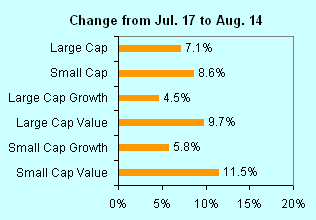
Small Cap Value ReturnFrom an investment style perspective, value materially outperformed growth. As a category, domestic small cap value funds have performed better than the other eight categories. The Russell 2000 Value Index, a proxy for the small cap value category is up 11.5%. The large cap growth proxy Russell 1000 Growth Index lagged gaining just 4.5%.

Oftentimes categories that are strong performers in one month can extend their leadership for a longer duration after taking a breather. As such, it makes sense to keep a watch on small cap value investments. Here are some ETFs and mutual funds that are sensible to track.

Vanguard Small Cap Value ETF – VBR

Vanguard Small Cap Value ETF seeks to track the performance of the MSCI US Small Cap Value Index, a broadly diversified index of value stocks of smaller U. S. companies.

VBR has gained 12.2 % during the past month. Over the past 5 years, the ETF has gained at a 2.8% annual rate.

With over $4.4 billion in assets, the Vanguard Small Cap Value holds over 1,000 companies. Averaging over 200,000 shares per day in trading volume, the liquidity of VBR shares is adequate. Vanguard Small Cap Value has a measly 0.15% expense ratio.

SPDR Dow Jones Small Cap Value ETF – DSV

SPDR Small Cap Value ETF seeks to track the performance of the Dow Jones U. S. Small Cap Value Total Stock Market Index.

DSV has performed better that VBR during the past month gaining 14.3%. This ETF also has the edge in long-term performance gaining at an annual rate of 3.8% over the past 5 years.

SPDR Dow Jones Small Cap Value has nearly $84 million in assets and spreads them over 800 companies. Shares of DSV do not change hands frequently. Average daily trading volume is around 14,000. This can cause DSV’s bid-ask spread to be relatively wide. SPDR Dow Jones Small Cap Value has an expense ratio of 0.25%.

Small Cap Value Mutual Funds

American Century Small Cap Value Fund – ASVIX

After remaining closed to new investors for more than seven years, the American Century Small Cap Value Fund reopened on April 20, 2009. American Century Small Cap Value has a relatively strong long-term track record averaging an annualized gain of 5.5% over the past 5 years. According to Morningstar, this places the fund in the top 15% of funds in the small cap value category.

The fund’s managers Benjamin Giele and James Pitman seek long-term capital growth by investing in stocks trading with low price/earnings ratio, low price/book ratio, low price/cash flow ratio, or high dividend yields and selling them when valuation metrics approach the small cap market averages.

American Century Small Cap Value fund has gained 10.4% during the past month lagging the Russell 2000 Value Index a tad. This no load fund manages nearly $1.4 billion with an expense ratio of 1.25%.

Royce Opportunity Investment Fund – RYPNX

Royce Opportunity Investment Fund seeks long-term capital growth by investing in smaller companies with an approach that emphasizes turnarounds and special situations.

Managed by Boniface Zaino and William Hench, the $1.3 billion Royce Opportunity has gained 14.5% during the past month. The fund has done reasonably well over longer periods as well. According to Morningstar, Royce Opportunity has returned 3.5 % over the past 5 years; this places the fund in the top 31% of small cap value funds. This no load mutual fund carries an expense ratio of about 1.17%.
Yacktman Fund YACKX – A Top US Mutual Fund?

Calls for U. S. investors to invest overseas get louder each day. While overseas investments can help investors diversify their mutual fund portfolios, domestic investments need not be overlooked.

Selected domestic mutual funds have achieved stellar returns since the market bottomed in March. One such fund is the no-load Yacktman Fund (YACKX) managed by the father and son team of Donald Yacktman and Stephen Yacktman.

Since March 9, the Yacktman Fund has outperformed both domestic and international equity performance benchmarks by investing most of its assets right here in the U. S. The Yacktman fund has gained over 88% outpacing both the S&P 500’s 51% gain and the MSCI EAFE Index’s 59% gain. This mutual fund has also performed better than investments in the popular BRIC countries of Brazil, Russia, India, and China, beating MSCI BRIC Index’s 80% gain.

The Yacktman Fund has achieved this success by loading up on consumer discretionary stocks like Liberty Media Interactive (LINTA) and Viacom (VIA) in the media group and finance companies like AmeriCredit (ACF) during the credit crisis. The fund has also treaded lightly on laggards like telecommunication stocks.

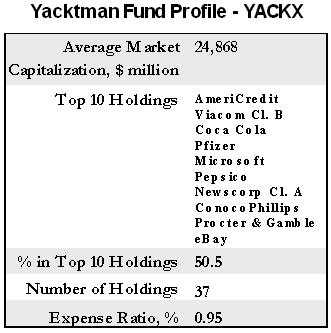
Yactman Fund YACKX ProfileMorningstar classifies the $738 million Yacktman Fund as large cap-value fund. The Yacktman Fund’s managers follow what they call a ‘flexible value investing’ strategy. They evaluate equity investments as if they are buying a long-term bond, adjusting their required rate of return based on the quality of the company: The higher the quality, the lower the required rate of return.

The Yacktman Fund typically has a concentrated portfolio. As of June 30, 2009, 50.5% of the fund’s assets were invested in the top ten holdings.

The Yacktman Fund is also not averse to holding cash for defensive purposes and opportunistic purchases. As of June 30, 2009, the fund held 13.5% of net assets in cash.

The recent success of the Yacktman Fund illustrates that investors can earn strong returns in the U. S. market as well. Tactical fund selection on the part of mutual fund investors can go a long way in undoing the damage from the bear market and rebuilding portfolios.

MSCI Emerging Markets Index: Eastern Europe Ain’t China or India

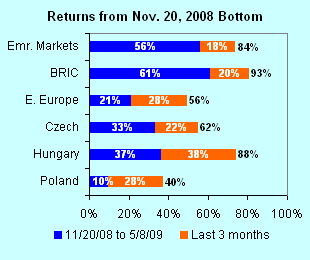
Year 2009 has been a good one for investors in emerging markets. Since bottoming on November 20, 2008, the MSCI Barra Emerging Market Index is up 84%. Equity prices in Brazil, Russia, India, and China or the BRIC nations are up a higher 93%.

Off-late, equity prices in Eastern Europe are up strongly and trying to catch up with other emerging markets. During the past three months, the MSCI Barra Eastern Europe (excluding Russia) Index is up 28%. This exceeds the 18% and 20% gains scored by equities in emerging markets and BRIC nations, respectively.

And, as emerging markets continue to rake in gains, calls for U. S. investors to invest overseas are growing louder. The underlying rationale is that prospects for economic growth in such markets are superior to those in the U. S. and such markets may be immune to the credit crisis.

However, before plunking dollars into emerging markets investors must beware that issues facing emerging economies vary significantly from one country to another. While some emerging economies are poised for strong growth others are not… at least not in the near-term. And, in some cases, emerging economies are contending with issues similar to those impacting the U. S. economy.

Eastern Europe

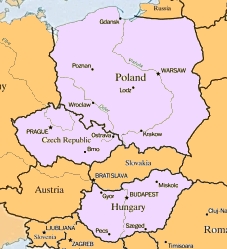
Emerging Market Index ReturnsTake the case of Czech, Hungary, and Poland. Here is a read of the economic situation in these Eastern European nations.

Czech. The global recession has hit Czech pretty hard. Slumping demand caused industrial output to decline over 12% for the 12-month period ending in June. The Czech National Bank expects GDP to contact 3.8% in 2009 and expand by just 0.7% in 2010.

Hungary. Hungary’s economy was particularly hit hard by the global financial crisis. Hungary took nearly $30 billion in emergency loans to avoid a default. The Hungarian government expects GDP to contract 6.7% in 2009. Hungary’s economy is forecasted to return to growth only in 2011.

Poland. Poland’s economy has a reasonable chance of avoiding a recession in 2009. After expanding at 0.8% annual rate in 2009’s first quarter, the Polish economy appears to be floundering. The Polish government is expecting 2009 GDP growth of 0.2%. Growth in 2010 is expected to accelerate just marginally to 0.5%.

Emerging Markets Eastern EuropeCompare the above picture with China and India. China’s economy is expected to grow 8% in 2009. India’s finance ministry is confident that economic growth in 2009 will exceed 6% even under the worst-case scenario.

Clearly, Eastern Europe is not in the same league as China or India as far as prospects for near-term growth go.

Is Eastern Europe a Buy, Sell, or Hold?

While economic growth is not the only factor that determines price performance of equities, investors need to recognize that the ability of companies to grow profits in contracting economies is limited. Cost cutting can only go so far and revenue growth for many companies in such economies will prove elusive. This in turn will put a cap on how high valuation metrics can go.

The global bull-run has lifted all equities including the ones in Eastern Europe. Closed-end funds with meaningful exposure to Eastern Europe, Central Europe & Russia Fund (CEE) and Morgan Stanley Eastern Europe Fund (RNE) have advanced 24% and 22%, respectively during the past three months.

Open-end mutual fund Metzler-Payden European Emerging Markets (MPYMX) has done a tad better advancing 25%.

Emerging Market Investment Returns Shares of Central European Media Enterprises (CETV), a TV operator in Eastern Europe, and shares of Central European Distribution Corp. (CEDC), a distributor of alcoholic beverages in this region, are each up over 32%.

Investors seeking shelter in emerging markets purely for their growth prospects and ‘immunity’ from the credit crisis are likely to be disappointed if they choose Eastern Europe as the destination for their dollars. Given the lack of exciting near-term growth prospects in this region, investors sitting on handsome profits here should consider it prudent to at least partly cash their chips.

Biotech Stocks and ETFs: Should You Board the Biotech Bandwagon Now?

July has been a good month for biotech investors. Share prices in the biotech sector as measured by the NYSE Biotechnology Index are up 24% compared to the 6.6% gain for the S&P 500. Earlier in the month, Amgen (AMGN) reported better-than-expected results from a trial of its experimental bone-protecting drug denosumab in patients with advanced breast cancer. Amgen’s shares vaulted 16% on the news.

In the week just ended, the momentum in biotech shares has continued further. While a host of favorable clinical trial results was the bigger driver, a large buyout announcement added the icing to the cake.

Clinical Trial Results

Case for investing in Biotech stocks and ETFs IBB and XBI: Clinical Trial SuccessesBringing back memories of the dotcom era, shares of Human Genome Sciences (HGSI) rose nearly 300% to $12.50 a share after the company reported favorable results for its experimental lupus drug Benlysta. Targacept (TRGT) shares more than doubled to $7.25 a share after its depression drug candidate met its goals in a mid-stage trial. Onyx Pharmaceutical (ONXX) reported encouraging results for its breast cancer treatment Nexavar to push its shares higher by 21%. Shares of Celgene (CELG) jumped nearly 16% after the company announced significant improvement in progression-free survival of patients taking Revlimid as a first-line treatment for multiple myeloma.

Buyout

Case for investing in Biotech stocks and ETFs IBB and XBI: Increasing MergersContinuing the trend of major pharma-biotech mergers, as in Roche (RHHBY.PK)-Genentech, and Eli Lilly (LLY)-ImClone, Bristol-Myers Squibb (BMY) announced it is buying Medarax (MEDX) for $16 a share. The Medarex takeover implies a net price tag of over $2 billion. Medarax shares jumped nearly 90% on the announcement.

Is it too Late to Board the Biotech Bandwagon?

Given strong gains in biotech shares in recent weeks, it is logical to ask if it is too late to get on the biotech bandwagon. I believe the answer, generally speaking, is no. Notwithstanding uncertainties surrounding health care reform, the fundamentals for biotech companies are reasonably favorable. Yet, one needs to take appropriate care in getting the timing right and in choosing proper investment vehicles.

Fundamentals

Several factors favor the long-term growth of biotech companies. These include an aging population, rising incidence of cancer and other degenerative diseases, and growing recognition that biotech products offer the best solutions for management of these diseases.

Several biotech drugs like Roche’s Avastin and Amgen’s Enbrel have the potential of becoming major blockbuster drugs by 2014. Biotech companies are seeking to expand uses of their approved drugs to treat more diseases. And, unlike drugs made by major pharmaceutical companies, biotech drugs are to a degree insulated from generic competition. Major pharmaceutical companies are also actively working to strengthen their biotech forte and increasingly acquiring biotech companies for their intellectual properties.

Timing

Equity prices have been strong across the board since the market bottomed on March 9 and the S&P 500 is up nearly 46%. Biotech shares are no exception. The market as well as biotech shares could be due for a pull-back. From a timing standpoint, it makes sense to put money to work in the biotech sector on a pullback.

Investment Vehicles

Stocks of established biotech companies like Amgen, Biogen Idec (BIIB), Genzyme (GENZ), and Gilead Sciences (GILD) typically move with little correlation to the broad market. That said, such shares carry some degree of event risk. Adverse results from key drug development efforts can cause such shares to swoon in a jiffy. As such, they may only be suitable for investors with well-diversified portfolios.

Smaller biotech companies often promise riches based on the success of one or two key drugs. They carry a high degree of event risk as failure in pivotal drug development activity can quickly break a company. Only the most risk-tolerant investors usually tend to court such shares.

Bundled products like biotech sector funds and ETFs are better suited for most investors since they reduce most of the event risk. And, there are plenty of biotech sector funds and ETFs to choose from. Investors looking for no load mutual funds can consider Fidelity Select Biotechnology (FBIOX) or Rydex Biotechnology (RYOIX).

In the ETF space, iShares Nasdaq Biotechnology (IBB) and SPDR S&P Biotech (XBI) are among the more popular ones. Investors looking for a global investment vehicle can look at PowerShares Global Biotech (PBTQ).

Aggressive traders looking for explosive short-term returns can turn to Biotechnology UltraSector ProFund (BIPIX). This mutual fund uses leverage to boost returns.

Sector Investing: Should You Be in the Tech Sector Now?

The week past was a noteworthy one for technology investors. Share prices in this sector zoomed higher by 9.4%. After Tuesday’s market close, Intel’s (INTC) second quarter earnings announcement injected life back into the stock market and triggered a bull stampede in many tech names.

The Good

Intel reported its strongest growth from the first quarter to the second since 1988 and offered optimistic comments for the second half of 2009. Based on improving conditions in the PC market, the technology bellwether expects sales in the third quarter to near $8.5 billion, well above the $7.8 billion tally forecasted by analysts. Commenting on the chip giant’s results, one analyst quipped, ‘Intel had a blow-out quarter on nearly every metric.’

This bullish enthusiasm continued through the week after International Business Machines (IBM) too blew past analysts’ earnings forecasts. Relentless cost cutting through automation and shifting of work to lower cost locales enabled IBM to increase its profits by 12% to $3.1 billion even though sales declined 13% to $23.3 billion. IBM’s earnings tally of $2.32 a share exceeded analysts’ $2.02 a share forecast. The tech-titan bumped its 2009 EPS forecast higher to at least $9.70 a share, 50 cents a share more than its January forecast.

The Bad

Even though Intel and IBM reported relatively strong results, the strength in operations did not resonate through other tech names. Nokia’s (NOK) forward looking statement gave investors concern. Lagging rivals like Apple (AAPL) and Research In Motion (RIMM) in the smartphone race, Nokia lowered its operating margin forecast on phones from ‘mid teens’ to about 10%.

Citing weak demand for computer hardware from business customers, higher component costs, and a competitive pricing environment Dell (DELL) lowered its gross margin forecast for its July quarter.

Invest in Tech?

So, with tech companies performing mixed, is it worthwhile to invest in the technology sector?
Given the prospect of a stabilizing economy, I believe the answer is yes. Selectivity however is key.

Look Before You Leap!

Fidelity Select Technology (FSPTX), Technology Select Sector SPDR (XLK), and Vanguard Information Technology (VGT) represent a sampling of broad technology-related sector funds and ETFs available for investing. Here’s how these investments have fared since the March 9 market bottom.
XLK, VGT, FSPTX Return
FSPTX has led the pack with a whopping 70% return. This exceeds the 53% gain for VGT by 17%. XLK has lagged the group with a 45% advance.

Why Such Differences?

As always, the devil is in the details. While FSPTX, XLK, and VGT have Technology in their names, they are differ in market capitalization of holdings, industry exposure, and expense ratio. XLK includes telecom services companies while the others typically do not. FSPTX often includes mid-cap and small-cap technology companies while XLK and VGT are heavily oriented towards large-cap names.
XLK, VGT, FSPTX Comparison
Exposure to telecom services companies like AT&T and Verizon is holding back XLK’s performance while higher exposure to mid-cap names has helped FSPTX leapfrog the competition since March 9. Rather than choosing investments with the lowest expense ratio or highest trading volume, it pays to understand what your mutual fund or ETF owns.

While broad investments in the technology can fare relatively well, we believe richer rewards await those timing their entry into specific industries in the technology sector.

Cleantech Investments: Mutual Funds, ETFs, and Stocks

PowerShares Cleantech PZD, MarketVectors Environmental EVX, Fidelity FSLEX, China, and more …

China has emerged as a major manufacturer of capital and consumer goods and much has been written about China’s economic miracle. Even though most of the world is mired in a deep recession, China’s economy continues to grow. The Chinese economy grew 6.1% in the first quarter from a year earlier.

Toll on the Environment

The economic miracle has however come at the cost of the environment: Air, water, and land have become tainted. China has surpassed the U. S. as the largest per capita emitter of carbon dioxide. Nearly 40% of Chinese cities face significant water shortages and 37% of China’s land mass is plagued by soil erosion problems. Serious acid rain falls on 415 of Chinese cities. Exacerbating the damage, China is building coal-fired power plants at a frenetic pace to narrow the gap between electric power generation and demand.

$500 billion Cleantech Investment Opportunity

The Chinese government is now proactively addressing the issue through its Green GDP strategy. U. S. trade officials expect China’s Green GDP market to tally $186 billion by 2010 and expand to nearly $500 billion by 2020. To push things forward quickly in the near-term, about 38%, or $221 billion of China’s $586 billion domestic stimulus package announced in late 2008 is earmarked for cleantech-related initiatives.

Cleantech needed in China

China’s $500 billion cleantech investment provides opportunities to profit with stocks, ETFs like PowerShares Cleantech PZD & MarketVectors Environmental EVX, and mutual funds like Fidelity Select Environmental FSLEX.


Cleantech in China means more than just wind turbines, solar cells, or electric cars. It includes advanced technology to free air, water and soil of harmful pollutants. China expects the Green GDP strategy to provide its economy a long-term competitive edge by lowering raw material costs in addition to combating severe pollution problems. With no major state-owned Chinese companies operating to clean up things, the giant Chinese market is creating significant opportunities for companies with a cleantech edge.

So, Who’s Poised to Profit

Here are some names to play this investing theme. While smaller companies typically will provide more exposure to this theme, they tend to be more volatile than larger ones.

Small and Mid-Sized Cleantech Stocks

Nalco Chemical (NLC), a Warren Buffett holding, is a leading provider of water treatment chemicals and services. It also offers many technologies that reduce nitrogen oxide and sulfur dioxide emissions from coal-fired plants. Seeing huge potential in China, Nalco has recently moved its Asia headquarters from Singapore to Shanghai. Nalco already has manufacturing plants, research centers, and 554 employees in China.

Afton Chemical, a unit of fuel-additive maker NewMarket (NEU) specializes in fuel and lubricant additives. Its Greenclean products include a diesel fuel detergent that boosts engine performance and cuts harmful emissions. With nearly 170 million motor vehicles already rolling on Chinese roads, NewMarket sees opportunity for petroleum additives here.

Large Cleantech Stocks

General Electric (GE) is pushing its Ecomagination initiatives in China and GE China is already a $5 billion business. GE’s Ecomagination unit focuses on green technologies and clean-energy products. The unit has been growing revenue at a 20% annual rate and pulled in revenue of $17 billion in 2008. With China contributing handily to growth, GE’s Ecomagination unit targets a ‘stretch’ revenue goal of $25 billion in 2010. Investors should however note that GE’s finance unit faces substantial challenges, a factor that stands to be a bigger driver of the company’s stock price.

Duke Energy (DUK) is working to enter into a series of joint ventures with Chinese firms to develop a range of energy capabilities from clean coal to wind power. By leveraging such partnerships. Duke seeks to reduce the cost of deploying renewable technologies and to mitigate technical risks.

Cleantech Mutual Funds and ETFs

If one does not want to deal with company-specific risk and prefers to invest in a basket, there are a few cleantech mutual funds and ETFs for consideration. These include PowerShares Cleantech ETF (PZD), Market Vectors Environmental Services ETF (EVX), and Fidelity Select Environmental (FSLEX). FSLEX and EVX include Nalco Holdings among their top 10 holdings while PZD has nearly 61% of its holdings in the Industrials sector.

Gold ETFs and ETNs: Glittering Opportunity Awaits You – about AP to be added

about AP to be added …

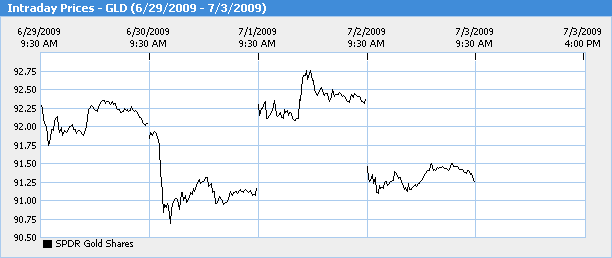
Following a volatile ride, the coming week promises to be an interesting one for gold investors.

GLD Price history

Leaders from the Group of Eight industrial nations and major developing nations including China will meet in Italy from July 8 to 10. The wide-ranging agenda includes discussion on the state of the world economy and financial regulation.

China has requested discussion on the position of the U. S. dollar as the world’s global reserve currency and expressed interest in using the International Monetary Fund’s Special Drawing Rights as a super-sovereign currency. Developed member nations are however downplaying this issue.

Separately, the U. S. Treasury will hold four auctions next week to sell $73 billion of notes, bonds and inflation-protected securities as President Obama pushes the nation’s marketable debt to a massive $6.45 trillion. Given China’s standing as the largest holder of U. S. Treasury debt, currency as well as gold traders will be keenly watching developments from the Group of Eight meeting. If recent market action serves as any guide, gold will likely rise first before paring gains.

Here are some ways to play gold depending on your risk tolerance and investment time horizon. While gold bullion is preferred by conservative investors, aggressive traders try to swing for the fences with leveraged or short securities.

Gold Bullion ETFs

Gold Bullion ETFsETFs that hold gold bullion like SPDR Gold Shares (GLD) and iShares COMEX Gold Trust (IAU) allow your investments to track the spot price of gold without worrying about theft of and insurance for the metal.

Gold Futures ETNs

Gold Futures ETNsETFs like PowerShares DB Gold Fund (DGL) allow you to own gold futures instead of bullion. Such ETFs automatically rollover futures contracts and save you the trouble.

Gold Mining Mutual Funds and ETFs

Gold Mining Mutual Funds and ETFsMutual funds and ETFs that invest in gold mining companies offer you the convenience of investing in a diversified basket of such companies. Ownership of gold mining shares often offers more upside potential with higher downside risk than ownership of bullion. Fidelity Select Gold (FSAGX), First Eagle Gold (FEGIX), and USAA Precious Metals & Minerals (USAGX) are examples of some mutual funds that invest in gold. Market Vectors Gold Miners (GDX) and PowerShares Global Gold & Precious Metals (PSAU) are ETFs that invest in gold mining companies.

Leveraged Mutual Funds, ETFs, and ETNs

Leveraged Mutual Funds, ETFs, and ETNsAggressive investors have a wide range of investment choices. Mutual funds like ProFunds Precious Metals UltraSector (PMPSX), ETFs like ProShares Ultra Gold (UGL) and ETNs like DB Gold Double Long (DGP) offer leveraged exposure to gold. Such leveraged investments are usually not suitable for buy-and-hold investors.

Short Mutual Funds, ETFs, and ETNs

Short Mutual Funds, ETFs, and ETNsMutual funds like Short Precious Metals ProFunds (SPPSX), ETFs like ProShares UltraShort Gold (GLL) and ETNs like DB Gold Short (DGZ) and DB Gold Double Short (DZZ) provide opportunities to profit from a decline in the price of gold.

Petroleum Refining and Oil Prices: Is it Time to Dig into Oil and Energy Stocks?

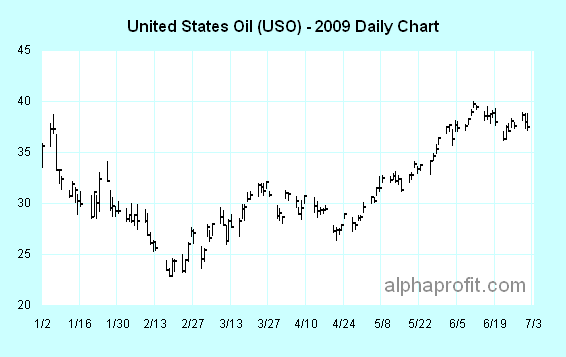
Weakness in the U. S. dollar and hopes of an improving global economy have thus far pumped up the price of oil. Oil has nearly doubled in price over the past three months.

While oil is taking its cue from the U. S. dollar on a day-to-day basis, the uptrend appears to be running into resistance in recent trading sessions.

News of unrest in nations like Iraq and Nigeria has failed to spike oil prices. The reality of slack product demand is seeping into the oil pits.

USO Price history

Product demand

Gasoline demand in the U. S., is nearly 6% lower than it was a year ago. According to the U. S. Department of Energy, gasoline inventories recently tallied 205 million barrels, following their biggest weekly increase.

The distillate picture is even more disconcerting. The deep recession has slowed industrial activity including freight transportation and taken a toll on diesel demand. Total U. S. demand for distillates is averaging nearly 3.4 million barrels per day, about 20% lower than year-ago levels.

Oil Price Forecast

In the near-term, gasoline demand in the U. S. should start to taper after the Fourth of July weekend. Beyond this seasonality, trends in disposable income will become a key factor driving gasoline demand. In distillates, diesel demand is likely to move in tandem with Gross Domestic Product while heating oil demand will be driven by weather patterns particularly in the Northeast.

Looking outside the U. S., China and to a lesser extent Brazil and India are expected to contribute to global growth. Europe is mired in a deep recession and is widely expected to lag the U. S. in recovery. As such, the possibility of a synchronized global recovery that rapidly boosts oil demand appears remote. Led by a 4.9% decline in U. S. consumption, the International Energy Agency expects global oil demand to fall 2.9%.

Meanwhile, supplies of oil seem adequate. While OPEC countries appear to be generally disciplined in limiting shipments to around 28.0 million barrels per day, non-OPEC production is increasing. Russia’s output appears to be higher than earlier estimates.

Against this backdrop of slack product demand and plentiful oil supplies, it is prudent to take a relatively conservative view on the outlook for the price of oil. This backdrop also has somber implications for refining and alternative energy shares.

Take Profits in Alternative Energy

The fortunes of alternative energy stocks like First Solar (FSLR) and ETFs like PowerShares WilderHill Clean Energy (PBW) are tied as much to the price of oil as investors’ risk appetite. Alternative energy stocks are unlikely to fare well if oil loses price momentum and upside is capped in the near-term. Given the healthy run-up in alternative energy shares in recent months, it is worthwhile to consider paring bets here.

Hold-off on Refiners

Slack distillate demand is causing refiners to curtail production when they should be building inventory ahead of the winter season. U. S. distillate inventories have climbed to 42 days of supply from nearly 28 days of supply a year-ago. The average price of diesel in the U. S. has fallen below that of gasoline for the first time since 2007.

Barring a major surge in demand, high distillate inventories are likely to act as a buffer and keep prices in check. It is prudent to take a wait-and-see posture on shares of refiners like Frontier Oil (FTO), Holly Corp. (HOC), Tesoro Corp. (TSO), and Valero Energy (VLO). If global growth surprises to the upside and product demand becomes more robust, such stocks can offer healthy potential for appreciation over the long-haul.

Earn 55% on Autopilot!

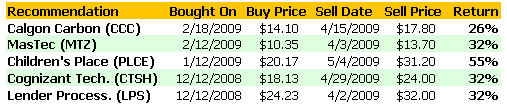
The AlphaProfit Sector Newsletter’s Stock Searchlight feature is enabling several subscribers to earn spectacular returns from individual stocks with little effort, month after month. Here are some examples of recent recommendations and their results:

Examples of Stock Searchlight Results

View more stock recommendations results.

We provide specific buy, sell, and stop-loss targets for each of the stocks recommended in Stock Searchlight. To use these recommendations, here is all you have to do when you receive the Monthly Report:

1) Go into your brokerage account and buy the featured stock if the stock price is lower than the recommended buy-below price.

If the current price is higher, place a limit order to buy the stock if the buy-below price is reached. Most brokerage accounts offer e-mail alerts that you can set to be notified if the buy-below price is reached. You will be notified when your order is filled.

2) Once you have purchased the stock, place limit orders for both sale and stop-loss based on recommended prices.

If the stock price rises, the sell order will be triggered and you will net a cool profit. If the stock price declines, the stop-loss order will kick in to limit your losses.

Sector Rotation: Increase Your Sector Selection Success by 75%

The first half of 2009 has been tough on most momentum-based strategies. After declining 11.0% in the first quarter, the broad market turned around and staged a roaring rally. The S&P 500 is now up 15.7% for the second quarter.

The snap in performance between the first and second quarters is even more striking at a sector level.

In general, sectors like financials and industrials down the most in Q1 have rallied impressively in Q2. For example, Financial Select SPDR (XLF) and Industrial Select SPDR (XLI) declined 28.7% and 19.9%, respectively in Q1 to rally 38.6% and 20.9% to date in 2Q. On the other hand, Vanguard Information Technology (VGT) that bucked the decimation in Q1, advancing 3.5%, has lagged in Q2.

Sector Rotation: 1Q and 2Q2009 to Date Sector Performance

One sector where momentum has continued from Q1 to Q2 is materials. After declining a modest 1.9% in Q1, Materials Select SPDR (XLB) has gained a respectable 22.2% in Q2.

The switch in popularity of sectors from Q1 to Q2 highlights the difficultly most momentum-based strategies face in delivering consistent out-performance. The probability of success improves when one looks beyond momentum and considers other factors in sector or security selection. Such factors include news quality, valuation, growth expectations, and the like. Our research shows that the probability of selecting winners increases by 75% when multiple factors are included in sector selection rather than momentum alone.

As one looks at Q2 performance to date, the financial sector stands out as a leader. The $64,000 question is, Will this leadership continue for the remainder of Q2 and into Q3?

Viewing news quality, financial institutions are benefiting from positives like a historically steep yield curve, low borrowing costs, shrinking credit spreads, and rising mortgage originations … all of which help profitability of banking operations.

As for negatives, uncertainty on capital adequacy of banks and valuation of distressed assets remain high. Against an already high levels of non-performing loans, the rate of mortgage foreclosures and loan delinquencies hardly show signs of abating.

While one could make a case for bank stocks trading at attractive prices with respect to their longer-term earnings potential, they hardly appear bargains if one goes by analysts’ 1-year forward earnings forecasts. Citigroup (C) is expected to lose money over the next 4 quarters. Bank of America (BAC) is expected to earn just 14 cents a share and this translates to a forward P/E of over 81 for BAC’s shares. Shares of better-positioned banks like JP Morgan Chase (JPM) and US Bancorp (USB) also trade at relatively high forward P/Es of over 21.

Given moderately favorable fundamentals and unattractive valuations, the financial sector taken in toto is unlikely to maintain its leadership in market returns going forward. Selected industries and stocks within the financial sector can however offer better opportunities. Aflac (AFL), Delphi Financial Group (DFG), and Everest RE (RE) represent three promising names in the insurance group for intermediate and long-term investors.