Utility ETFs and Stocks – Should You Buy, Sell, or Hold Utilities?

Although the S&P 500 has advanced 32% since the March 9 market bottom, the rally has been quite selective from a sector perspective. Groups decimated during the recent bear market have rallied the most. Financial shares are up big after losing 81% from September 30, 2007.

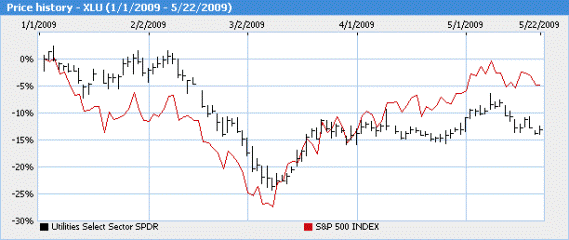
With investors demonstrating healthy risk appetite, defensive sectors have generally lagged. Utilities Select Sector SPDR (XLU), for example, is up just 15%.

Things have been worse for shares of individual utility companies like Consolidated Edison (ED), FirstEnergy (FE), Southern Company (SO), and Wisconsin Energy (WEC). These stocks trade fairly close to their 52-week lows. At current prices ED, FE, and SO shares carry plump dividend yields nearing 6% or more. WEC’s yield is lower at 3.7%.

SPDR XLU Utility ETFs Price Chart

Shares in the Utility sector have lagged the recovery. The Utilities Select Sector SPDR ETF (XLU) is up just 15% while the S&P 500 has advanced 32%.

So, why are Utilities out of favor?

Part of the reason is that the weak economy has quashed demand at most electric utilities. With the nation gripped in a recession, most state regulators are reluctant to grant healthy rate increases. Weak demand is offsetting benefits from lower fuel prices. As a result, reduction in 2009 earnings forecasts has been quite common among utilities.

Other reasons for underperformance include investors’ preference for more volatile stocks during a period when the stock market has been buoyant. In recent weeks, the up-tick in bond yields is also pressuring utility stocks.

So, should you buy, sell, or hold Utilities?

Selected utility stocks such as ED, FE, and SO are oversold and due for a short-term bounce. Nimble traders can look here to make a quick buck at relatively low risk. With earnings outlook less than stellar, intermediate and long-term investors will be better off looking elsewhere.

Will Investors Continue to Chase Risk?

Investors are chasing risk since the markets bottomed in March. While the U. S. large cap stocks as measured by the Russell 1000 index are up 10.9%, small cap stocks have rebounded 12.6%. Developed foreign markets have scored even better, galloping 18.0%.

While the above returns are impressive, the real action has been in emerging markets. After being drubbed in the latter part of 2008, emerging markets are re-asserting their leadership. The MSCI Emerging Market index has surged 24.2% with Latin American stocks leading their Asian peers.

True, many emerging economies are in better shape than developed economies like those in North America and Europe. For one, emerging economies continue to grow. China’s economy swelled 6.1% in the first quarter, in stark contrast to the 6.1% shrinkage in U. S. gross domestic product. Likewise, many emerging economies enjoy substantial foreign exchange and budget surpluses.

Yet, investing in emerging markets is not without risk. Recent news from Thailand and Mexico highlights the political and country-specific risks such investments can pose. Stock prices in emerging markets are usually more volatile than in developed markets.

So, will the current rally continue? Will investors continue to chase risk?

Prudent investors do not bet on ‘yes or no’ answers. To reap rewards and manage risk, they prefer to invest in a diversified portfolio of well-managed domestic, foreign, and emerging market mutual funds like those recommended in the AlphaProfit Fund Investors’ Guide.

Subscribe to the AlphaProfit Sector Investors’ Newsletter and access the domestic, foreign, and specialty fund recommendations included in the AlphaProfit Fund Investors’ Guide.

About AlphaProfit

AlphaProfit Investments, LLC, is a Texas-based investment research firm. AlphaProfit publishes the AlphaProfit Sector Investors’ Newsletter. As evident from its Hulbert rankings, the newsletter is a consistent, top performer that has bagged the coveted #1 RANK several times. Drawing on insights and research into sector investing, the newsletter offers winning sector fund and exchange traded fund recommendations and top mutual fund portfolios for superior long-term results.

To learn more about AlphaProfit and to subscribe to the AlphaProfit Sector Investors’ Newsletter, visit https://www.alphaprofit.com.

A new bull market is just beginning

The stock market continues to sizzle and pullbacks are modest even in the face of bad news. The ability to digest bad news raises our conviction that the market will add to recent gains in the months ahead.

After six straight up weeks, the market has consolidated its gains over the past two weeks and is providing an exciting entry point.

With the new bull market just beginning, this is a perfect time to recharge your investment portfolio with AlphaProfit.

Why? Because our sector selection methodology has an enviable track record of success in selecting market-beating winners.

Here are some examples of actual gains scored by AlphaProfit subscribers from our past recommendations:

•  117% from Wireless

•  46% from Healthcare Providers

•  45% from Oil & Gas Equipment & Services

Do not let this opportunity pass by today!

Subscribe to the AlphaProfit Sector Investors’ Newsletter and position yourself to profit.


About AlphaProfit
AlphaProfit Investments, LLC, is a Texas-based investment research firm. AlphaProfit publishes the AlphaProfit Sector Investors’ Newsletter. As evident from its Hulbert rankings, the newsletter is a consistent, top performer that has bagged the coveted #1 RANK several times. Drawing on insights and research into sector investing, the newsletter offers winning sector fund and exchange traded fund recommendations and top mutual fund portfolios for superior long-term results.

To learn more about AlphaProfit and to subscribe to the AlphaProfit Sector Investors’ Newsletter, visit https://www.alphaprofit.com.

Market Bottom Appears Enduring

The March 6 market bottom appears enduring.

  • The credit market is easing; corporations have raised nearly $225 billion in debt during the first two months of 2009.
  • Money supply is soaring at a 15.3% annual rate and cash should soon find its way to the stock market.
  • Technical indicators like MACD and RSI on major indexes are demonstrating bullish positive divergences with momentum bottom recorded in Oct. 2008 and price bottom in Mar. 2009.

The AlphaProfit sector model portfolios will be repositioned on Tuesday, March 31 to capture emerging opportunities in a bottoming market while reducing risk.

AlphaProfit Core Model Portfolio: The Right Choice for Rollover and SEP-IRA

The AlphaProfit Core model portfolio is a diversified portfolio, pursuing long-term capital growth. It is an alternative to investing in diversified mutual funds. The Core portfolio completed its fifth anniversary on September 30, 2008. As part of monitoring portfolio performance, we compare the performance of the Core portfolio with those of the five largest domestic funds and the five largest Fidelity domestic funds.

Portfolio, Fund, or Benchmark

Ticker

Annualized Return, %

During the past five years, the AlphaProfit Core model portfolio has outperformed all of the largest diversified domestic mutual funds.

AlphaProfit Core Model Portfolio

  8.2

5 Largest No-Load Domestic Funds

Growth Fund of America, C

GFACX

  6.1

Vanguard 500 Index

VFINX

  5.0

Vanguard Total Stock Market Index

VTSMX

  5.9

American Funds Investment Company, C

AICCX

  4.6

American Funds Washington Mutual, C

WSHCX

  4.8

Fidelity’s 5 Largest Domestic Funds

Fidelity Magellan

FMAGX

  2.3

Fidelity Equity Income

FEQIX

  4.5

Fidelity U.S. Equity Index Investor Class

FUSEX

  5.1

Fidelity Value

FDVLX

  7.8

Fidelity Blue Chip Growth

FBGRX

  3.1

Average for Large Domestic Funds

  4.9

S&P 500

  5.2

Data: Mutual fund returns from Morningstar

In addition to performance, here are three other reasons to invest with the Core model portfolio:

Diversification and Tax-efficiency: The Core model portfolio is well diversified, typically holding seven or eight sectors or industry group funds. Most funds are held 1 year or longer to reduce tax bite.

Modest Investment Requirements: The Core model portfolio can be used with as little as $5,000 in SEP-IRA or Keogh accounts or $25,000 in regular or other qualified accounts like Rollover, Roth, or Regular IRA.

Consistent Investment Process and Style: Mutual fund investors often worry about changes in fund management affecting returns. The Core model portfolio makes it less of an issue by using a consistent strategy to select sectors and industry groups using AlphaProfit’s ValuM investment process.

AlphaProfit Focus Model Portfolio: Powerful Returns from Prudent Risk Taking

The AlphaProfit Focus model portfolio completed its fifth anniversary on September 30, 2008. As part of monitoring portfolio performance, we compare the Focus model portfolio’s performance with those of the 10 largest non-diversified domestic funds in the large-cap, mid-cap, small-cap, and multi-cap categories.

During the past five years, the AlphaProfit Focus model portfolio has outperformed all but one of its peer group non-diversified mutual funds. The fund outperforming the Focus portfolio showed 49% higher risk as measured by its standard deviation.


Portfolio, Fund, or Benchmark

Ticker

Ann. Return, %

Std. Dev., %

AlphaProfit Focus Portfolio

12.2

  9.0

Ten Largest Non-Diversified Domestic Funds

Janus Twenty

JAVLX

11.4

  8.9

A Focus Mutual Fund

23.8

13.4

Marsico Focus

MFOCX

  5.0

  6.7

Janus Adviser Forty Cl. S

JARTX

10.4

  8.5

Columbia Marsico Focus Cl. Z

NFEPX

  4.8

  6.7

Morgan Stanley Focus Gr. Cl. C

AMOCX

  2.4

  8.2

FBR Focus

FBRVX

  8.6

  7.4

Fidelity Fifty

FFTYX

  2.5

  8.4

Jennison 20/20 Focus Cl. C

PTWCX

  9.4

  7.5

Neuberger Berman Focus Inv.

NBSSX

  3.0

  7.2

Median Non-Diversified Fund

  6.8

  7.9

S&P 500

  5.2

  5.3

Data: Mutual fund returns from Morningstar

The AlphaProfit Focus model portfolio is a non-diversified portfolio, pursuing aggressive growth. It is an alternative to investing in non-diversified domestic mutual funds. Standard deviation is a measure of risk. A higher standard deviation implies greater risk.

In addition to performance, here are three other reasons to invest with the Focus model portfolio:

Prudent Risk Taking: The Focus model portfolio balances return with diversification and tax efficiency. The Focus portfolio typically holds two to four sectors or industry group funds to mitigate risk. By using the Focus portfolio for a portion of their assets, investors with diversified portfolios increase the return of their overall portfolio.

The Focus portfolio usually holds sector or industry group funds 6 months or longer. Aggressive investors with a long investment time horizon use the Focus portfolio for their tax-deferred accounts.

Low Investment Requirements: Focus model portfolio can be used with as little as $1,000 in SEP-IRA or Keogh accounts or $5,000 in regular or other qualified accounts like Rollover, Roth, or Regular IRA.

Consistent Investment Process and Style: Mutual fund investors often worry about changes in fund management affecting returns. The Focus model portfolio makes it less of an issue by using a consistent strategy to select sectors and industry groups using AlphaProfit’s ValuM investment process.

AlphaProfit Beats Popular Fidelity Funds – FLPSX FDGRX FEQIX and More

Subscribers tracking the AlphaProfit Core model portfolio since inception in September 2003 more than doubled their investment account this October.

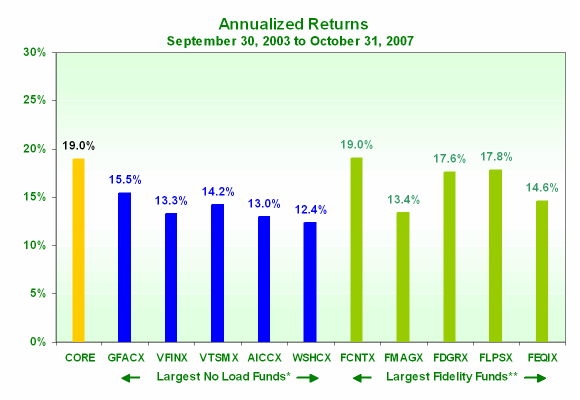
The Core model portfolio is an alternative to diversified domestic mutual funds for many subscribers. We compare its performance with that of the five largest no-load domestic mutual funds and Fidelity’s five largest domestic funds.

AlphaProfit Core has compounded at an average annualized rate of 19.0% since inception on September 30, 2003 to October 31, 2007. During this period, the above universe of large domestic mutual funds has on average gained at 15.1%. The Core model portfolio outperformed the titans by 3.9% per year yielding $1,950 more annually on a $50,000 investment.

Mutual fund investors often worry about changes in fund management affecting returns. The Core model portfolio makes it less of an issue by using a consistent strategy to select sectors and industry groups based on their valuation, momentum, and news quality.

AlphaProfit Core versus Large Fidelity Funds - FCNTX, FMAGX, FDGRX, FLPSX, FEQIX

** The five largest Fidelity funds in the domestic category are Fidelity Contrafund (FCNTX), Fidelity Magellan (FMAGX), Fidelity Growth Company (FDGRX), Fidelity Low Priced Stock (FLPSX), and Fidelity Equity Income (FEQIX).
* The five largest no-load domestic funds are Growth Fund of America Class C (GFACX), Vanguard 500 Index (VFINX), Vanguard Total Stock Market Index, (VTSMX), American Funds Investment Company of America Class C (AICCX), and American Funds Washington Mutual Investors Class C (WSHCX).
Source: Mutual fund data from Morningstar

Here are some additional points worth noting about the Core model portfolio:

  • The portfolio seeks to outperform the broad averages by using favorably ranked sectors and industry groups while leaving out unfavorably ranked ones.
  • The portfolio strives to balance return, diversification, and tax efficiency.

For many investors, the Core model portfolio tends to be a worthy choice for their Rollover IRAs.

PowerShares ETFs: PowerShares ETFs Fueled by Active Indexes

Adopting novel fundamental indexes, PowerShares has expanded the options available for sector as well as thematic ETF investors.

PowerShares, a unit of U. K.-based Invesco PLC, is emerging as a strong player in the sector ETF arena. Starting off with two ETFs in 2003, PowerShares introduced 22 sector and industry group ETFs in 2005 and followed them with 21 similar offerings in 2006. PowerShares is expected to expand the lineup of sector and industry group ETFs further in the current year.

PowerShares ETF Index Selection & Application

Majority of ETFs use market capitalization weighted indexes such as those constructed by Dow Jones & Co. and Standard & Poor’s. Eschewing such passive, market capitalization-weighted indexes, PowerShares uses two novel types of indexes for their sector and industry group ETFs. PowerShares also offers some unique theme-based ETFs.

1. Dynamic Intelligent Indexes

A large number of PowerShares’ sector and industry group ETFs under the Dynamic series seek to track AMEX’s Intellidex indexes. Each sector or industry Intellidex index is composed of a limited number of stocks which are selected each quarter from companies within the sector or industry. Stocks within the sector or industry that are assessed to have high capital appreciation potential are identified using a variety of criteria such as fundamental growth, valuation, investment timeliness, and risk. The index is divided into large-cap, mid-cap, and small-cap sub-groups. Each market cap sub-group is allocated a collective weight and all stocks within the sub-group receive equal weight.

2. Fundamental Indexes

Nine PowerShares sector ETFs seek to track the corresponding FTSE RAFI sector index. The FTSE RAFI sector indexes consist of the largest U. S. companies in the sector as determined by four fundamental measures, book value, cash flow, dividends, and sales. An overall weight is calculated for each company by equally weighting each fundamental measure. Firms with the highest fundamental weight are selected and each firm is assigned a weight equal to its fundamental weight. The FTSE RAFI indexes are reconstituted annually.

3. Niche Plays

Certain PowerShares ETFs delve into unique industry groups. PowerShares Water Resources ETF (Amex: PHO) and PowerShares Global Water ETF (Amex: PIO) based on Palisades Water Index and Palisades Global Water Index, respectively are examples of niche industry ETFs in the utilities sector. Some PowerShares ETFs also focus on specific investment themes. PowerShares Lux Nanotech ETF (Amex: PXN) ventures into nanotechnology, a process with application potential in health care, information technology, materials, and industrial sectors. The Lux Nanotech index has holdings distributed across companies in these sectors.

AlphaProfit Take

By being willing to embrace novel indexes, PowerShares has expanded the investment options available for sector ETF investors. PowerShares offers ETFs that can be attractive for investors pursuing a GARP, value, or thematic approach to investing.

1. PowerShares ETFs for GARP Investors

Sector and industry group PowerShares ETFs in the Dynamic series offer a compromise between actively managed mutual funds and ETFs tracking low-turnover, static benchmarks. The Intellidex indexes used as benchmark for these ETFs apply rules-based criteria to select securities and are reconstituted quarterly. While specifics of the security selection process are kept proprietary, Amex has disclosed that factors such as fundamental growth and valuation are considered in security selection. By balancing growth with valuation-related parameters, the Intellidex indexes appear to seek ‘growth at a reasonable price’. As such, the Dynamic series of PowerShares ETFs may whet the appetite of GARP investors.

2. PowerShares ETFs for Value Investors

The weightings for securities in the PowerShares FTSE RAFI series of ETFs are derived from four fundamental or accounting measures, book value, cash flow, dividends, and sales. By weighting stocks on these four fundamental measures of size rather than market capitalization, the FTSE RAFI indexes seek to avoid over-weighting over-valued stocks and under-weighting under-valued stocks. The weighting factors used in the construction of the FTSE RAFI indexes do not explicitly include measures of growth. In contrast, value investors typically consider the FTSE RAFI index weighting factors on a normalized basis to screen for attractively priced stocks. Given this similarity, the PowerShares ETFs in the FTSE RAFI series are more in tune with a value investor’s security selection process.

3. PowerShares ETFs for Thematic Investors

PowerShares offers a group of ETFs that focus on specific investment themes like clean energy and clean technology. In offering such ETFs, PowerShares has leveraged the knowledge base of organizations that have in-depth expertise in niche areas. PowerShares Global Clean Energy ETF (Amex: PBD) and PowerShares WilderHill Clean Energy ETF (Amex: PBW), for example, are based on WilderHill indexes constructed by Wildershares, LLC. These ETFs provide investors with vehicles to invest in themes such as renewable energy sources and environmentally friendly technologies.

Sector ETFs vs. Sector Mutual Funds – The Battle of the Behemoths

Mutual fund titans Vanguard and Fidelity are taking different approaches to compete against sector ETFs.

The allure of low expense ratios, better transparency, and ready liquidity has made exchange-traded funds (ETFs) a popular investment vehicle.

The robust returns earned off-late by energy and other commodity ETFs have resulted in money gravitating towards such ETFs. The Energy Select Sector SPDR (XLE) for example sports about $4.5 billion in assets. According to the Investment Company Institute’s latest report, assets in sector ETFs totaled over $39 billion, up from $26 billion, a year ago. And, these assets do not include the over $8 billion invested in commodity trusts like streetTRACKS Gold Shares (GLD) and iShares COMEX Gold Trust (IAU).

Sector ETFs arrived on the scene in force in 1998 when State Street (STT) launched its series of sector SPDRs. Since then Barclays (BCS), PowerShares, now a part of AMVESCAP (AVZ), and other financial institutions have followed suit introducing sector and industry-group ETFs in growing numbers.

Mutual fund behemoths Vanguard and Fidelity have much at stake as far as sector funds go. With about $26 billion in assets, the actively managed Vanguard Health Care Fund (VGHCX) is in a league of its own. Fidelity Select Energy (FSENX) and Fidelity Select Healthcare (FSPHX) each have well over $2 billion in assets. And the mutual fund titans have not been sitting pat watching sector ETFs encroach.

Vanguard introduced its series of sector ETFs under the VIPER name in 2004. The sector VIPERs are just a class of Vanguard index fund shares that trade on an exchange. By offering this class of shares, Vanguard extended the reach of its sector mutual funds into the world of sector ETFs to directly compete with the latter on their own turf.

Among mutual fund companies, Fidelity by far has the most number of unique industry-group funds. Increasing competition from industry-group ETFs has drawn a response from Fidelity. In contrast to Vanguard, Fidelity is electing to battle sector and industry-group ETFs on its own terms.

Starting October 1, Fidelity will discontinue the practice of pricing its Select Portfolio sector mutual funds on an hourly basis. Like conventional mutual funds, these sector funds will be priced once a day at 4.00 p.m. Eastern Time instead. This in itself further distances the Select Portfolio of sector mutual funds from sector ETFs which are priced throughout the day.

Additionally, restrictions on the number of roundtrip transactions involving Fidelity Select funds will become similar to those of most other Fidelity mutual funds. Such restrictions are intended to discourage frequent trading of Select funds.

In taking the above steps and by not following Vanguard’s lead in introducing a class of shares that trade on the exchange, Fidelity is positioning its 41 Select funds firmly as sector mutual funds and preserving their uniqueness.

Unlike ETFs which offer transparency through indexing, the Select funds are actively managed. Fidelity’s response will allow the firm to continue with the practice of keeping sector fund holdings closely guarded.

Fidelity is betting on the prowess of its global research capabilities to appeal to the interest of long-term investors. By discouraging shareholders from engaging in frequent trading that are oftentimes disruptive to the operations of a mutual fund, Fidelity expects to provide a better milieu for its fund managers to deliver on their stock picking acumen. And if the fund managers can put the new policies to good use and record superior returns, Fidelity’s sector mutual funds can give sector and industry-group ETFs a run for their money.

Fidelity Makes Changes to Fidelity Select Portfolio Mutual Funds

Fidelity Investments is proposing some changes to the Fidelity Select Portfolio mutual funds. The changes being proposed include:

  • Adoption of standard Fidelity mutual fund trading policies
  • Elimination of the $7.50 exchange fee
  • Removal of hourly pricing

Additionally, the Fidelity Select funds will be aligned under ten major sectors and the investment policies of certain Select funds will be changed following shareholder approval.

Fidelity Investments is targeting to have the new policies effective on October 1, 2006.

Some of you have written to us seeking our thoughts on these changes and what they mean for AlphaProfit Newsletter Subscribers.

We see the proposed changes as being generally beneficial for Newsletter Subscribers. Specifically, we see the adoption of standard Fidelity mutual fund trading policies and the elimination of the $7.50 exchange fee as being beneficial. To enhance your ability to track the model portfolios, we are considering changes to the Repositioning Alert communication schedule to offset the impact from the removal of hourly pricing. The reclassification of Select funds under ten major sectors may have an impact on personal taxes.

Looking at the impact of the proposed items in some detail:

Adoption of standard Fidelity mutual fund trading policies

The proposal is to make the trading policy for Fidelity Select funds similar to that of other Fidelity funds. Currently, a 0.75% short-term redemption fee is charged if Select fund investments are held less than 30 days and there are no restrictions on the number of round-trip transactions. (For Select funds, sale of shares within 30 days of purchase constitutes a round-trip transaction.)

The proposed policy leaves the short-term redemption fees and conditions unchanged. Subject to certain exclusions, the proposed policy seeks to restrict the number of round-trip transactions allowed over rolling 90 day and 12 month periods.

In our investment approach, we actively seek to help you avoid round-trip transactions. The model portfolio repositioning changes, the AlphaProfit Sector Portfolio Indicator, and the Favored Buy ratings are all designed to meet this objective. As such, Fidelity’s proposal to extend their standard mutual fund trading policies to Select funds is not a concern for Newsletter users.

Additionally, the proposed trading policies will likely discourage other investors from trading Fidelity Select funds on a short-term basis. This is likely to positively impact long-term fund performance.

Elimination of the $7.50 exchange fee

The elimination of the exchange fee is an obvious positive.

Elimination of hourly pricing

Fidelity Select funds are currently priced every hour, at the top of the hour from 10:00 a.m. (Eastern Time) to 4:00 p.m. The proposal is to do away with hourly pricing so that Fidelity Select funds like other Fidelity funds will be priced only at market close, i.e., 4:00 p.m.

The hourly pricing feature allowed Subscribers to reposition their investment accounts within 30 market minutes after AlphaProfit model portfolios are repositioned. The elimination of hourly pricing will increase the timing difference to 1 trading day.

To offset the above impact and improve your ability to track the model portfolios more closely, AlphaProfit is considering making changes to the model portfolio Repositioning Alert communication schedule.

Re-alignment of funds under ten major sectors

Fidelity Select funds are currently classified into seven major sectors. The proposal is to align the Select Portfolios under the 10 major sectors of the Global Industry Classification Standard developed by Standard & Poor’s and Morgan Stanley Capital International.

In the near-term, some Select funds may sell some stocks and replace them with those that better meet the fund’s new objective. If stocks are sold with relatively large capital gains, such activity may result in larger-than-normal capital gains distributions. Such distributions may have an impact on your personal tax situation if the Select fund is held in taxable accounts. Distributions received in qualified accounts generally will not have an immediate impact on your personal taxes.

Looking beyond the near-term impact, we believe the new classification system and the implementation of the proposed investment policy changes will better align the Select funds’ investment characteristics with standard industry descriptions. This should enhance our ability in using these funds to construct the AlphaProfit Focus and Core model portfolios.

We are committed to our objective of serving you with sector- and industry group-based investment ideas to construct portfolios for aggressive growth and long-term capital appreciation. When making decisions, we will strive to preserve and augment the AlphaProfit model portfolio characteristics that drive superior long-term returns. Additionally, we will seek to enhance your ability to track the model portfolios and help you keep trading costs and fees to a minimum.

We expect to be able to provide you the specifics on changes relating to the communication of model portfolio Repositioning Alerts as we get closer to October 1.