PowerShares ETFs

A Sector Investing Perspective

PowerShares ETFs are issued by PowerShares Exchange Traded Fund Trust. PowerShares Capital Management, LLC is the advisor and sponsor of the PowerShares ETF family of exchange traded funds. PowerShares Capital Management, LLC is a unit of UK-based investment management company, INVESCO PLC.

Breadth of Sector ETFs

PowerShares Exchange Traded Fund Trust offers 45 sector and industry-group ETFs.

Investment Approach

PowerShares sector and industry group ETFs commonly use the American Stock Exchange’s Intellidex Index (i.e., PowerShares Dynamic series) and FTSE RAFI Sector Index (i.e., PowerShares FTSE RAFI series) as underlying indexes. Selected industry group ETFs cover unique niches and use other indexes.

The Intellidex Index is an equal dollar-weighted index constructed from stocks having capital appreciation potential. The Intellidex Index is dynamic in that its component stocks are chosen every quarter. PowerShares ETFs are rebalanced and reallocated each quarter to match the composition of Intellidex index.

The FTSE RAFI sector index is constructed using equities in a particular sector by equally weighting scores on each of the four fundamental metrics, book value, cash flow, dividends, and sales. The FTSE RAFI sector indices are reconstituted annually.

Expense Ratio

The maximum expense ratio for PowerShares ETFs is 0.60%.

Trading Size

PowerShares ETFs shares may be purchased in ’round lots’ of 100 shares or smaller with the minimum number being one share.

AlphaProfit Take

PowerShares offers a group of ETFs that span several sectors and industry groups. PowerShares ETFs in the Dynamic series are ‘dynamically’ indexed with both growth and valuation-related parameters being used to select securities. The Dynamic series of PowerShares ETFs may whet the appetite of GARP investors.

By using fundamental weighting factors, PowerShares ETFs in the FTSE RAFI series seek to avoid over-weighting over-valued stocks and under-weighting under-valued stocks. Security selection in this series of PowerShares ETFs is more in sync with criteria used by value investors.

Some PowerShares ETFs target unique niches like alternative energy, private equity, and water resources. Investors seeking industry group-specific ETFs will find the PowerShares offerings worthy of consideration.

The expense ratio of PowerShares ETFs usually tends to be a tad higher than competing ETFs. Some PowerShares ETFs may not be highly liquid and may have relatively large bid-ask spreads.

AlphaProfit Newsletter and PowerShares ETF Recommendations

AlphaProfit Sector Investors’ Newsletter is the premier resource for sector investors. The Newsletter offers PowerShares exchange traded fund recommendations. The Newsletter and its model portfolios have frequently been ranked #1 by Hulbert Financial Digest.

About AlphaProfit MoneyMatters

AlphaProfit MoneyMatters is a free e-letter distributed to registered users of AlphaProfit’s website. The e-letter analyzes the economy, markets, and sectors and provides money-making insights on stocks, exchange-traded funds, and mutual funds. AlphaProfit MoneyMatters is edited by Dr. Sam Subramanian acclaimed for his financial acumen and analytical skills. Sign Up for ETF Newsletter.

Select Sector SPDRs: Ways to Maximize Return and Minimize Risk

Exchange-traded funds (ETFs) are growing in popularity. Bucking difficult market conditions, assets invested in ETFs have increased from $569 billion in January 2008 to $693 billion in September 2009. The flexibility provided by Select Sector SPDR ETFs in creating low-cost portfolios with customized asset allocations have enabled them to carve out a niche in the ETF world.

The Select Sector SPDRs (popularly called spider or spyder) divide the S&P 500 into nine sector index funds as follows:

  • Consumer Discretionary Select Sector SPDR Fund (XLY)
  • Consumer Staples Select Sector SPDR Fund (XLP)
  • Energy Select Sector SPDR Fund (XLE)
  • Financial Select Sector SPDR Fund (XLF)
  • Health Care Select Sector SPDR Fund (XLV)
  • Industrial Select Sector SPDR Fund (XLI)
  • Materials Select Sector SPDR Fund (XLB)
  • Technology Select Sector SPDR Fund (XLK)
  • Utilities Select Sector SPDR Fund (XLU)
Select Sector SPDR ETFs consist of Consumer Discretionary Select Sector SPDR Fund (XLY), Consumer Staples Select Sector SPDR Fund (XLP), Energy Select Sector SPDR Fund (XLE), Financial Select Sector SPDR Fund (XLF), Health Care Select Sector SPDR Fund (XLV), Industrial Select Sector SPDR Fund (XLI), Materials Select Sector SPDR Fund (XLB), Technology Select Sector SPDR Fund (XLK), Utilities Select Sector SPDR Fund (XLU)

The Select Sector SPDRs are formed by allocating each stock in the S&P 500 to one Select Sector SPDR ETF. Collectively, the nine Select Sector SPDRs make up the S&P 500.

Select Sector SPDR ETF Performance

The performance of an individual Select Sector SPDR ETF is tied to the performance of shares in that sector. Share prices in certain sectors are influenced more by the economy and by factors such as government policies, regulations, or commodity prices.

As such, an individual Select Sector SPDR ETF’s performance can be quite different from other Select Sector SPDRs as well as the S&P 500 index. For example, in 2005 Energy Select Sector SPDR (XLE) gained over 40% while Consumer Discretionary Select Sector SPDR (XLY) declined almost 6% and the S&P 500 gained about 5%.

Likewise, the performance a specific Select Sector SPDR ETF can vary over time. The Technology Select Sector SPDR (XLK) lost nearly 42% in 2000 to be the bottom performer after being the top performer in 1999 with a 67% gain.

Benefits of Select Sector SPDRs-based Custom Portfolios

Select Sector SPDRs provide low-cost exposure to specific sectors. They provide investors the ability to build customized portfolios that over-weight or under-weight particular sectors. By over-weighting specific sectors or by eliminating exposure to troubled sectors investors can enhance returns, reduce risk, or both.

Enhance Returns

Take the case of an investor who doubles the weighting to both energy and financial sectors in 2005 vis-à-vis the S&P 500 and proportionally reduces allocation to the seven other sectors. This investor earns almost 8% compared to the 5% gain for the S&P 500, a 60% improvement. The higher return is achieved with a 5% increase in daily volatility as standard deviation in daily returns increases from 0.64 to 0.67.

Select Sector SPDRs Enhance Return: Double Exposure to Energy Select Sector SPDR Fund (XLE) and Financial Select Sector SPDR Fund (XLF)

Reduce Risk

Likewise, take the case of an investor eliminating exposure to financial and technology sectors in 2008 and proportionally increasing allocation to the other seven sectors. This investor limits losses to 30% while the S&P 500 loses 37%, a relative improvement of 7%. The superior relative return is achieved with a 13% reduction in price volatility. The standard deviation in daily returns declines from 2.41 to 2.10.

Select Sector SPDRs Reduce Risk: Eliminate Exposure to Financial Select Sector SPDR Fund (XLF) and Technology Select Sector SPDR Fund (XLK)

Investors can increase returns, reduce risk, or both by mixing Select Sector SPDRs in different proportions. Investors can take this concept to the next level of higher return and lower risk by targeting specific industries within individual sectors.

Fatten Your Wallets from Financials’ Fire Sale

Stocks have recently made new 2009 highs. Volatility has declined. As confidence in the economy and financial markets improves, initial public offerings are increasing. The pace of corporate transactions is picking up as well.

A surging stock market and rising capital market activity are often good for firms in the investment management business. Yet, large financial services firms are busy shedding their asset management units.

Just in the third quarter alone, Bank of America (BAC) sold most of Columbia Fund Management to Ameriprise Financial (AMP) for $1 billion. American International Group (AIG) sold its asset management business to Hong Kong-based Pacific Century for $500 million. Lincoln Financial (LNC) sold Delaware Management to Australia’s Macquarie Group for over $400 million.

These transactions follow Barclays (BCS) divestiture of Barclays Global Investors to BlackRock (BLK) for $13.5 billion earlier this year. And, the trend is by no means over. Currently, Morgan Stanley (MS) is reported to be seeking a buyer for its Van Kampen mutual fund unit.

Why the rush to sell investment management businesses? There are a few reasons:

Need for Capital: The financial services industry lost nearly $1.2 trillion in the global financial crisis. Many large institutions needed the government’s support. Regulators have required several financial institutions to raise capital. Proceeds from the sales of asset management firms enable large financial services firms to shore up their capital base and repay the government.

Neglected Business: Being unsuccessful in drawing good investment management talent, large financial institutions have failed to attract money into their mutual funds and grow the asset base. These failings make them see their asset management units as non-core businesses.

Buyers Market in Investment Management

Financial services firms are selling investment management businesses at fire sale pricesWhile the acquisitions game is fraught with risk and many acquisitions end up destroying value for acquirers, the purchase of asset management businesses has a good probability of working well for buyers. Why?

The pressure on financial services firms to jettison asset management businesses is enabling buyers to acquire them at attractive prices. Ameriprise for example is paying just 7-times annual earnings before interest, taxes, depreciation and amortization (EBITDA) for Columbia Funds. Additionally, these acquisitions are helping buyers cost-effectively grow their business.

Profiting from Divestitures of Investment Management Businesses

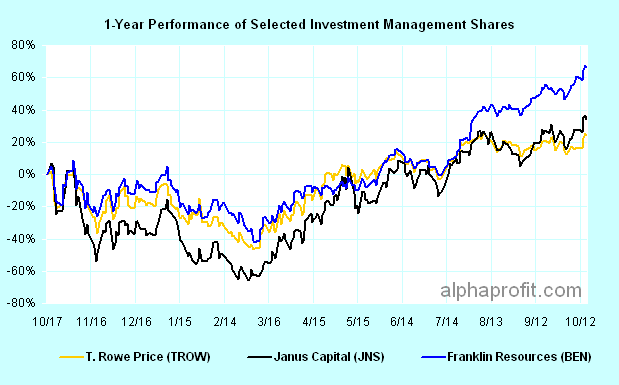
With buyers better positioned than sellers, stocks of investment managers offer a way for investors to profit from the financial crisis. Franklin Resources (BEN), T. Rowe Price (TROW), and Invesco (IVZ) represent three large cap asset managers. In the mid-cap space, Janus Capital (JNS) and Legg Mason (LM) merit attention. These firms have the possibility of creating value by acquiring asset management businesses when large financial services firms divest.

Investment Management Business Returns

Mutual funds and ETF investors can look to products like Fidelity Select Brokerage & Investment Management (FSLBX), SPDR KBW Capital Markets (KCE), and iShares Dow Jones US Broker-Dealers (IAI). While none of the bundled products is a pure-play, both KCE and IAI have a fair share of asset management firms among their holdings. Investors looking for global exposure will find FSLBX more in line with their preference. FSLBX has 25% of its assets invested overseas.

Information Technology Consulting Firms: Profit from Consolidation

Leading information technology consulting firms have received takeover offers. Affiliated Computer Services (ACS) has received a $6.7 billion offer from Xerox (XRX). Perot Systems (PER) has accepted a $3.9 billion offer from Dell (DELL). These transactions unveil a major trend in the technology sector where hardware companies are vying to acquire IT consulting and services firms.

So, why the rush to buy IT consulting and services firms? The reasons are both internal and external.

Internal Factors: The IT hardware business is commoditized and margins in this cyclical business are thin. With IT consulting company shares trading at relatively low valuation metrics, hardware companies are seizing the opportunity to add stable, long-term service revenue streams to their business. Such revenues also offer higher margins and help lessen the dependence on hardware sales.

Large IT Consulting FirmsExternal Factors: The recession has forced information technology customers to cut their budgets. With limited resources committed, customers now prefer one-stop-shops to solve specific business problems. Rather than procure hardware and software applications from different vendors and use internal staff to bring together disparate technologies, customers prefer vendors who can not only provide the hardware and software but also the brainpower to integrate technologies and maintain networks.

With no dearth of buyers, consolidation in the $806 billion IT services is likely to continue. The list of potential acquirers includes several large, well-capitalized information technology companies including Cisco Systems (CSCO), Dell, Hewlett-Packard (HPQ), and International Business Machines (IBM). Information technology consulting firms are of interest to software giants like Oracle (ORCL) and Microsoft (MSFT) too.

So, which IT consulting firms are next inline to be acquired?

The list of potential takeover targets comes in three categories: large firms, mid-sized firms, and niche players.

Information Technology Consulting: Large Firms, Computer Sciences CSC Potential targets include names like Computer Sciences (CSC) and Accenture (ACN). Acquirers are likely to value Computer Sciences’ access to government contracts. Accenture is more of a long shot given its $19 billion enterprise value and potential for integration challenges.

Mid-sized IT Consulting Firms

Information Technology Consulting: Mid-Sized Firms, CGI Group GIB Canada’s CGI Group (GIB) and Pennsylvania-based Unisys (UIS) are among the firms that fit this description. CGI Group which focuses on IT and business processes is likely to be ‘cleaner’ acquisition. Unisys with a mélange of services and technology businesses is a troubled company that has unsuccessfully tried to turn itself around for many years.

Niche Players

Information Technology Consulting: Niche Players, Salesforce.com CRM Salesforce.com (CRM), CommVault (CVLT), and FalconStor Software (FALC) are three players in attractive niche areas that can whet the appetite of acquirers. Recently, customer relationship management specialist Salesforce.com announced a partnership with Cisco. It remains to be seen if this partnership blossoms into something bigger. CommVault and FalconStor provide storage software, a line of business companies like Dell may find attractive.


Profiting from Consolidation in IT Consulting and Services

One way to profit from consolidation in the IT consulting and services space is to invest in potential targets. However, make sure that the specific company is a worthy standalone investment in case the takeover offer does not materialize.

Another alternative is to invest in no-load Fidelity Select IT Services (FBSOX), the only pure-play IT consulting and services mutual fund in town. ETF investors will have to settle for a broad software play like iShares S&P North American Technology-Software (IGV).

Natural Gas Futures Trading: Opportunities for Both Shorts and Longs

Yesterday’s natural gas inventory report from the U. S. Energy Department’s Energy Information Administration (EIA) provided traders and investors a grim reminder on the over-supply of natural gas.

The EIA reported that natural gas stored in the lower 48 states amounted to nearly 3.6 trillion cubic feet. This tally is the highest on record on a seasonally adjusted basis since record keeping began in 1975. The inventory overhang is close to EIA’s estimated peak storage capacity of 3.9 trillion cubic feet.

Reacting quickly and decisively, traders pushed to the spot price of natural gas below $3 per million BTU. Natural gas futures prices however have been more resilient, pinning hopes on a cold winter and a recovering economy. The contango price structure is so steep that natural gas for November delivery trades at a nearly 60% premium to the October spot price.

For the near-term, the short side of the natural gas futures trade looks more appealing given the massive natural gas inventory overhang. Speculators can get into the action through the NYMEX natural gas futures contract that trades in units of 10,000 million BTUs. The NYMEX also offers a smaller miNY natural gas futures contract for investment portfolios. The miNY contract trades the equivalent of 2,500 million BTUs of natural gas or 25% of the standard futures contract.

Economic indicators suggest that the worst of the recession may be behind. Suggesting pickup in manufacturing activity, the Institute for Supply Management’s manufacturing index has exceeded the 50 threshold for two straight months. A turn in the U. S. economy for the better should spur industrial demand and help strengthen the price of natural gas.

For long-term investors, pullbacks such as the one seen today provide attractive buying opportunities to get in fairly close to the ground floor. Investors looking for bundled products can average into vehicles like Fidelity Select Natural Gas (FSNGX) or First Trust Advisor’s ISE-Revere Natural Gas (FCG).

Stock Market Predictions: Can Corporate Takeovers Tame the Bear?

With the stock markets taking a breather, calls that the worst for U. S. equities is yet to come are growing louder. Bearish calls usually cite the possibility of a collapsing dollar, rising inflation, or plunging commercial real estate values.

In recent weeks, corporate takeover activity has intensified. Disney (DIS) will fork out $4 billion to purchase Marvel Entertainment (MVL). Cadbury (CBY) continues to call Kraft’s (KFT) $17 billion offer inadequate. Dell (DELL) has offered nearly $4 billion for Perot Systems (PER). Unilever (UL) is working to acquire Sara Lee’s (SLE) personal care business for nearly $2 billion.

Can corporate takeovers continue to remain strong to prove the bearish stock market predictions wrong in 2010?

Here are some factors that can have a bearing on corporate takeover activity.

Corporations flush with cash. Corporations have slashed payroll expenses and are generating tons of cash. The U. S. Commerce Department has reported companies posted annualized cash flow of more than $1.5 trillion in each of the last three quarters, the most on record since 1947.

Growth stronger in emerging markets. As consumers in most of the developed world de-leverage, even well-managed companies are struggling to grow organically. Meanwhile, emerging economies continue to grow at a rapid clip.

Equity valuation reasonable. S&P 500 companies are expected to earn $66.83 a share, implying a forward P/E of about 16. The forward P/E looks attractive against the backdrop of subdued 1.4% core inflation rate and a relatively low 3.5% yield on 10-year Treasuries.

Corporate Takeover Activity Can Remain Strong

A combination of excess cash, challenges to growth, and reasonable valuation provides sufficient reason for businesses with strong balance sheets to become acquisitive.

Modest valuations make it easier for acquisitions to work. Companies can boost their earnings by eliminating key rivals or by deriving synergies. Acquisitions can also help corporations expand their geographic footprint and increase their exposure to high-growth emerging markets.

As cash keeps piling up on balance sheets, companies can look to ways to use this cash to shore up growth. If not, they run the risk of their cash hoard making them takeover targets as buyers load up on debt to purchase cash-rich companies.

Stock Market Predictions

While possibility of rising inflation and commercial real estate defaults are threats to be concerned about, increasing corporate takeover activity is among the more potent forces bulls can bank on.

In recent transactions, action has revolved around cash generative defensive groups like food and beverage. If confidence in financial markets improves, takeover activity should broaden to other sectors as well.

Takeover activity can gather momentum if companies fear being left behind in the race for growth. Equity valuations will start to embed the take-over premium on likely targets when investors get inkling that strength in takeover activity is real and here to stay. This can set the stage for equity prices to steadily climb in 2010 rather than quickly crash.

If this scenario of gradually rising equity prices punctuated by short and shallow pullbacks unfolds in 2010, ‘buy and hold’ may well become the mantra again. Plain vanilla ETFs like DIAMONDS Trust 1 (DIA), SPDR S&P 500 (SPY), and PowerShares QQQ (QQQQ) can become staple diets for many investors.

Despite growls from the bears, leveraged short ETFs like UltraShort Dow30 (DXD), UltraShort S&P500 ProShares (SDS), UltraShort ProShares QQQ (QID) will be unable to repeat their 2008 performance. The leveraged short ETFs will however play a useful role as trading and hedging vehicles.

Both bulls and bears will do well to keep pulse of corporate takeover activity to get a handle on the market’s direction.

3 Housing Investments Best Suited for a Recovery

The housing market is showing signs of stabilization. The free fall in home prices appears to have ended. Even though foreclosures are on the rise, strong increases in sales are enabling home prices to stage a modest rebound.

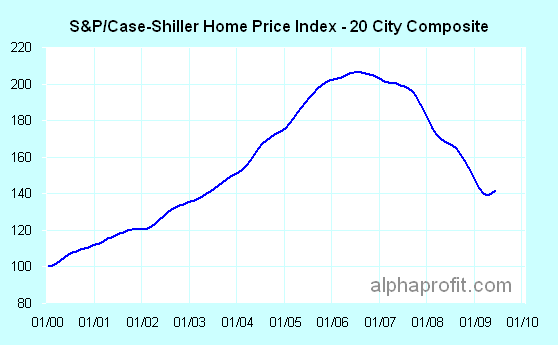
Home prices as measured by the S&P/Case-Shiller index advanced 1.4% in June. This marks the second straight monthly gain for the battered housing market.

With home prices showing signs of turning around, it pays to look at leading indicators of supply of and demand for homes to assess whether the bottom can be enduring.

Supply of Homes

New construction as well as foreclosure contributes to the supply of homes.

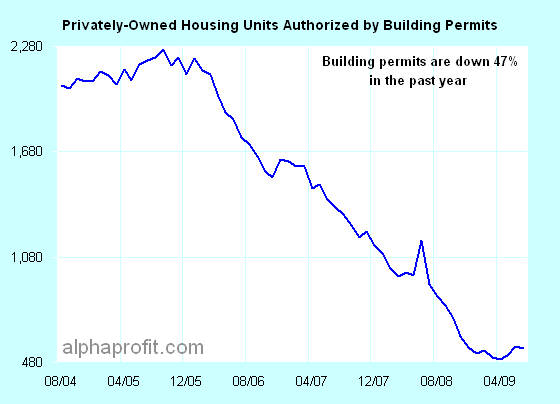
Issuance of building permits is a leading indicator of new construction activity. There is ample evidence that construction activity is slack. Number of building permits is down nearly 40% on a year-over-year basis.

Foreclosures are however a point of concern. The U. S. foreclosure rate shows no signs of abating. The foreclosure rate could also increase materially if forecasts for a double-digit unemployment rate come true.

Demand for Homes

Pending home sales are a useful leading indicator since they track contract signings. Here the picture is encouraging.

Housing Investments: S&P/Case-Shiller Home Price Index Trend

A turnaround in the S&P/Case-Shiller index augurs well for housing investments and homebuilders.

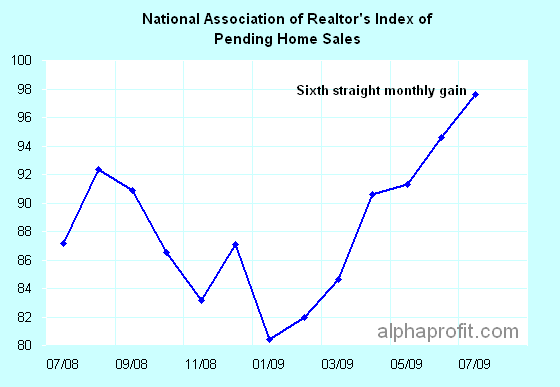
The National Association of Realtors recently announced that pending home sales gained 3.2% in July. Coming on the heels of a 3.6% increase in June, this marks the sixth straight monthly gain in pending home sales.

With frugality being the new norm for consumers, purchases of smaller sized homes are becoming more common. The average size of new homes is down to 2,065 square feet. The Commerce Department’s data show that sales of new homes costing less than $200,000 accounted for nearly half of all sales in the first half of 2009.

What This Means for Home Prices

As long as the job market doesn’t get much worse and mortgage rates don’t rise too much, home sales should continue to trend upward and help home prices recover further. The strength of the recovery is likely to be subdued and the duration drawn-out as high levels of foreclosures offset restraint on new construction.

Given the above outlook, it is right to get into housing-related investments … but selectively. We believe new starter home builders, home improvement companies, and selected home furnishings makers can prosper as home prices recover.

Homes for First Time Buyers

Housing Investments: First Time Home Builders

Mortgage availability is less abundant than in the go-go days. Added to this, uncertainty on the job front is running high. These factors are working to curb consumers’ appetite for large mortgages. Against this backdrop, the lower-end of the house price spectrum appears more appealing than the higher end.

Shares of lower-end homebuilders offer one way to play the housing recovery. D. R. Horton (DHI) and KB Homes (KBH) are examples of homebuilders catering to first-time buyers.

Home Improvement Companies

Housing Investments: Home Improvement Companies

The backdrop of modestly rising home prices and lower mobility from a slack job market is likely to encourage homeowners to upgrade their homes. Home improvement companies like Home Depot (HD) and Lowe’s (LOW) can fare well in this milieu and offer another means to play the housing recovery.

Home Furnishings

Housing Investments: Home Furnishings

Teeing off the potential for homeowners to upgrade their homes, makers of home furnishings that help to increase the value of homes look appealing as well. Masco (MAS) a maker of cabinets, plumbing products, and paints is an example that fits this bill. Floor covering product maker Mohawk Industries (MHK) is another company that can benefit.

Is the Housing Recovery for Real?

The housing market is sending mixed signals. Home sales are rising. Foreclosures are increasing too. Is the worst really over for housing?

Rising Sales of New and Existing Homes

Sales of existing and new homes are increasing. In July, total sales of new and existing homes rose to a 5.673 million annual rate, the highest since November 2007. The steep decline in home prices, low mortgage rates, and an $8,000 tax credit for first-time buyers have helped to prop up demand.

Foreclosures Show No Signs of Abating

Rising unemployment is causing increasing number of homeowners to default on their mortgages. Foreclosures have spiked particularly in states like Nevada, Florida, and California. According to RealtyTrac, 358,471 U. S. properties received a foreclosure notice in August. This represents an 18% increase from August 2008.

Home Prices Tick Up

Even though foreclosures are on the rise, strong increases in sales are helping the housing market to stabilize and enabling home prices to stage a modest rebound.

The S&P/Case Shiller Index which tracks home prices advanced 1.4% in June, its second straight monthly gain.

So, are home prices about to rebound?

Getting a handle on leading indicators for supply of and demand for homes can help in assessing where home prices are likely headed.

Supply of Homes

The news here is mixed.

Rising foreclosures are a concern. They continually bring distressed properties into the market and add to the inventory of unsold homes. Things can get ugly if unemployment rate ticks up to double-digits and causes foreclosure rates to increase further.

Supply from new construction is not nearly a concern as much. The Commerce Department recently stated that housing starts in July tallied 587,000, down 1% from June.

Building permits, an indication of future construction activity, too declined 1.8% to a seasonally adjusted annual rate of 560,000 in July. Number of building permits issued in July 2008 is nearly 40% lower than a year-ago prior to the financial meltdown.

New Homes Building Permits Chart

Demand for Homes

It is useful to look at a leading indicator like pending home sales that track contract signings.

The National Association of Realtors recently announced that pending home sales gained 3.2% in July. This follows a 3.6% increase in June. Such strength in contract signings augurs well for home sales going forward.

Existing Home Sales Up Despite Foreclosures
Buyers are however turning frugal with their home purchases. The Commerce Department’s data show that sales of new homes costing less than $200,000 accounted for nearly half of all sales in the first half of 2009. The average size of new homes is down to 2,065 square feet.

All said, the housing market appears to have stabilized. As long as the job market doesn’t get much worse and mortgage rates don’t rise too much, home sales should continue to trend upward and help home prices to recover further.

The strength of the recovery is likely to be subdued and drawn-out as high levels of foreclosures offset restraint on new construction.

The investment implications of this analysis are discussed in a separate article titled 3 Housing Investments Best Suited for a Recovery.

Commodity Trading Strategies: Profiting from Gold and Natural Gas

Investors often lump commodities together and run the risk of making improper investment choices. While some commodities can be hot, others may not. The supply and demand factors affecting commodity prices are usually specific to a commodity.

Take the case of gold and natural gas this year. The price of gold has been relatively strong. The surge in the yellow metal’s price over the past few trading sessions has put gold just short of the $1,000 an ounce mark, the third time gold has approached this level.

Gold – Demand and SupplyIn contrast, the price of natural gas has been on a downtrend. With a series of lower lows getting set, natural gas prices are near levels seen in March 2002. To some, such weakness in natural gas has surprisingly come in the face of strong oil prices.

So what gives? What’s driving gold and natural gas?

Following a spectacular 52% advance in the S&P 500 from its March 6 lows, investor’s comfort with equities has eroded on concerns that stock prices are leapfrogging an eventual economic recovery. The implications of soaring budget deficits in the U. S. and U. K. are a point of concern as well.

Commodity Trading Strategies: Natural Gas and Gold Returns
Divergence of gold and natural gas prices indicates the need for commodity trading strategies.

Against this backdrop, investors appear under-weighted in gold. They are pulling monies out of equities to put them in gold. Meanwhile, central banks are restraining their sales of gold and limiting supplies of the precious metal. The European Central Bank, the Swiss National Bank, and Sweden’s Riksbank have agreed to limit gold sales to less than 400 metric tons per year over the next five years.

Natural Gas – Demand and Supply

First off, it is important to note that unlike oil, natural gas is a domestic commodity. The price of U. S. natural gas is influenced primarily by U. S. demand and supply. Economic growth in regions like China and India has little bearing on natural gas. In contrast, the price of oil is influenced by growth in Asia.

The deep U. S. recession has taken a heavy toll on natural gas demand. The U. S. Department of Energy expects use of natural gas in U. S. factories to decline 8.6% this year. Steps taken by gas producers in curtailing output have not been adequate in stemming the surge in natural gas inventories. According to the Energy Department, natural gas inventories have bulged to 3.323 trillion cubic feet, a seasonally adjusted high since 1993.

So, what’s the right way to play gold and natural gas?

Profiting from Gold

Trade Gold Given the strong run-up in the price of gold and gold-related assets last week, a short pause may be in order here. That said, the fundamentals for gold appear reasonably favorable at least in the near-term. From a technical perspective, the momentum is with the bulls. The seasonal pattern too favors gold. Coming just ahead of the surge in jewelry demand from the wedding season in India, September is often a strong month for gold.

It is conceivable that gold can crack the $1,000 an ounce mark in the near future and stay above this psychologically important level. Where gold goes in the intermediate to long-term depends on the ability of the U. S. dollar to hold up against major world currencies. Gold can thrive if the greenback declines and inflation heats up.

Read: Specific ways to invest in gold

Investing in Natural Gas

Invest in Natural Gas The near-term supply-demand balance for natural gas looks pretty depressing. The market is well-supplied… to put it in mild terms. Barring a surprise wave of warm weather that increases air-conditioning demand or a storm that reduces Gulf of Mexico natural gas output, excess inventories are likely to keep natural gas prices in check for sometime.
Natural gas investments are a longer-term play premised on the belief that the U. S. economy will resume growth sometime in the future. The attraction is that natural gas may have substantial upside when the turnaround does occur.

First, natural gas is trading at a material discount to oil on an energy equivalent basis. Second, the price of natural gas delivered in future is much higher than its spot price. Natural gas for January delivery closed at nearly $4.79 per million BTU, an 80% premium (or about $2.13 per million BTU) to the October futures price.

While natural gas investments do not appear particularly timely at present, there are varieties of investments long-term investors can monitor and profit from once the bull market in natural gas ensues.

One can play the natural gas theme by investing in the commodity itself through iPath DJ AIG Natural Gas ETN (GAZ).

Alternatively, one can invest in stocks of companies reasonably leveraged to natural gas. These include Anadarko Petroleum (APC), Chesapeake Energy (CHK), Devon Energy (DVN) and Canada-based EnCana (ECA).

Mutual fund and ETF investors can look at Fidelity Select Natural Gas (FSNGX) and SPDR S&P Oil & Gas Exploration & Production (XOP). While these bundled products are not entirely pure-plays on natural gas, they do offer the benefit of reducing company-specific risk.

Newspaper Publishers Can’t Wait Longer for Better Times

Industry wide ad revenue in the larger print segment declined 30% to $6.2 billion in the second quarter. Even the smaller online-only segment has not been immune to the recession. According to the NAA, online-only ad revenue fell 16% to about $650 million.

Against the backdrop of shrinking demand for products and services, employers grew reluctant to increasing head count. Job recruitment ad revenue declined 66%, the highest among classified categories. Ads in troubled sectors like real estate and autos fell 46% and 43%, respectively.

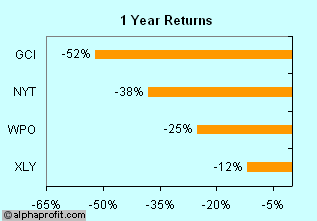
Newspaper Stock ReturnsNewspaper publishers like Gannett (GCI) and New York Times (NYT) derive more than 50% of the sales from ad revenue. Washington Post (WPO) too is exposed to ad sales. WPO is however better diversified as 50% of the company’s revenue comes from educational services provided by its Kaplan unit.

Against this miserable advertising scenario, it is hardly a surprise that newspaper stocks have suffered massive declines. GCI and NYT shares have seen nearly 52% and 38% of their value wiped out over the past year while WPO shares are down 25%. These stocks have underperformed shares in the consumer discretionary sector where the Consumer Discretionary Select Sector SPDR (XLY) is down 12%.

With the economy showing signs of leveling off and providing hopes of recovery, newspaper publishers can hardly wait longer for better times. The second quarter data from the NAA has a silver lining. With the exception of real estate, classified ad sales declined less in each category during the second quarter compared to the first.