Discount Online Stock Trading: Charles Schwab Calls the Shots

The largest U. S. online brokerage firm Charles Schwab Corp. (SCHW) has cut commission rates on stock trades. Retail investors will pay $8.95 per online stock or non-Schwab exchange-traded fund (ETF) trade. The new rate represents a $4 per trade discount to the previous rate or savings of 31%.

The lower rate hitherto available only to active, high net-worth households is now available to retail investors regardless of account size or trading frequency. It is also available to investors who trade in Personal Choice Retirement Accounts (PCRA) or Company Retirement Accounts (CRA).

Charles Schwab offers free ETF tradingSchwab’s new commission schedule compares favorably with base fees of $9.99 at TD Ameritrade (AMTD), $12.99 at E*Trade (ETFC), and $19.95 at Fidelity Investments. The new schedule is also lower than the $9.99 E*Trade and $10.95 Fidelity Investments charge for certain active traders with higher account balances. Among larger online brokers, Scottrade at $7 per trade offers a lower cost alternative to Schwab.

This move to cut trading commissions is Schwab’s most recent salvo at its competitors. It comes on the heels of launching six low-cost ETFs.

Schwab U.S. Broad Market ETF (SCHB)

Schwab U.S. Large-Cap ETF (SCHX)

Schwab U.S. Small-Cap ETF (SCHA)

Schwab International Equity ETF (SCHF)

Schwab U.S. Large-Cap Growth ETF (SCHG)

Schwab U.S. Large-Cap Value ETF (SCHV)

All Schwab ETFs except U.S. Small-Cap and International Equity have a highly competitive expense ratio of just 8 basis points. The latter two ETFs charge 15 basis points. Schwab is also allowing its customers to trade these 6 in-house ETFs free of charge.

The Price War Initiated by Charles Schwab in Discount Online Stock Trading is Suggestive of a Bull Fight
The intensity of competition initiated by Charles Schwab in the discount online stock trading industry is suggestive on a bull fight!

What do these changes mean for you?

In many cases, it makes sense to invest in companies whose products or services you like to use. Online brokers, at least in the current milieu, are different.

Good to be online broker customer

Price competition among online brokerages should help you lower your commission expenses. Brokers know that competition is just a mouse click away and they have to be competitive on price. As such, it is highly likely that one of Schwab’s competitors will respond by cutting commission rates.

Likewise, commission free trading of low-cost ETFs is another goodie. Schwab is expected to add 2 more ETFs to its slate of commission free ETFs for its customers. They are:

Schwab International Small Cap Equity (SCHC) and

Schwab Emerging Markets Equity ETF (SCHE)

The new ETFs are expected to have measly expense ratios of 35 basis points.

Internal Sponsorship

If You Can’t Beat Them, Join Them!

Did you earn returns like these in the past 12 months?

  • 59% from Fidelity Select IT Services
  • 78% from SPDR S&P Retail
  • 298% from Group 1 Automotive

Well, our Subscribers did. Subscribe to AlphaProfit’s investment newsletter now!

Bad to be discount stock broker investor

Some time ago, in Online Stock Trading Companies: Buy, Sell, or Hold, I had commented that shares of Ameritrade and Schwab can be bought or held by long-term investors. Things are now changing for the worse. Investors who own shares in brokerage firms like Schwab, Ameritrade, and E*Trade should be rightly concerned with competition pressuring margins. Players like Interactive Brokers (IBKR) and optionsXpress (OXPS) are also vulnerable.

Schwab is taking aim at the competition at a time when online brokers are facing headwinds. Trading volumes are down. In November, Schwab’s average daily trading volume was lower by 27% than a year-ago and 11% lower than a month-ago. Meanwhile, near-zero dividend yields on money market funds have compelled brokerages to waive fees on such investments so that they can pass on at least meager income to investors.

Line your pockets by trading other company stocks, not your broker’s. When it comes to discount, it pays to be a customer … not an investor.

Three Ways You can Hedge against Fed’s Follies

Uncle Sam responded to a ‘once-in-a-generation’ type of global economic crisis in 2008 with near-zero interest rates, rapid money supply expansion, and gargantuan fiscal stimulus.

Now comes the harder part of timing the orderly removal of these measures.

If the measures are withdrawn too soon, the recovery could be derailed and the economy can recede. If the measures are kept too long, the risks of inflation and asset bubbles increase.

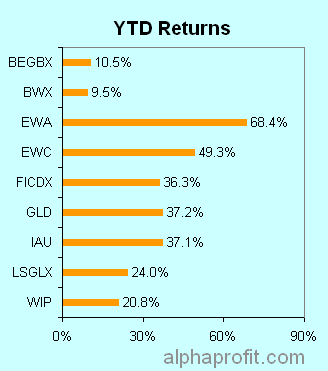
Investors are increasingly betting that the Federal Reserve is likely to flounder. Even though current inflation data are not a cause for concern, gold has been on a tear rising nearly 38% since the start of 2009. Washington’s measures have taken a toll on the U. S. dollar. The U. S. dollar index is down nearly 9% since the turn of the year.

Buy Gold: GLD and IAU

The Fed is caught between Scylla and Charybdis

One obvious way is to invest in gold by buying shares of SPDR Gold (GLD) or iShares COMEX Gold Trust (IAU). Despite being right with my call for gold breaking through the $1,000 an ounce mark in ‘Commodity Trading Strategies: Profiting from Gold and Natural Gas‘, I believe there are better ways to hedge against potential Federal Reserve follies.

Gold has risen strongly in recent trading sessions and the entry point is far from ideal. Furthermore, gold’s upside potential can be limited if the U. S. economy cooperates and makes the Fed’s job easier.

Better ways to hedge include investing in foreign bonds and selected foreign stocks. Unlike gold, these investments offer the possibility of paying off well even if the Fed gets its timing right in withdrawing measures used to fight the deep recession.

Buy Foreign Bond Funds and ETFs: LSGLX and BEGBX

FICDX, LSGLX, BEGBX, IAU ETF, and GLD ETF returns

Foreign bonds offer the benefits of providing foreign currency exposure, geographic diversification, current income, and potential for capital gains. Most individual investors are however not equipped to analyze individual foreign bonds. Foreign bond funds like Loomis Sayles Global Bond (LSGLX) and American Century International Bond (BEGBX) and ETFs like SPDR Barclays International Treasury Bond (BWX) and SPDR DB International Government Inflation-Protected Bond (WIP) are a good way to go here.

Foreign bond funds and ETFs are typically less volatile than gold and the current income they generate can come in handy in limiting damage if the Fed gets the timing right and the U. S. dollar rallies against foreign currencies.

Buy Selected Foreign Stocks Funds and ETFs: FICDX and EWA

You can profit from a decline in the U. S. dollar by investing a portion of your portfolio in well-managed, natural resource economies like Australia and Canada. Natural resources like oil and base metals are priced in U. S. dollars and often rise in price when the dollar declines. Natural resource producers can also benefit from the demand for raw materials needed to support growth in China and India.

iShares Australia ETF (EWA), iShares Canada ETF (EWC) and Fidelity Canada Fund (FICDX) are ETFs and mutual funds that focus on Australia and Canada. Such investments provide foreign country exposure and geographic diversification. They also offer the possibility of substantial capital gains from their indirect emerging market exposure.

So, think beyond gold as you seek ways to protect yourself from the Fed’s policies. Foreign bonds and stocks in selected natural resource economies certainly merit consideration.

ETF Holdings, Performance, and Risk: Will Your ETF Be Next to Blow Up?

While cost and transparency advantages provided by exchange-traded funds (ETFs) get a lot of attention, the relatively high degree of company-concentration risk embedded in certain ETFs does not.

Certain ETFs that focus on narrower segments of the global market like specific countries, sectors, or industries use market capitalization-weighted indexes to select and weight stocks. This exposes these ETFs to a high degree of company-concentration risk.

Take a look at some iShares ETFs that have a meaningful chunk of their assets in their top holding:

iShares ETF Name (Ticker)

Top Holding

% ETF Invested

iShares DJ US Energy ETF (IYE)

Exxon Mobil

25.2%

iShares MSCI Belgium ETF (EWK)

Anheuser-Busch InBev

24.8%

iShares MSCI Spain ETF (EWP)

Banco Santander

23.8%

iShares MSCI Mexico ETF (EWW)

America Movil

23.1%

iShares DJ US Oil Services ETF (IEZ)

Schlumberger

22.3%

iShares MSCI Israel ETF (EIS)

Teva Pharmaceutical

21.6%

iShares MSCI Switzerland ETF (EWL)

Nestle

19.1%

iShares Peru ETF (EPU)

CDM Buenaventura

18.7%

iShares DJ US Telecom ETF (IYZ)

AT&T

18.6%

iShares MSCI South Korea ETF (EWY)

Samsung Electronics

18.0%

Source: iShares.com

ETF Performance: Why is company-concentration risk important?

In the past year alone, we have seen the demise or near demise of titans like American International Group (AIG), General Motors, and Lehman Brothers (LEHMQ.PK). Shareholders who have held on these shares have seen their entire investment evaporate in a trice.

Looking over a longer time-frame, shares of Pfizer (PFE) and Microsoft (MSFT) have been on a secular decline for nearly a decade as earnings growth has slowed or proved elusive. Pfizer and Microsoft shares are now down over 60% and 50% from their 1999 highs.

These anecdotes highlight that even large companies are not immune to company-specific risks. The underlying factors for such risks can range from management hubris to rising competition to changing industry landscape.

As such, an ETF that concentrates a high portion of its assets in the top holding exposes its investors to company-concentration risk.

So, what do you do if you own one of these iShares ETFs?

There is no need to panic and sell.

ETFs that have a high degree of company-concentration risk are in general aggressive ETFs such as country ETFs or sector ETFs. So, just make sure your overall portfolio is appropriately diversified so that it will not blow up even if a specific ETF does.

Best ETFs to Build Your ETF Portfolio

‘Don’t put all your eggs in one basket’.

This is commonly believed to be a sound investing maxim. Why?

Because diversification helps investors to lower risk and to stay on course towards their goals without being derailed by market sell-offs.

So, how does one build a diversified portfolio?

Investors can build a diversified portfolio by bringing together assets that do not move in tandem. Diversified portfolios to suit different investment objectives, risk tolerances, and investment time horizons can be constructed by using low-cost, broadly diversified exchange-traded funds (ETFs) in each asset class.

Here are the best ETFs in key asset classes that can help in building diversified portfolios to meet most investment objectives.

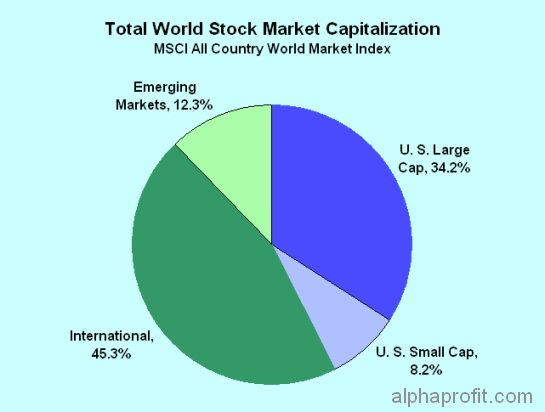
Exchange-Traded-Funds-Best-ETFs-to-Build-Your-ETF-Portfolio

1. Large Cap ETF

With U. S. being the world’s largest economy, large cap stocks here are a ‘de facto’ core holding for most investors. The S&P 500 index is a commonly used benchmark for large cap U. S. stocks.

Best large cap ETF: SPDR S&P 500 ETF (SPY)

2. Small Cap ETF

Offering higher growth prospects and carrying higher risk, small cap stocks often behave differently from large cap stocks. Ibbottson & Associates show long-term annual returns from small cap stocks exceed those from large caps by over 2.2%.

Best Small Cap ETF: iShares Russell 2000 Index ETF (IWM)

3. International ETF

Investments in developed economies of Europe, Australasia, and the Far East can deliver stronger returns even when the U. S. market is lacking luster. Such investments also offer investors the opportunity to profit from a declining U. S. dollar.

Best International ETF: iShares MSCI EAFE Index ETF (EFA)

4. Emerging Markets ETF

Although relatively small in stock market capitalization, emerging economies particularly in Asia and Latin America are major contributors to global economic growth. Emerging market investments offer potential for higher returns while being highly volatile.

Best Emerging Markets ETF: iShares MSCI Emerging Markets ETF (EEM)

5. Bond ETF

Bond investments are often less volatile than stock investments. High quality bonds can provide stability to portfolios during difficult economic times and lower portfolio risk.

Best Bond ETF: iShares Barclays Aggregate Bond ETF (AGG)

6. REIT ETF

Even though the 2008 credit crisis has tarnished the investment appeal of real estate investment trusts (REITs), they make sense in most portfolios. REITs provide worthwhile current income and diversification.

Best REIT ETF: Vanguard REIT ETF (VNQ)

7. Commodity ETF

Investments in commodities help investors preserve purchasing power. Investors can either invest in a broad commodity basket or in a specific commodity like gold favored as a safe-haven and inflation hedge.

Best Commodity ETFs: PowerShares DB Commodity Index Tracking Fund (DBC) and SPDR Gold Shares (GLD)

8. Money Market Fund

It often makes sense to have a portion of one’s portfolio in cash-equivalents such as money market funds. The cash cushion not only stabilizes the portfolio against rough weather but also helps to take advantage of market declines.

Key Points

Investors can meet different investment objectives by appropriately allocating monies to the best ETFs in different asset classes. Investors need to periodically re-balance the ETF portfolio to ensure asset allocations are consistent with their current financial situation.

Fidelity Sector Funds

Maximize Your Returns and Minimize Risksfidelity-sector-funds-model-portfolios

Fidelity sector funds can be volatile investment vehicles particularly when viewed in isolation. However, AlphaProfit can help you achieve extraordinary returns by exploiting the return potential of Fidelity sector funds while lowering your risk.

AlphaProfit helps you maximize your returns from Fidelity sector funds while minimizing your risks.

How do we do it?

We maximize your reward and minimize your risk by taking a portfolio approach to investing with sector funds.

Using Fidelity Sector funds, we construct two actionable model portfolios for you to use:

AlphaProfit Fidelity Core Portfolio

AlphaProfit Core is a diversified portfolio constructed using Fidelity sector funds. The Core model portfolio takes a targeted approach to diversification by including a set of industry groups that are expected to outperform the broad equity market.

AlphaProfit Fidelity Focus Portfolio

AlphaProfit Focus is a concentrated portfolio constructed using Fidelity sector funds. The Focus model portfolio pursues aggressive growth by typically including 2 to 4 Fidelity sector funds.

Fidelity Sector Funds with High Expected Sector-Specific Returns Maximizes Your Reward

Stock prices of companies within a sector or industry move together due to causal factors. Examples of such causal factors include:

  • Business cycle dynamics
  • Key sector or industry earnings’ driver trend
  • Demographic or consumer demand changes
  • New technology or product introduction
  • Government policies or regulatory changes
  • International events

Since sector funds focus their investments within a specific sector or industry, their returns are strongly dependent on the impact of sector-specific factors. AlphaProfit maximizes your return by selecting Fidelity sector funds that have high expected sector-specific returns.

In Capital Asset Pricing Model or CAPM terms, we seek Fidelity sector funds with high expected values of future CAPM Alpha. We use the ValuM™ Investment Process to analyze and identify Fidelity sector funds for inclusion in our model portfolios.

Choosing a Group of Fidelity Sector Funds to Minimizes Your Risk

Sector funds concentrate their investments in a specific sector of the economy while diversifying the fund’s assets within that sector. The causal factors that drive sector-specific returns lead to sector-specific risks. We endeavor to diversify sector-specific risks by choosing a group of Fidelity Sector funds.

iShares ETF and iShares Trusts from Barclays

A Sector Investing Perspective

The iShares family includes several sector and industry-group specific iShares exchange-traded funds (ETFs) as well as commodity-oriented iShares trusts. The sector and industry-group specific iShares ETFs are registered as iShares, Inc. under the 1940 Investment Company Act. The commodity-oriented iShares Trusts are investment vehicles designed to track the price movements of certain commodities. The iShares Trusts are neither an investment company registered under the 1940 Investment Company Act nor a commodity pool as defined by the Commodity Exchange Act.

Breadth of Sector iShares

The iShares family includes 40 sector and industry-group iShares ETFs. Three commodity-oriented iShares Trusts are also offered.

Investment Approach

iShares ETFs take an index or ‘passive’ approach to investing. All of the sector and industry-group iShares seek to track the returns of their target index less any fees and expenses. Of the 40 sector and industry-group iShares, 22 track Dow Jones indexes and 11 track S&P Global indexes.

The objective of the commodity-related iShares is to track price movements of the underlying commodity. The iShares COMEX Gold Trust seeks to track the price of gold. The settlement price for the spot month gold contract on the COMEX is used as the basis. The iShares Silver Trust seeks to track the price of silver as determined by the London Fix. The iShares S&P GSCI Commodity-Indexed Trust seeks to match the performance of the S&P GSCI Total Return Index, a world-production weighted benchmark of commodity prices.

Expense Ratio

Most sector and industry-group iShares have an expense ratio of 0.48%. The iShares COMEX Gold Trust has a 0.40% expense ratio whereas the iShares Silver Trust has a 0.50% expense ratio. The iShares S&P GSCI Commodity-Indexed Trust carries a 0.75% expense ratio.

Trading Size

iShares ETFs and Trusts may be purchased in ’round lots’ of 100 shares or smaller with the minimum number being one share.

AlphaProfit Take

Backed by one of United Kingdom’s largest financial services groups Barclays Bank PLC, iShares are a force in the world of ETFs.

Relatively wide selections of sector and industry-group ETFs are available as iShares. Coming in two flavors, iShares ETFs that track Dow Jones indexes consist of U. S. companies while iShares ETFs that track S&P Global indexes include companies domiciled abroad as well. Investors looking for global sector exposure as well as industry-group exposure will want to take a closer look at iShares offerings. The liquidity of sector and industry-specific iShares varies case-by-case. As such, bid-ask spread for certain iShares may be somewhat wide.

The iShares COMEX Gold Trust and iShares Silver Trust are convenient investment vehicles that allow investors to profit from moves in the price of gold and silver bullion without venturing into the spot or futures markets. iShares S&P GSCI Commodity-Indexed Trust offers a play on commodities in general with prices in the energy complex being the key underlying driver. The iShares Trusts are however not a substitute for owning commodities.

AlphaProfit Newsletter and iShares ETF Recommendations

AlphaProfit Sector Investors’ Newsletter is the premier resource for sector investors. The Newsletter offers iShares exchange traded fund recommendations. The Newsletter and its model portfolios have frequently been ranked #1 by Hulbert Financial Digest.

About AlphaProfit MoneyMatters

AlphaProfit MoneyMatters is a free e-letter distributed to registered users of AlphaProfit’s website. The e-letter analyzes the economy, markets, and sectors and provides money-making insights on stocks, exchange-traded funds, and mutual funds. AlphaProfit MoneyMatters is edited by Dr. Sam Subramanian acclaimed for his financial acumen and analytical skills. Sign Up for ETF Newsletter.

Using Sector Funds to Construct Diversified Mutual Fund Portfolios

High-potential diversified portfolios can be constructed by dividing assets among a group of sector funds. This approach gives the investor flexibility to over-weight or under-weight certain sectors versus broadly diversified indexes.

Sector funds are too risky.’ ‘I doubled my money with Fidelity Select Technology in 12 months!’ ‘Avoid sector funds.’ If all of this sounds confusing, you are not alone. Sector funds are among the more misused and misunderstood investments. So, how should you use sector funds?

Before looking at one of the uses of sector funds in detail, let’s review what sector funds really are: Sector funds confine their investments to a particular sector of the economy. Fidelity Select Healthcare (NDQ: FSPHX) is an example of a sector fund. By focusing on stocks of companies in the healthcare sector, the price moves of this fund are more dependent on factors that impact the healthcare sector rather than the economy as a whole. Demographic change, such as increasing age of the population, is an example of a factor that particularly drives investments in healthcare. By diversifying its assets across over 60 companies within the healthcare sector, Fidelity Select Healthcare provides investors with the opportunity to benefit from secular trends driving the demand for healthcare while mitigating company-specific risks such as failure of clinical trials conducted by a particular company.

Let’s now look at a high-potential approach of using sector funds.

Using sector funds to create a diversified mutual fund portfolio

By allocating assets across a group of sector funds, investors can effectively create a diversified mutual fund portfolio using sector funds. This approach gives the investor flexibility to over-weight or under-weight certain sectors versus broadly diversified indexes such as the S&P 500®.

To implement this active approach to money management, it helps to have a diverse group of sector funds to choose from. Fidelity Investments manages 41 sector funds under the Fidelity Select Portfolios® umbrella which makes this family of sector funds well-suited for this purpose. By dividing assets across, say, 8 sector funds in the Fidelity Select Portfolios, e.g., Fidelity Select Biotechnology (NDQ: FBIOX), Fidelity Select Computers (NDQ: FDCPX), Fidelity Select Energy Service (NDQ: FSESX), Fidelity Select Home Finance (NDQ: FSVLX), Fidelity Select Medical Delivery (NDQ: FSHCX), Fidelity Select Multimedia (NDQ: FBMPX), Fidelity Select Retailing (NDQ: FSRPX), and Fidelity Select Wireless (NDQ: FWRLX), one can build a customized diversified portfolio. With each of the sector fund managers actively scouting for the best investment ideas within their sectors, this cluster of Fidelity Select Portfolios packs a lot of power into your diversified portfolio.

Other mutual fund families that provide a relatively wide choice of sector funds include ProFunds and Rydex Funds. Exchange traded sector funds such as Select Sector SPDRs, iShares, and Sector HOLDRS, that trade on the American Stock Exchange, can also be used to construct diversified sector fund portfolios.

The wide selection of sector funds available provides you with the ability to take advantage of changing market conditions and continually optimize the risk-reward characteristics of your diversified portfolio. To employ this approach effectively, you need to understand and follow the dynamics of the individual sectors. You must also be able to make informed decisions on sectors to select and sectors to avoid. At the end of the day, you should be right more often than wrong with the sectors you select.

AlphaProfit.com’s research suggests that by constructing diversified mutual fund portfolios using sector funds, investors have the potential to outperform the market averages on the basis of relative returns as well as risk-adjusted returns. The track-record of AlphaProfit’s model portfolios indicates the potential of this approach.

A Caveat

Diversification is one of the cornerstone principles of mutual fund investing. Sector funds that focus on high-growth sectors or narrow niches of the economy tend to be volatile. It is generally not advisable to commit a substantial portion of your total assets to a single sector fund. Maintaining adequate diversification across sectors in your overall mutual fund portfolio is good investing practice.

Key Points to Remember

1. Sector funds are investment vehicles that focus their investments on a particular sector or industry group. Sector funds provide investors with an opportunity to profit from trends impacting a particular sector or industry while reducing company-specific risks.
2. High-potential diversified portfolios can be constructed by dividing assets among a group of sector funds. This active investment approach requires investors to make informed decisions on sector selection. The power-packed cluster of sector funds may offer investors the potential to outperform the market averages.
3. Diversifying mutual fund portfolios across sectors is good investing practice.

Why Fidelity Mutual Funds

Fidelity Investments offers sector funds under the Fidelity Select fund umbrella. We prefer these Fidelity sector funds for the following reasons:

Fidelity Sector Fund Choices

After pioneering the sector investing concept in 1981, Fidelity Investments has expanded the Fidelity Select funds to span 7 sector groups. Each sector group has one broad sector fund and several industry-specific funds. In all, we have 41 Fidelity Select Funds to choose from.

Active Management of Mutual Funds

Rather than track sector-specific indexes, Fidelity sector fund managers actively seek to invest their fund’s assets in the best ideas within their universe. Fidelity Investments employs a staff of over 600 portfolio managers, analysts, and traders world-wide to conduct research and develop investment ideas for managing the Fidelity mutual funds.

Multiple Account Types

Fidelity sector funds are available for regular and retirement accounts. The retirement account may be a Fidelity IRA account such as Roth IRA, Rollover IRA or self directed IRA account. Fidelity sector funds are available for Fidelity SEP-IRA or Fidelity Keogh accounts as well. Fidelity sector funds may also be available in a Fidelity 401k account if your employer sponsored 401k plan has this option. Fidelity 401k investments can be conveniently managed using Fidelity Netbenefits.

Low Minimum Investment

The minimum investment required to open a regular or IRA account in any Fidelity Select fund is $2,500. The minimum investment required to open a SEP-IRA or Keogh account in any Fidelity Select fund is $500.

Low Costs

Fidelity mutual funds are no-load funds. Further, for the Fidelity sector funds there are no fees for exchanges done through the Internet when the investment is held over 30 days. This works to our advantage since our holding duration for sector fund investments is typically 6 months or longer. (Note: The Fidelity Select fund prospectus provides a description of the fees & expenses associated with these funds. Read the fund prospectus carefully before investing.)

Sector Investing: Sector Funds and Sector Rotation

Sector investing harnesses the potential of sector funds through sector rotation to create wealth.

Sector funds focus their equity investments within a specific sector or industry of the economy. Stock prices of companies within a sector or industry move together due to causal factors. Examples of such factors include introduction of new technologies or products, changes in consumer demand or demographics, or increase in merger & acquisition activity.

Impacted by above-mentioned factors, the share price performance of a sector or industry can be markedly different from that of a broad index like the S&P 500. Sector returns highlighted in yellow indicate those of the year’s best Fidelity Select Fund picked by AlphaProfit’s prescient ValuM investment process for inclusion in the sector model portfolios.

YearBrokerageGoldOil & Gas E&PTechnologyUtilitiesS&P 500
2006 21.3% 25.4%  5.2%   7.5% 30.1% 15.8%
2002-17.2% 64.3% -9.6% -37.8%-30.4%-23.4%
2000 28.3%-18.3%71.0% -31.8%-13.6%-10.1%
1999 30.6%   8.4%26.2%132.4% 26.5% 19.5%
1997 62.3%-39.4% -8.1%  10.2% 30.3% 31.0%

Returns of Fidelity Select Funds that invest in the above listed sectors or industries are used as measure of the sector’s or industries’ share price performance.

The ValuM process enables subscribers to add value to their accounts in both bull and bear markets.

  • 1999 bull market: 132.4% gain from technology (FSPTX) far outpaces the S&P 500’s 19.5% advance
  • 2002 bear market: 64.3% gain from gold (FSAGX) bucks the S&P 500’s 23.4% loss

Harnessing Sector Investing through Sector Rotation

Given the wide variation in returns of individual sectors, one needs to invest in the right sectors at the right time to harness the potential of sector investing.

Sector rotation is an investment process where the investor seeks to increase returns by opportunistically switching from one sector to another, thereby earning returns in excess of those earned by buy-and-hold investors.

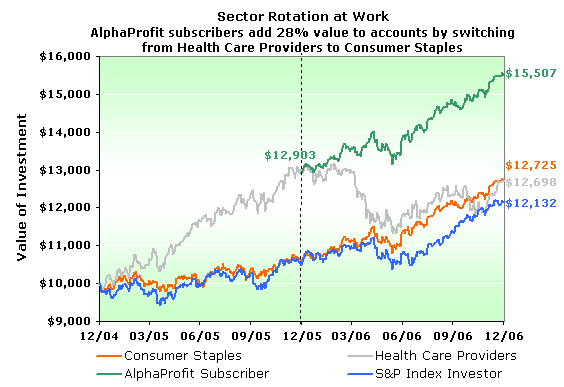
The chart below illustrates how AlphaProfit subscribers enhanced their return by 28% by switching from Health Care Providers (FSHCX) to Consumer Staples (FDFAX).SectorRotationAtWork

Timely sector rotation increased the value of investment accounts starting at $10,000 to $15,507, nearly $2,800 more than buy-and-hold investors staying either in Health Care Providers, Consumer Staples, or the S&P 500 index fund.

Prudent sector rotation offers significant potential to grow wealth over time. As shown above, an index investor adds wealth at a 10.2% annual rate during the two-year period. In comparison, an AlphaProfit subscriber adds wealth at a 24.5% annual rate. Assuming the AlphaProfit subscriber and index investor add wealth at 24.5% and 10.2% annual rates, respectively for another three years, their accounts starting at $10,000 will be worth $29,938 and $16,228, respectively. In other words, AlphaProfit subscriber adds $13,710 or 137% in value.

Investing in Sector Funds

Mutual funds as well as exchange-traded products like ETFs are available for investing in sectors. Investors can use these sector focused investment products in different ways:

  1. Use sector funds to construct diversified portfolios. Sector funds are attractive investment vehicles that can be used to construct diversified portfolios to deliver superior returns. This principle is exemplified by the AlphaProfit Core Portfolio.
  2. Include sector funds as return enhancers of diversified portfolios. The reward potential of sector funds lends them to be used as ‘return enhancers’ of portfolios that are already adequately diversified. The AlphaProfit Focus Portfolio illustrates this potential of sector funds.
  3. Profit from opportunistically investing in sector funds. From time-to-time, the market may create attractive opportunities to profit by investing in sector funds. AlphaProfit assigns ‘Favored Buy’ ratings on sectors to highlight such sector investing opportunities.

By prescient sector selection and prudent sector rotation, AlphaProfit enables subscribers to harness the reward potential of sector funds.

Exchange Traded Funds – ETF Investing – ETFs vs Mutual Funds

Exchange traded funds or ETFs are investment vehicles that combine some investment attributes of mutual funds with those of stocks. Like mutual funds, exchange traded funds are a basket of securities generally designed to track an index. The index may be a stock, sector, or bond index. Some exchange traded funds track commodity prices as well. Like stocks, exchange traded funds trade on a stock exchange.

Issuers of Exchange Traded Funds

Exchange traded funds are issued by leading financial institutions under various names. Examples include:

Sponsor or IssuerExchange Traded Fund Family
Barclays Global InvestorsiShares
PowerShares Capital *PowerShares
ProShare AdvisorsProShares
State Street Bank & TrustSPDR and streetTRACKS
Vanguard GroupVanguard

Merrill Lynch sponsors exchange traded entities called HOLDRs. HOLDRs or Holding Company Depositary Receipts represent beneficial ownership of a specified group of stocks.

Types and Examples of Exchange Traded Funds

Like mutual funds, a wide array of exchange traded funds is available. Exchange traded funds are commonly classified by asset class, investment style, and market capitalization of securities invested.

  • Asset Class: Equities, Fixed Income, Commodities, or Hybrid
  • Investment Style: Growth, Value, or Blend (or Core)
  • Market Cap: Large Cap, Mid Cap, Small Cap, or Multi Cap

Exchange traded funds may also be classified based on the sector or industry group the assets are invested in.

Health Care SPDR that trades under ticker symbol XLV is an example of a sector exchange traded fund. iShares NASDAQ Biotechnology that trades under ticker symbol IBB is an example of an industry group-focused exchange traded fund.

Additionally, exchange traded funds can also be classified based on the country or geographic region the assets are invested in.

Trading Flexibility of Exchange Traded Funds

Exchange traded funds trade like stocks and offer trading flexibility. Exchange traded funds are priced continuously during trading hours and can be traded at intraday market prices. Exchange traded funds can also be traded using stop or limit orders. Additionally, exchange traded funds can be purchased using margin and sold short.

Costs Involved in ETF Investing

There are three types of costs involved in the trading exchange traded funds:

  • Brokerage commissions: Investors typically incur brokerage commissions to buy or sell exchange traded funds.
  • Bid-Ask spread: As with stocks, the ask price represents the lowest price an investor can buy shares of the exchange traded fund at. The bid price represents the highest price an investor can realize when selling shares of the exchange traded fund.

The bid-ask spread is the amount by which the ask price exceeds the bid price. The liquidity of the exchange traded fund is a key factor that determines the magnitude of the bid-ask spread. The higher the liquidity of the exchange traded fund, the lower the bid-ask spread.

  • Administrative expenses: The sponsor or the issuing company usually charges a fee for managing the exchange traded fund. The annual expense ratio for exchange traded funds is generally lower those of other investment products.

Additionally, investors selling exchange traded fund shares in non-qualified accounts may realize capital gains or losses.

Suitability of Exchange Traded Funds

In assessing the suitability of exchange traded funds, prudent investors will want to look beyond the expense ratio and compare the total cost of owning an exchange traded fund with the total cost of owning a no load mutual fund.

In certain cases, brokerage commissions and the bid-ask spread may more than offset the exchange traded fund’s advantage of a lower expense ratio. In such cases, no load mutual funds may be a less expensive option.

Generally speaking, exchange traded funds are attractive vehicles for investors who invest large sums of money and trade infrequently. No load mutual funds may be a better option for investors who invest relatively small sums of money or investors who dollar cost average.

AlphaProfit ETF Newsletter and ETF Recommendations

AlphaProfit Sector Investors’ Newsletter is the premier resource for sector investors. The Newsletter offers exchange traded fund recommendations. The Newsletter and its model portfolios have frequently been ranked #1 by Hulbert Financial Digest.

About AlphaProfit MoneyMatters

AlphaProfit MoneyMatters is a free e-letter distributed to registered users of AlphaProfit’s website. The e-letter analyzes the economy, markets, and sectors and provides money-making insights on stocks, exchange-traded funds, and mutual funds. AlphaProfit MoneyMatters is edited by Dr. Sam Subramanian acclaimed for his financial acumen and analytical skills. Sign Up for ETF Newsletter.