Contrarian Investors: Best Stock Investment

Education Services and Online Colleges

With the S&P 500 up 79% from the March 2009 bottom, one strategy to score home runs is to follow contrarian investors and look for best stocks in beaten down or out-of-favor sectors.

In the first part of this two-part article, I outlined two ideas for contrarian investors: Medical devices with Medtronic (MDT) as the top stock pick and Natural gas with iPath DJ-UBS Natural Gas ETN (GAZ) as the top pick.

Here is my third and best idea for contrarian investors: Education Services and Online Colleges.

Education Stocks Hammered on Regulatory Fears

After benefiting from rising job losses during the Great Recession, things have changed for the worse for education services companies this year. Low student loan repayment rates have caught regulatory attention.

The U. S. Department of Education believes education services companies and online colleges have misled students on employment prospects after graduation by misrepresenting the value of programs.
Contrarian investors can find plenty of education stocks for investing.

Contrarian investors will find shares of education services providers & online colleges in general and Apollo Group in particular worthy of consideration.

In mid-August, the Education Department released loan repayment data at leading education services providers that show companies like Corinthian Colleges (COCO), Strayer Education (STRA), and Washington Post’s (WPO) Kaplan Unit particularly in poor light.

The Education Department has proposed that schools with less than 35% student loan repayment rate should become ineligible for federal government-issued student loans. A slate of rule changes have been proposed too relating to recruiting and marketing practices of educational service providers and online colleges.

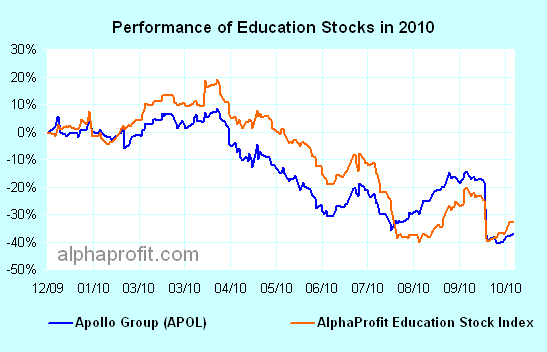
While education services stocks have been sliding since the second quarter, recent forecasts from Apollo Group (APOL) and Capella Education (CPLA) for a significant drop in enrollment for their degree programs in 2011 have delivered a one-two punch. AlphaProfit’s equal-weighted education service index is down 33% year-to-date.

Education Services and Online Colleges, an Opportunity for Contrarian Investors

Stocks in the education services group have been left out of the post-Great Recession rally. Such stocks trade below their March 2009 lows. In fact, AlphaProfit’s education service index is 25% lower than its March 9 value.
The ‘negativity’ gripping education services has pushed valuation metrics of such stocks well below historical levels. The recovery potential in education services stocks may be abnormally large if you believe such companies play an important role in higher education as job requirements change and necessitate re-training.

Top Education Stock Investment for Contrarian Investors: Apollo Group (APOL)

Apollo Group has certain attributes that make it my top contrarian stock.

Wide economic moat: Apollo is the nation’s largest private university with an enrollment of over 475,000. The company’s University of Phoenix unit is the country’s largest online education provider. Competing against higher cost traditional schools with scale and efficiency, Apollo enjoys a wide economic moat.
Superior regulatory risk profile: At 44%, Apollo’s debt repayment rate is above the 35% minimum proposed by the Education Department for federal funding eligibility. Apollo is also requiring all prospective students with less than 24 credit hours to take a free, three-week orientation course to improve retention.

Serving right markets: Departing from the past practice of focusing on short-term associate programs, Apollo is now emphasizing less-cyclical advanced degree programs. This move can prove timely if the economy continues to improve.

Targeted growth strategies: Apollo is uniquely well-positioned to expand its programs globally through its joint venture with The Carlyle Group.

Risks of Investing in Apollo as Contrarian Investment

Apollo shares currently trade at about 8.7 times analysts’ EPS forecast for the fiscal year ending in August 2011. The alluring upside in Apollo shares can become reality if the company can get back on a growth trajectory at some point.

Year 2011 is likely to be transition year for Apollo as the company rolls out its orientation program and implements a new plan for enrollment advisor compensation. While these steps can result in steadier growth down the road, they could pressure enrollment and margins in the near-term. Then, there is some possibility that the Securities and Exchange Commission’s informal inquiry into Apollo’s revenue-recognition practices can balloon into a full investigation.

As such, plunking in a lump-sum would be unwise. Prudent contrarian investors would be better off buying Apollo shares in incremental steps spread out well over time as long as the fundamentals merit. This can help mitigate downside while positioning for a likely upswing in Apollo shares.

In AlphaProfit’s Premium Service, we look to recommend Apollo shares with specific entry and exit points at the appropriate time.

How to Invest in the Stock Market: Protecting Yourself from Federal Reserve Quantitative Easing

Comments on Federal Reserve’s policy made by Chairman Ben Bernanke at Jackson Hole, WY on August 27 have recently had a major influence on the course of stock and commodity prices.

Bernanke acknowledged high unemployment levels, slow growth, and tight credit availability are restraining growth in household spending. He added that the Federal Reserve would engage in another phase of large-scale asset purchases to lower interest rates and stimulate growth, a process economists dub quantitative easing.

While the Federal Reserve’s policy statement has helped to dampen fears over the U. S. slipping into another recession, fears of inflation have risen considerably.

Market Reaction to Federal Reserve Quantitative Easing Phase 2

The U. S. dollar has slid against most major currencies setting an all-time low against the Swiss franc. Gold has set a new all-time high and silver has risen to a 30-year high.Market Reaction to Federal Reserve Quantitative Easing Phase 2.

In the fixed income market, the price of the intermediate-term 10-year treasury has gained on expectation that the Federal Reserve will be a big buyer whereas the threat of inflation has caused the price of the long-term 30-year treasury to decline.

Price Changes since Federal Reserve outlined
Quantitative Easing Phase 2 on August 27, 2010

Asset

ETF Name

ETF Ticker

Since 8/27

U. S. Dollar

PowerShares DB US Dollar Bullish ETF

UUP

   -7%

Gold

SPDR Gold Shares ETF

GLD

+11%

Silver

iShares Silver Trust ETF

SLV

+28%

Intermediate-term Treasury

iShares Barclays 7-10 Yr Treasury ETF

IEF

   +2%

Long-term Treasury

iShares 20+ Year Treasury Bond ETF

TLT

   -3%

Large-cap Stocks

SPDR S&P 500 ETF

SPY

+12%

Developed market stocks

iShares MSCI EAFE ETF

EFA

+14%

Emerging market stocks

iShares MSCI Emerging Markets ETF

EEM

+15%

Corporations and private-equity firms are taking advantage of low interest rates to lower their cost of capital and acquire businesses. According to Bloomberg, U. S. companies issued over $160 billion in corporate bonds in September, the second-busiest month on record. American Express (AXP), General Electric (GE), Hewlett-Packard (HPQ), and Microsoft (MSFT) were among the larger debt issuers.

M&A activity is on the rise with hostile pursuits having their share. Intel (INTC) is buying McAfee (MFE) for $8 billion while private equity firm 3G Capital is buying Burger King (BKC) for over $3 billion. BHP Billiton (BHP) & Potash Corp (POT) and Sanofi-Aventis (SNY) & Genzyme (GENZ) are engaged in hostilities.

Rising deal activity and receding recession fears have spurred stock prices. The S&P 500 has rallied 11% since August 27 and is within 3% of 2010’s high. The backdrop of a falling greenback has boosted returns on foreign stocks.

Will Federal Reserve’s Quantitative Easing Reduce Unemployment?

Last Friday, Bernanke appeared to set the stage for announcing specific asset purchase plans after the next Federal Reserve meeting ends on November 3. Bernanke stated that high unemployment poses a great threat to the economy. Downplaying the price stability imperative, he said the central bank must weigh deflation risk rather than maintain its traditional concern on inflation.

I have my doubts if quantitative easing is likely to help in reducing unemployment. Through the Phase 1 part of quantitative easing, the Federal Reserve purchased nearly $2 trillion in assets over the last two years. While these purchases have lowered market interest rates and helped to stabilize the economy, they have not helped to generate many jobs. Furthermore, the recent acceleration in corporate takeovers could lead to more layoffs down the road rather than create jobs.

How Should You Invest in this Stock Market?

It remains to be seen if the Federal Reserve will pursue phase 2 of quantitative easing. If it does, the central bank has to get the stimulus magnitude and pace of asset purchases right. As upticks in the price of gold and long-term bond yields already suggest, too much stimulus would result in rising inflation expectations, an undesirable consequence.

To stay ahead of the curve in this uncertain environment, you need to emphasize safety by holding adequate cash, diversifying in the right mix of assets, and owing the right types of stocks.

Hold cash: Even though short-term instruments yield close to zero, cash is a ‘must-have’ for most investors in this environment. It will help you reduce downside risk and exploit market volatility.

Have right asset mix: Owning assets like international stocks and commodities in modest amounts as part of a diversified portfolio can help offset the negative impact of a declining dollar and rising inflation. Given that commodities and to a lesser extent international stocks are up quite a bit recently, waiting for a pullback or buying such assets in incremental amounts over time would be sensible.

Own right stocks: With the U. S. economy needing stimulus to continue growing, ‘conservative investing’ should be the order of the day for most investors. You can minimize downside risk by emphasizing quality and valuation. Even if a bearish phase ensues and stocks sell off, quality stocks trading at modest valuations stand a better chance of regaining lost ground and returning to the black. If you are in the fortunate situation of owning stocks that have gone up a lot, here is a good ‘house keeping’ opportunity for you to weed out the low quality ones.

Contrarian Investing – Two Top Stocks for Contrarian Investors

Certain industries or groups, at times, get hit hard providing venturesome contrarian investors opportunities to earn outsized profits. Contrary investors with the courage and conviction to get into automotive and retailing shares at the depth of the Great Recession have made it out like a bandit.

Fidelity Select Automotive Fund (FSAVX) and SPDR S&P Retail ETF (XRT) are up 305% and 189%, respectively from their 2009 lows, while selected stocks in these groups like Ford (F) and Saks (SKS) are up 699% and 449%, respectively.

In this two-part article, I present three contrarian investment ideas in the current market.

Contrarian Investing Pick #3: Medical Device Stocks
Top Medical Device Stock for Contrarian Investors: Medtronic (MDT)

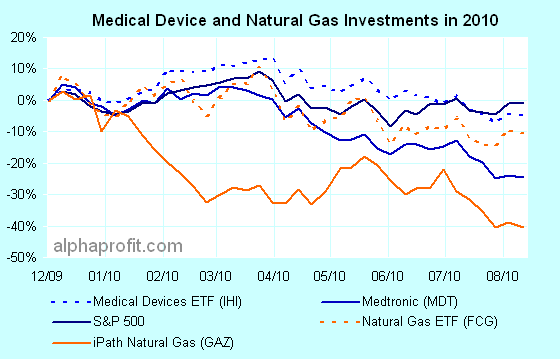
Medical device stocks are among the weaker performers this year. iShares Dow Jones US Medical Devices ETF (IHI) and Fidelity Select Medical Equip & Systems Fund (FSMEX) are both down 3% and 5%, respectively.

Contrarian investors can find plenty of medical device and natural gas stocks for investing.

Contrarian Investing: With strong recovery potential, medical devices and natural gas represent two groups where contrarian investors can find plenty of stocks getting primed for profits. Medtronic (MDT) and iPath DJ-UBS Natural Gas ETN (GAZ) are my favorites.

Business conditions for medical device makers have not been robust. High unemployment and rising insurance costs have caused patients to cut down on doctor’s visits. Leading medical device companies Medtronic (MDT) and Stryker (SYK) are reporting a slowdown in sales. Product safety-related recalls have weighed on shares of Boston Scientific (BSX). Price competition in the medical device business has heightened at a time when hospitals are implementing cost-reduction strategies.

If you believe patients cannot postpone the usage of medical devices forever and will return to the doctor, you can find plenty of opportunities in this space. Among the opportunities, industry heavyweight Medtronic trading at nearly 9-times next year’s earnings and yielding just under 3% stands out in my view.

Historically, Medtronic has been adept at coming up with market-dominating products that have enabled the company to maintain profit margins in excess of 20%. With $16 billion in annual revenue and $2.6 billion in free cash flow, Medtronic has the means to execute its strategy and grow its businesses by investing in research, developing new products, and making targeted acquisitions.

Contrarian Investing Pick #2: Natural Gas Stocks
Top Natural Gas Stock for Contrarian Investors: iPath DJ-UBS Natural Gas ETN (GAZ)

Combination of slack industrial demand and rising production from shale formations has caused a glut in domestic natural gas supplies. The U. S. Energy Information Administration recently reported total natural gas storage of 3.1 trillion cubic feet (Tcf), nearly 6% above the 5-year average. The administration forecasts U. S. natural gas inventories to climb to over 3.7 Tcf approaching November 2009’s record of 3.84 Tcf.

The price of natural gas is down about 35% this year. Shares of natural gas producers have declined to a lesser degree. Anadarko Petroleum (APC), Chesapeake Energy (CHK), Devon Energy (DVN), and EnCana (ECA) are down between 11% and 17% each. Natural gas ETFs and mutual funds like First Trust ISE-Revere Natural Gas (FCG) and Fidelity Select Natural Gas (FSNGX) are both down about 10%.

At current prices, natural gas is undervalued vis-à-vis coal. Given natural gas’s advantage of being a cleaner fuel than coal, electric utilities should feel compelled at some point to switch from coal- to natural gas-fired power plants.

If you believe the natural gas glut will prove temporary and that natural gas cannot remain this low forever, you are in good company. The oil titan Exxon Mobil (XOM) has made a massive wager on natural gas by buying XTO Energy for $41 billion. And, if natural gas does become the fuel of the future … as Exxon thinks it will … the price of natural gas may well exceed its 2005 record high earning you a 300% return.

With natural gas stocks not down nearly as much as natural gas, I believe the best natural gas play is the commodity itself. Easy ways to play the commodity is through ETNs like iPath DJ-UBS Natural Gas ETN (GAZ) or United States Natural Gas Fund (UNG).

Before You join Contrarian Investors …

As attractive as medical device and natural gas investments are, they can go down further in the near-term. For one, some investors holding these shares through the decline may choose to recognize losses before year-end to minimize their capital gains taxes.

To maximize your return, you need to make sure that these groups have indeed bottomed and then get in on the action in a timely manner. If you do not want to do the watching yourself, subscribe to AlphaProfit’s Premium Investment Newsletter and we do it for you!

In a subsequent article, I will look at what I believe is the single best contrarian investing idea in the current market that is worthwhile for contrarian investors to consider.

MINDX – Matthews India Fund – Review – Indian Mutual Fund

Indian stocks are among the better performers this year. In what is turning out to be a downbeat year for the U. S. as well as most global markets, Indian stocks as measured by the S&P CNX Nifty 50 Index (CNXN) are up nearly 8% in U. S. dollar terms.

India’s lower reliance on exports for growth compared to China has enthused institutional investors particularly at a time when developed economies are sluggish. The International Monetary Fund estimates India’s economy to have grown 9.4% in the first half of 2010. Investors recently had no qualms in pushing online travel agency MakeMyTrip’s (MMYT) initial public offering to an 89% first-day gain.

Indian investments can continue to do well in future as the nation’s young, growing, English-speaking workforce strives to increase per capita income and thereby, consumption. India’s economic growth can receive a boost from the government’s plans to spend $1 trillion on infrastructure between 2012 and 2016.

Indian ETFs like WisdomTree India Earnings (EPI), iPath MSCI India Index (INP), PowerShares India Portfolio (PIN), and iShares S&P Nifty 50 Index Fund (INDY) and Indian mutual funds like Matthews India (MINDX), Eaton Vance Greater India (EGIIX), and Franklin India Growth (FIGZX) have taken advantage of investor interest to gather assets. However, when it comes to performance … Matthews India is a clear leader among Indian ETFs and mutual funds with a longer time history.

So, what investment strategy does Matthews India use to lead other Indian ETFs and mutual funds? Should you invest in India with MINDX? For insights to help you make an informed decision, read on …

MINDX Investment Strategy

Consistent with Asia-specialist Matthews Funds’ strategy, Matthews India Fund takes a long-term approach to investing. The fund’s managers Sharat Shroff and Andrew Foster look for Indian companies including government entities with sustainable long-term growth prospects, robust business models, strong management teams, and reasonable valuations.

While MINDX uses the Bombay Stock Exchange 100 Index as its benchmark, the fund’s managers are not afraid to deviate from the benchmark. The fund’s fundamental, bottom-up investment process results in holdings across all capitalizations. Large caps like HDFC Bank (HDB), ICICI Bank (IBN), and Infosys Technologies (INFY) however form a meaty chunk of the fund.

MINDX Nuts & Bolts: Fund Performance, Risk, Expense, and Tax Efficiency

Matthews India’s investment approach has worked to its advantage. MINDX holds top honors for 3-year returns among all mutual funds in the Pacific/Asia ex-Japan Stock category.

Matthews India – MINDX vs. Benchmarks

Item

MINDX

Category Avg.

MSCI EAFE Index

3-Year Annualized Return, %

  9.39

  2.24

 -9.16

Standard Deviation

42.37

35.61

25.58

Expense ratio, %

  1.27

  1.98

  1.41

Portfolio turnover, %

18

109

103

Category metrics for Pacific/Asia ex-Japan Stock Funds
Source: Morningstar

In terms of risk, MINDX is on par with other Indian mutual funds like Eaton Vance Greater India and JPMorgan India Select (JIDSX). That however does not say much since India’s stock market is notoriously volatile. Matthews India investors should note that the fund is about 20% more volatile than the average Pacific/Asia ex-Japan stock fund and 65% more volatile than the MSCI EAFE developed market benchmark.

From an expense perspective, no load Matthews India compares favorably with its peers.

Looking at tax efficiency … Matthews India fund managers focus on long-term growth. The fund’s 18% portfolio turnover is far less than that of its peers. Capital gains distributed by MINDX can however be quite lumpy over time. Prospective new investors in MINDX should note that the fund has capital gains exposure. As such, investors are liable to incur capital gains taxes on profits previously earned by the fund.

Using MINDX to Invest in India

India has the potential to grow rapidly in the coming years bucking global trends. However, investors in Indian stocks face some long-term risks and have to deal with high volatility.

Lack of stability in governmental policies and the periodic ebb & flow of funds from foreign institutional investors can spike volatility in Indian stocks. From a domestic consumption perspective, inflation is a key risk that can sap purchasing power. The susceptibility of India’s agricultural output to the vagaries of the monsoon can turn inflation up on a dime. High inflation can also become a secular trend if India falters in infrastructure development.

Investors looking to invest in India will find Matthews India fund a sound option. Even though MINDX stands tall among Indian mutual funds and ETFs, the high volatility of such investments makes them appropriate only as a satellite holding for risk-tolerant investors with well-diversified portfolios. Thematic investors and investment style rotators will also find Matthews India Fund MINDX a worthy selection when seeking focused exposure to Indian stocks in their portfolios.

Alternative Energy Mutual Funds and ETFs – Fidelity Investments and FSLEX

Fidelity Investments is now offering investors a way to invest in the alternative energy group by extending the investment objective of a Fidelity Select fund.

Sensing stronger demand from investors to invest in alternative energy ideas following BP’s (BP) oil spill in the Gulf of Mexico and Massey Energy’s (MEE) coal mine disaster in West Virginia, Fidelity has changed the investment objective of Fidelity Select Environmental Portfolio to include alternative energy investments. As of July 1, 2010, the fund is called Fidelity Select Environment and Alternative Energy, FSLEX.

What does the change mean for holdings of Fidelity Select Environment and Alternative Energy?

Under the new investment policy, Fidelity Select Environment and Alternative Energy will invest in Energy Efficiency, Renewable Energy, and Alternative Energy companies in addition to investing in Pollution Control, Water Infrastructure and Technologies, Waste Management, and Environmental Support Services companies.

Until now, the fund has often held concentrated positions in environmental facility companies like Republic Services (RSG) & Waste Management (WM), specialty chemical companies like Ecolab (ECL) & Nalco (NLC), and pollution control equipment companies like Pall Corp (PLL).

While the above may not entirely change, overtime one can expect the fund to add shares of companies like solar energy solutions providers First Solar (FSLR) & Trina Solar (TSL), wind power systems makers Vestas Wind Systems (VWDRY.PK) & Broadwind Energy (BWEN), and energy efficient lighting maker Cree (CREE).


Table of Popular Environment and Alternative Energy Investments

Alternative Energy Exchange Traded Fund

  • Market Vectors Global Alternative Energy ETF, GEX

Alternative Energy Mutual Funds

  • Calvert Global Alternative Energy Fund, CAEIX
  • FirstHand Alternative Energy Fund. ALTEX
  • Guinness Atkinson Alternative Energy Fund, GAAEX
  • New Alternatives Fund, NALFX

Clean Energy Exchange Traded Funds

  • First Trust Nasdaq Clean Edge Green Energy ETF, QCLN
  • iShares S&P Global Clean Energy Index ETF, ICLN
  • PowerShares Global Clean Energy ETF, PBD
  • PowerShares WilderHill Clean Energy ETF, PBW

Clean Energy Mutual Fund

  • Winslow Green Growth Fund, WGGFX

Energy Efficiency Exchange Traded Funds

  • First Trust NASDAQ Clean Edge Smart Grid Infrastructure Index ETF, GRID
  • PowerShares Cleantech ETF, PZD
  • PowerShares WilderHill Progressive Energy, PUW

Environmental Services Exchange Traded Fund

  • Market Vectors Environmental Services ETF, EVX

Solar Energy

  • Claymore/MAC Global Solar Energy ETF, TAN
  • Market Vectors Solar Energy ETF, KWT

Wind Energy

  • First Trust ISE Global Wind Energy Index ETF, FAN
  • PowerShares Global Wind Energy ETF, PWND

What does addition of alternative energy stocks mean for risk?

The addition of alternative energy stocks to Fidelity Select Environment and Alternative Energy will likely increase the volatility of the fund. Most alternative energy companies are in early stages of growth. Their fortunes can be affected by fossil fuel prices as well as willingness of governments to support development of new technologies through incentives. With many companies vying to develop new methods of generating electricity, technological obsolescence is a risk as well. The above factors coupled with smaller market capitalizations of most alternative energy stocks tend to make them more volatile.

Why invest in Fidelity Select Environment and Alternative Energy?

Alternative energy technologies have the potential to be one of the key growth areas in the future, as they help develop more compelling energy solutions. They include generation of electric power from renewable, clean sources, and improvement in energy efficiency from more efficient lighting. Fidelity Select Environment and Alternative Energy provides a convenient way for investors to participate in the growth of alternative energy technologies by investing capital in a diverse set of companies. See: Profiting from Cleantech Investments – Mutual Funds and ETFs

How to invest in Fidelity Select Environment and Alternative Energy?

There are two ways to invest in Fidelity Select Environment and Alternative Energy, broadly speaking. To participate in the long-term growth of environmental and alternative energy companies, investors with broadly diversified portfolios can consider including Fidelity Select Environment and Alternative Energy as a satellite or complementary holding in the mix of investments.

Considering risks and the likelihood of a volatile ride, investors can also take a more opportunistic approach to investing in FSLEX. Investments in Fidelity Select Environment and Alternative Energy can be made through a sector rotation strategy that selects the fund when environmental services and alternative energy stocks are in favor.

Energy Stocks: Best Way to Invest to Profit from 2010 BP Gulf of Mexico Oil Spill

The energy industry is very much in the news after Deepwater Horizon, a drilling unit owned by Transocean (RIG) exploded on April 20, 2010. Damage from the resulting oil spill, the largest in U.S. offshore drilling, could exceed $50 billion. The U. S. Government has named BP (BP) as the responsible party in the incident. Shares of both BP and Transocean are down roughly 50% each since the incident.

This incident is the last thing energy stocks need with crude oil prices already under pressure from concerns of weak demand and a stronger dollar. Shares in the energy sector are among the worst performers this year. The Energy Select Sector SPDR ETF (XLE), that is made up of a basket of energy companies in the S&P 500 ($SPX), is down 13.0%.

Shares of ExxonMobil (XOM) and Chevron (CVX) yield 3.1% and 4.3%, respectively while those of Noble Energy (NE) and Diamond Offshore (DO) trade at forward P/E multiples of 6.8 and 8.2, respectively.

With energy stocks trading at historically low valuation metrics, is it time to jump in? What about BP and Transocean as deeply discounted value plays? Or, are there better ways to invest to make money from the 2010 BP Gulf of Mexico oil spill?

Best Way to Invest to Profit from 2010 BP Gulf of Mexico Oil Spill

Moratorium on U. S. deepwater drilling imposed in response to BP’s 2010 oil spill in the Gulf of Mexico has pressured energy stocks. But, the best way to profit from the oil spill lies far from the oil patch.

To understand the implications of the oil spill and pick the best investing plays, it is worthwhile to segment the energy sector into different industry groups since the implications of the oil spill are different for different groups.

Integrated Oil Companies

Operating costs for integrated oil companies will likely increase as insurance costs ramp up, regulations tighten, and permitting pace slows. These negatives to a degree will be offset by higher commodity prices resulting from lessening competition. ExxonMobil has upped the ante on natural gas with its purchase of XTO Energy and is well-positioned to benefit from an upswing in this commodity’s price.

Oil spill implication:

Mildly negative

Best energy stocks:

ExxonMobil, Chevron, Total (TOT)

Oil & Gas Exploration & Production Companies

As safer ways of producing energy gain emphasis, natural gas can get a leg up. Companies with large, proven onshore resources as well as unconventional oil plays can benefit while those scouting offshore are at a disadvantage.

Oil spill implication:

Short-term positive for onshore and natural gas producers

Best natural gas stocks and ETFs:

Forest Oil (FST), Newfield Exploration (NFX), iPath DJ-UBS Natural Gas ETN (GAZ), Fidelity Select Natural Gas (FSNGX), First Trust ISE-Revere Natural Gas (FCG)

Energy Services Companies

While the moratorium on offshore drilling is an obvious short-term negative, regulatory changes are likely to provide more business opportunities for oilfield services companies by requiring robust casing architectures and frequent testing. Onshore drillers are better positioned than offshore and deepwater drillers. The oversupply in deepwater drilling is likely to worsen.

Oil spill implication:

Long-term positive for oilfield service providers and land drillers

Best energy service stocks:

Schlumberger (SLB), Nabors Industries (NBR)

Best Way to Invest to Profit from 2010 BP Gulf of Mexico Oil Spill

The near-term fundamentals for the energy sector as a whole are not particularly appealing. Factors that largely account for the underperformance of energy shares this year — concerns of demand destruction in Europe and a strengthening U. S. dollar — are likely to persist for sometime. It appears prudent to underweight energy stocks.

As for BP and Transocean, the political, legal, and regulatory risks surrounding these companies are essentially unquantifiable. While such shares may provide appealing long-term opportunities at some point, the bottom in these shares could be much lower than where they are currently trading. BP and Transocean shares are suitable only for venturesome, nimble traders.

A better way to profit from the oil spill dynamics lies in the insurance group. Demand for catastrophe insurance from oil and gas producers should increase as tendency to self-insure wanes. Insurers and re-insurers stand to benefit from both higher demand and higher rates. Fidelity Select Insurance (FSPCX), SPDR KBW Insurance ETF (KIE), iShares DJ US Insurance ETF (IAK), and PowerShares Dynamic Insurance ETF (PIC) provide opportunities to profit from the improving prospects of the insurance industry.

Emerging Markets ETFs – Emerging Market Mutual Funds

Investing Options, Asset Allocation, and more …

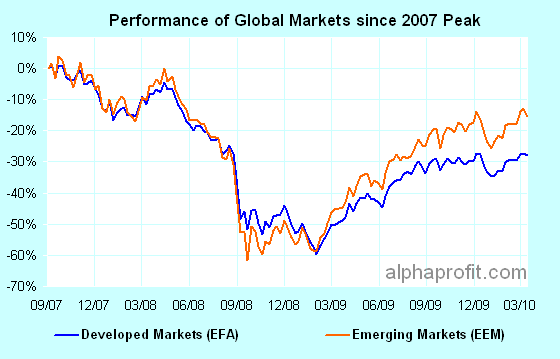
Emerging markets ETFs and mutual funds declined 67% from their 2007 peak to their trough in 2008 and have recovered strongly since then. The iShares MSCI Emerging Markets Index ETF (EEM) needs to advance just 22% to scale back to its 2007 high.
While developed foreign markets suffered slightly less than emerging markets during the deep global recession losing 62% from peak to trough, they have lagged emerging markets during the recovery. The iShares MSCI EAFE Index ETF (EFA) now needs 39% to catch up its 2007 high.

The reasons for emerging markets mutual fund and ETFs leading the recovery include fiscal fitness and growth prospects of emerging economies as well as corporate profitability of companies domiciled in emerging economies.

  • Fiscal fitness: External debt for the emerging market members of the G20 group of nations is only 36% of gross domestic product (GDP) compared to 327% for the group of G7 developed nations.
  • Growth prospects: Emerging economies are expected to grow 4.5% in 2010, 2.7% more than the 1.8% growth expected in developed economies.
  • Corporate profitability: Companies in the MSCI Emerging Markets Index have a Return on Equity (ROE) of 17.4%, well above the 12.2% ROE for companies in the MSCI EAFE Index.
Emerging markets ETFs and mutual funds have recovered more rapidly than developed market investments

Emerging markets ETFs and mutual funds have recovered more rapidly than developed market investments from their recession lows.

Top Emerging Market ETFs and Mutual Funds

Here is a list of some top emerging market ETFs and mutual funds across different asset classes:

Top Currency, Bond, and Stock ETFs & Mutual Funds for Investing in Emerging Markets

Currency ETFs

  • WisdomTree Dreyfus Brazilian Real, BZF
  • WisdomTree Dreyfus Chinese Yuan, CYB
  • WisdomTree Dreyfus Emerging Currency, CEW

Stock ETFs and Mutual Funds

Diversified Emerging Markets

  • BLDRS Emerging Markets 50 ADR, ADRE
  • Fidelity Emerging Markets, FEMKX
  • iShares MSCI Emerging Markets, EEM
  • Vanguard Emerging Markets Stock ETF, VWO

Country Investments

  • iShares FTSE/Xinhua China 25, FXI
  • iShares MSCI Brazil, EWZ
  • iShares MSCI Mexico, EWW

Bond ETFs and Mutual Funds

  • Fidelity New Markets Income, FNMIX
  • iShares JPMorgan USD Emerging Markets Bond, EMB
  • PowerShares Emerging Markets Sovereign Debt, PCY

Stock ETFs and Mutual Funds

Regional Investments

  • Fidelity China Region, FHKCX
  • Fidelity Latin America, FLATX
  • iShares MSCI Pacific ex-Japan, EPP
  • iShares S&P Latin America 40, ILF
  • SPDR S&P Emerging Middle East & Africa, GAF

Thematic Investments

  • Claymore/BNY Mellon BRIC, EEB
  • PowerShares Emerging Markets Infrastructure, PXR

Additionally, ADRs of several leading companies domiciled in emerging markets trade on U. S. exchanges. Here is a sampling of leading companies in the BNY Mellon Emerging Markets 50 ADR Index (BKTEM):

  • Petrobras, PBR
  • Taiwan Semiconductor Manufacturing, TSM
  • China Mobile, CHL
  • America Movil, AMX
  • Infosys Technologies, INFY

Investing in Emerging Markets – How much is Right?

Emerging market companies make up 20% of total global market capitalization and emerging economies make up nearly 27% of global GDP. Harvard and Yale Endowments have found emerging markets investments compelling enough to allocate 30% of their equity investments.

While such large allocations may be suitable for some institutions, most individual investors would do well to consider volatility and their capacity to take on roller coaster rides. Over the past two and a half years, emerging market stocks have proven to be nearly 70% more volatile than U. S. stocks and 44% more volatile than developed market stocks. Limiting emerging market exposure to less than 15% of one’s assets may not be a bad idea for most individual investors.

Near-Term Risks for Emerging Market ETFs and Mutual Funds

While it is worthwhile to have a portion of assets invested in emerging market stocks and bonds for the long haul, the near-term outlook for such investments is clouded by inflation concerns.

A quick economic rebound aided by stimulus measures is pumping inflation in many emerging economies including China, India, Vietnam, and the Philippines. Although some countries have raised interest rates and some have pared stimulus measures, inflation is likely to get worse in emerging markets before it gets better.

Stocks and bonds often do not deliver exceptional returns when inflation and interest rates are rising. If emerging market stocks and bonds succumb to this generality, the underperformance of broad emerging market mutual funds and ETFs vis-à-vis domestic investments can continue for a while.

JAOSX – A Worthy International Mutual Fund? Review of Investment Strategy, Fund Performance, Expense, and More

With emerging economies forecasted to grow at a 6.2% annual rate over the next couple of years compared to a 2.6% annual clip for the U. S. economy, increasing number of mutual fund investors are venturing overseas in pursuit of profit opportunities.

International mutual funds like American Funds Capital World (RWIGX), Fidelity Diversified International Fund (FDIVX), Harbor International Fund (HIINX), and Vanguard International Growth Fund (VWIGX) have been adept at gathering assets to emerge as titans.

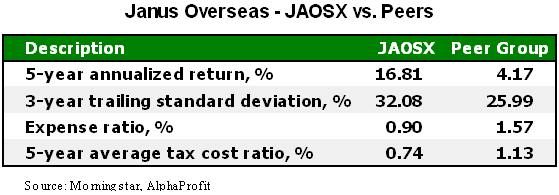
Meanwhile, Janus Overseas Fund (JAOSX) has accumulated an enviable 5-year track record that trounces the titans.

So, what investment strategy does JAOSX use to lead the pack? Should you invest in JAOSX? For insights to help you make an informed decision, read on …

JAOSX Investment Strategy

Even though JAOSX is often classified as an international mutual fund, the fund literally seeks opportunities worldwide. Brent Lynn, managing the fund solely since 2001, follows a ‘go-anywhere’ investing strategy.

While the fund invests a significant portion of its assets in shares of companies in developed foreign markets, the portfolio manager can invest meaningful portions of the assets in the U. S. as well as emerging markets. The fund may also invest in foreign debt securities.

Brent Lynn uses a ‘bottom up’ approach to make what he calls high conviction, long-term investments in world-class companies with exciting growth prospects trading at undeservedly low valuations.

JAOSX Nuts & Bolts: Fund Performance, Risk, Expense, and Tax Efficiency

The willingness to venture beyond developed foreign markets and invest in economies and firms with higher growth prospects has worked to Janus Overseas’ advantage while elevating volatility.

JAOSX-International-Mutual-Fund

JAOSX peer group consists of international large-cap growth mutual funds including AIM International Growth (AIIEX), AllianceBernstein International Growth (AWPYX), American Century International Growth (TWGAX), Artisan International (ARTIX), Fidelity Diversified International (FDIVX), Laudus International MarketMasters (SWOIX), MFS International Growth (MGRAX), Oppenheimer International Growth (OIGAX), T. Rowe Price International Stock (PRITX) and William Blair International Growth (BIGIX).

JAOSX has outperformed most of its peers over long periods ranking in the top 3 and 8 percentiles of foreign large-cap growth funds over the 5-year and 10-year timeframes. The fund proves to be nearly 25% more volatile than its peer group of international large cap growth mutual funds. JAOSX also has a tendency to lag its peers in down markets as illustrated by its bottom 20 percentile finish during the bear markets of both 2002 and 2008.

From an expense perspective, JAOSX ratio compares favorably with the average international mutual fund.

Past performance shows JAOSX to be superior to the average foreign large cap growth peer from a tax efficiency perspective. On average, Janus Overseas investors have paid 0.74% of their assets as taxes over the past 5-years. However, prospective new investors in JAOSX should note that JAOSX has capital gains exposure. As such, investors are liable to incur capital gains taxes on profits previously earned by the fund.

Using JAOSX as an International Mutual Fund

Most investors are likely to find JAOSX too volatile to be a core foreign stock fund. Risk-tolerant investors with a long time horizon can probably tolerate this volatility. The fund can however serve as a solid satellite fund for gaining exposure to the more venturesome parts of international markets. Investment style rotators will also find JAOSX a worthy selection when they seek exposure to foreign large cap growth stocks in their portfolios.

Auto and Auto Part Stocks: Autoliv, Penske Auto, and Five More Ways to Play the Turnaround

The financial crisis took a toll on 2009 US auto sales pushing them below 1982 levels. At the depth of the recession, auto sales slumped to a seasonally adjusted annual rate of just 9.2 million a year, nearly 44% lower than the pre-recession level of nearly 16.5 million units in 2007.

While cash-for-clunkers provided the initial boost late summer last year, auto sales have since recovered along with the rest of the economy. In recent months, auto sales have hovered around 11 million on an annualized basis. Recently Toyota’s (TM) recall of its popular Camry, Corolla, and Avalon brands has become headline news.

The auto sales story is quite different in China and India. Auto sales in China tallied 13.6 million in 2009 eclipsing U. S. as the world’s largest market for the first time. After skirting the global recession, India’s auto sales are expected to double to 3 million units by 2015.

Following an initial boost from cash-for-clunkers, US auto sales are recovering with the rest of the economy
While cash-for-clunkers provided a boost to U. S. auto sales last summer, auto demand is showing signs of a nascent, uneven recovery.

Against this backdrop, auto company shares have emerged as a leader in the stock market. The Dow Jones US Automobiles & Parts Index ($DJUSAP) has vaulted 140% in the past year.

Is it too late to jump into auto stocks?

No. However, given the mature state of the auto rally, one has to be choosy.

So, what’s the right way to play auto stocks?

Looking through the auto value chain, the simple answer is invest in auto part makers, speculate in automakers, and be selective on auto retailers.

Auto Part Stocks

Auto part makers as a group are executing well. Autoliv (ALV), BorgWarner (BWA), Gentex (GNTX), Goodyear Tire (GT), and Johnson Controls (JCI) blew away analysts’ EPS estimates in the recent quarter, beating by at least 20%. Auto part companies are following automakers into emerging markets offering a means to profit from global auto demand.

As for specific names, Autoliv, the world leader in seatbelts, is my favorite. Autoliv’s shares trade at a low double-digit P/E multiple compared to the prospects of EPS nearly tripling in 2010.

Automakers Stocks

Ford Motor (F) is a primary play on the recovery of the domestic auto industry. The Detroit automaker stands to benefit from the vehicle recall problems of Toyota and Honda Motor (HMC).

Ford is making progress in its turnaround and will likely be profitable in both 2010 and 2011. Yet, its balance sheet is saddled with $34 billion of auto business-related debt. As such, Ford Motor shares carry a high degree of risk and are suitable only for speculative portion of one’s portfolio.

Auto Retailer Stocks

Auto retailers have cut operating costs and inventories through the recession. In the ideal world, they should all be well primed to benefit as demand ramps up. However, Toyota’s massive recall has come in the way of retailers like Group 1 Automotive (GPI) fully benefiting from a leaner structure.

Auto retailers like Asbury Automotive (ABG), Penske Auto Group (PAG), and Sonic Automotive (SAH) have relatively limited exposure to Toyota’s problems. Among these three, Penske Auto has been more consistent in its execution and merits consideration.

Auto Plays for Mutual Fund and ETF Investors

Mutual funds and ETFs trade off selectivity for diversification. With that caveat …

Fidelity Select Automotive (FSAVX) is pretty much the only pure-play available for mutual fund investors. This fund is currently heavy on auto part makers and has only 3% of assets invested in automakers.

ETF sponsors like BlackRock (BLK), State Street (STT), and Invesco (IVZ) have left the auto ETF space open. As such, ETF investors have to look beyond the obvious for surrogate plays.

SPDR S&P International Consumer Discretionary (IPD) with over 25% of its holdings in automakers including Toyota, Honda, Daimler (DAI), Nissan (NSANY), and Bayerische Motoren Werke (DE:BMW) is an alternative.

With nearly 57% and 50% of world palladium and platinum supplies, respectively used in auto exhaust treatment, ETFS Physical Palladium (PALL) and ETFS Physical Platinum (PPLT) offer a way to play the auto cycle. Over 40% of world’s palladium supplies come from Russia making metal prices vulnerable to supply shocks.

Fidelity Investments Offers Free Trading on iShares ETFs: Ways You Can Profit from ETF Trading

Competition in the online trading space has been heating up. In the closing months of 2009, Charles Schwab (SCHW) cut commissions to $8.95 per trade of stock or non-Schwab exchange-traded fund (ETF). Schwab has also allowed commission free trading of its eight in-house ETFs.

Responding to Schwab’s move, Fidelity Investments has replaced its tiered commission structure ranging from as high as $19.95 a trade with a flat $7.95 rate. Fidelity has also announced that its customers can trade 25 ETFs commission free.

Fidelity has partnered with BlackRock (BLK), the manager of iShares ETFs, to offer commission free trading on 25 iShares ETFs. Fidelity will receive a fixed amount from BlackRock to cover certain expenses.

iShares ETFs Available at Fidelity InvestmentsThe lineup of commission-free ETFs includes several popular U. S. stock, foreign stock, and bond ETFs and increases the range of indexed products available to Fidelity customers. The assets invested in these ETFs tally nearly $200 billion. Here is the list:

for Commission Free Trading

U. S. Stock ETFs

Large-Cap

  • iShares S&P 500 (IVV)
  • iShares S&P 500 Growth (IVW)
  • iShares S&P 500 Value (IVE)
  • iShares Russell 1000 (IWB)
  • iShares Russell 1000 Growth (IWF)
  • iShares Russell 1000 Value (IWD)
  • iShares Russell 3000 (IWV)

Mid-Cap and Small-Cap

  • iShares Russell 2000 (IWM)
  • iShares Russell 2000 Growth (IWO)
  • iShares Russell 2000 Value (IWN)
  • iShares S&P Mid Cap 400 (IJH)
  • iShares S&P Mid Cap 400 Growth
    (IJK)
  • iShares S&P Mid Cap 400 Value
    (IJJ)
  • iShares S&P Small Cap 600 (IJR)
  • iShares S&P Small Cap 600 Growth (IJT)
  • iShares S&P Small Cap 600 Value (IJS)

Foreign Stock ETFs

World

  • iShares MSCI ACWI (ACWI)

Developed Markets

  • iShares MSCI EAFE (EFA)
  • iShares MSCI EAFE Small Cap (SCZ)

Emerging Markets

  • iShares MSCI Emerging Markets (EEM)

Bond ETFs

Total Bond Market

  • iShares Barclays Aggregate Bond (AGG)

Inflation Protected Bonds

  • iShares Barclays TIPS Bond (TIP)

High-Grade Corporate

  • iBoxx $ Investment Grade Corporate Bond (LQD)

Emerging Markets

  • iShares JP Morgan USD Emerging Markets Bond (EMB)

Tax Exempt

  • iShares S&P National AMT-Free Municipal Bond (MUB)

Should You Jump Ship from Fidelity Index funds to iShares ETFs?

No, not really. The cost advantages provided by ETFs vis-à-vis Fidelity index mutual funds like Spartan 500 (FUSEX), Spartan Total Market (FSTMX), Spartan International Index (FSIIX) or Fidelity U. S. Bond Index (FBIDX) mutual funds is not significant enough to make a change without weighing tax consequences.

How Can You Use Free ETF Trading to Your Advantage?

Commission free ETFs are asset allocation investments that are suitable for building core portfolios with exposure to a broad range of asset classes. The elimination of commissions makes these ETFs suitable for buy-and-hold or dollar-cost averaging. If you are starting fresh or have cash that you can use for building a diversified portfolio, the ETF option can look appealing.

Position yourself for more commission free ETFs likely to follow. Given the intense competition among ETFs for assets, it is conceivable that other ETF sponsors like State Street (STT) will seek to enter into partnerships with brokerage firms and make their ETFs available to investors on a commission-free basis. Like Schwab, Vanguard Group has the option of waiving commission on in-house ETFs for Vanguard Brokerage Services customers. Such developments can widen the range of ETFs you can use for building your portfolio.

How Can You Profit from Consolidation in Online Brokerage Firms?

The intensity in competition among online stock brokers is picking up at a time when industry conditions are challenging. This may well accelerate consolidation in the online trading space.

Speculation on E*Trade’s (ETFC) takeover has reared many times given the firm’s weak finances. This rumor may well become reality soon if TD Ameritrade (AMTD) or Schwab makes an offer. If you want to plunk some money into low-priced E*Trade shares with the hope of making a quick buck, do so … but only with the money you can afford to lose.