Will 1Q22 Earnings Reports Perk Up Stocks?

The S&P 500 fell 2.2% during the week, shortened by the Good Friday holiday. Bond yields continued their rise after inflation reports showed robust increases in consumer and producer prices. Investors also contended with mixed bank earnings and additional disruptions to exports from China.

Investors focused on inflation data and bond yields after consumer and producer price indexes rose sharply in March.

The CPI increased 8.5% in a year, the fastest annual gain since December 1981, while the PPI gained 11.2%, its highest yearly increase since 2010.

The yield on the 10-year Treasury bond added 0.12% for the week, ending at 2.83%.

In other economic data, retail sales rose a less-than-expected 0.5% in March as higher gasoline prices impacted household spending.

Banks kicked off the first-quarter earnings reporting season. Although the bottom line topped analysts’ estimates, the reports failed to enthuse investors. Banks reported a sharp decline in profits and warned of credit losses to rise in future quarters.

China expanded lockdowns beyond Shanghai to other cities in response to rising COVID cases. The Japanese bank Nomura estimates that 45 Chinese cities that account for nearly 40% of China’s economic output have implemented full or partial lockdowns.

News of supply chain disruptions from widespread lockdowns in China and rising bond yields hit technology stocks hard.

For the week ending April 15, the S&P 500 (SPY) fell 2.2%. Four of the 11 sectors advanced.
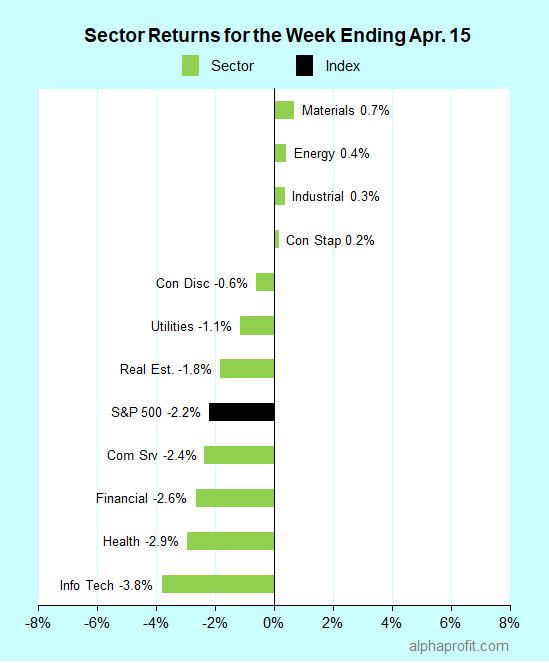
Leading and lagging sectors as 1Q22 earnings reports broaden beyond financials - April 15, 2022

Leading and lagging sectors as 1Q22 earnings reports broaden beyond financials – April 15, 2022.

Materials (XLB), energy (XLE), and industrials (XLI) bucked the S&P 500, gaining 0.3% or more.

Information technology (XLK), health care (XLV), and financials (XLF) lagged the S&P 500.

The S&P 500’s top 10 winners included the following:

1. Consumer Discretionary Sector

  • Bath & Body Works (BBWI) +15%
  • PVH Corp. (PVH) +11%
  • Marriott International (MAR) +10%

Delta Air Lines’ earnings outlook and the state of the travel industry boosted shares of hotel chain Marriott.

2. Industrials Sector

  • Delta Air Lines (DAL) +14%
  • American Airlines Group (AAL) +12%
  • Southwest Airlines (LUV) +10%

Airline shares rallied broadly after Delta Air Lines reported lower losses than expected in the past quarter and forecasted profits in the current quarter due to historically high demand.

3. Consumer Staples Sector

  • Molson Coors (TAP) +10%

4. Energy Sector

  • Coterra Energy (CTRA) +10%

The natural gas producer rallied after JP Morgan and Wells Fargo raised their price targets on Coterra shares to imply an upside of over 25%.
5. Materials Sector

  • Nucor Corp. (NUE) +10%

Nucor shares rallied ahead of the steelmaker reporting earnings this week on April 21.
6. Communication Services Sector

  • DISH Network (DISH) +9%

Top ETFs for the week

The following ETFs themes worked well: airlines, metals & mining, commodities, gold, and silver. The top ETFs for the week include:

  • U.S. Global Jets ETF (JETS) +8.0%
  • SPDR S&P Metals and Mining ETF (XME) +7.3%
  • Invesco Optimum Yield Div. Commodity Strategy ETF (PDBC) +5.4%
  • VanEck Junior Gold Miners ETF (GDXJ) +5.4%
  • ETFMG Prime Junior Silver Miners ETF (SILJ) +4.6%

Top Fidelity Fund for the week

  • Fidelity Select Gold (FSAGX) +4.7%

Will 1Q22 Earnings Reports Perk Up Stocks?

The first-quarter earnings reporting season gathers some steam this week. Yet, earnings reports may not get the attention they usually do. Investors are likely to remain fixated on persistently high inflation, the Federal Reserve’s interest rate policy, and the war in Ukraine.

* Federal Reserve Chair Powell participates in a panel at the International Monetary Fund on Thursday to discuss the global economy. Powell’s comments may well be the highlight of the week.

* This week, the earnings reporting season broadens beyond financials to a mix of defensive and economically sensitive companies. The reporting companies include defensives like Johnson & Johnson, Procter & Gamble, and Verizon and economically sensitive ones like American Express, Tesla, and Union Pacific. Investors will focus on corporate earnings commentaries to understand the impact of inflation, rising commodity prices, and supply chain disruptions on profits.

* Investors are worried about housing demand due to the sharp increase in mortgage rates this year. The week’s economic reports should help investors gauge how the housing sector is doing. The economic calendar includes homebuilder sentiment, housing starts, and existing home sales data.

* The fallout from the war in Ukraine remains a concern for investors. The war has pushed up commodity prices, boosting inflation.


Stay on top of the stock market with ‘Looking Back, Looking Forward’

Sign up free to receive Looking Back, Looking Forward in your Inbox.


Learn more:

How AlphaProfit's investment strategy minimizes your risk
How AlphaProfit keeps your fees and expenses low
Performance of model portfolios & recommendations in AlphaProfit's Premium Service investment newsletter
AlphaProfit's free and premium investment newsletters
1Q22 Bank Earnings and Inflation Data in Focus

Federal Reserve officials portrayed an aggressive stance in fighting inflation compared to previous communications. The bond and stock markets reacted to their comments. The 10-year bond yield rose to 2.7%, its highest since March 2019. Investors favored stocks with higher earnings stability over those with higher growth prospects.

The Federal Reserve changed its tone to communicate its urgency in its fight against inflation.

Federal Reserve Governor Brainard said, “Inflation is much too high and is subject to upside risks.” She added the central bank needs to shrink its balance sheet “rapidly” to drive down inflation.

Brainard expects the Fed to methodically increase interest rates and rapidly reduce its balance sheet to bring U. S. monetary policy to a “more neutral position” later this year.

Other Federal Reserve Presidents Harker and Bullard concurred with Brainard. The latter said the federal funds rate should reach 3.5% this year.

The Federal Reserve also released the minutes of its March interest rate policy meeting. The minutes revealed officials “generally agreed” on shrinking the central bank’s balance sheet by $95 billion per month or over $1 trillion per year. The minutes also revealed the inclination of bank officials to consider raising interest rates by 0.5% instead of the usual 0.25% in future meetings.

The yield on the 10-year Treasury note rose 0.34% last week to end above 2.7%, its highest since March 2019.

The war in Ukraine continued with civilians becoming targets. Russian Foreign Minister Lavrov said Ukraine had presented Moscow with a draft peace deal that contained “unacceptable” elements. Speaking to the United Nations Security Council, Ukraine’s President Zelenskyy called for a Nuremberg-like tribunal to hold Russia accountable for alleged war crimes.

Investors gravitated towards defensive sectors such as health care as they raised the odds of a U. S. recession resulting from the Fed’s fight against inflation. The continued rise in bond yields weighed on information technology companies.

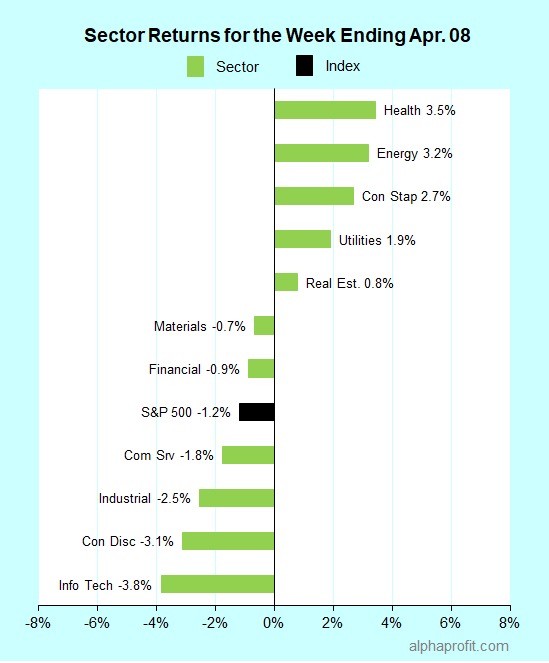
For the week ending April 8, the S&P 500 (SPY) fell 1.2%. Five of the 11 sectors advanced.
 

Leading and lagging sectors with 1Q22 bank earnings and inflation data in focus – April 10, 2022

Leading and lagging sectors with 1Q22 bank earnings and inflation data in focus – April 10, 2022.

Market breadth was negative. The number of advancing stocks in the S&P 500 lagged the number of decliners by a 7-to-8 ratio.

Health care (XLV), energy (XLE), consumer staples (XLP) bucked the S&P 500 gaining 2.7% or more.

Information technology (XLK), consumer discretionary (XLY), and industrials (XLI) lagged the S&P 500.

The S&P 500’s top 10 winners included the following:

1. Communication Services Sector

  • Twitter (TWTR) +18%

The social media company was the week’s top performer in the S&P 500 after Elon Musk took a 9.2% stake.

2. Materials Sector

  • Mosaic (MOS) +16%
  • CF Industries (CF) +15%

Fertilizer makers rode the rally in fertilizer prices as Belarus, China, Russia, and Ukraine curtail supplies.

3. Consumer Discretionary Sector

  • AutoZone (AZO) +11%
  • Target Corp. (TGT) +11%
  • O’Reilly Automotive (ORLY) +10%
  • Advance Auto Parts (AAP) +9%
  • Dollar General (DG) +9%

As fears of a recession rose, investors favored auto parts retailers and discount retailers likely to fare well in a weak economy.

4. Utilities Sector

  • Constellation Energy (CEG) +10%

5. Information Technology Sector

  • HP Inc. (HPQ) +9%

Top ETFs for the week

The following ETFs themes worked well: uranium, health care, energy, health care providers, and consumer staples. The top ETFs for the week include:

  • North Shore Global Uranium Mining ETF (URNM) +10.6%
  • Health Care Select Sector SPDR Fund (XLV) +3.4%
  • Energy Select Sector SPDR Fund (XLE) +3.2%
  • iShares U.S. Healthcare Providers ETF (IHF) +2.8%
  • Consumer Staples Select Sector SPDR Fund (XLP) +2.7%

Top Fidelity Fund for the week

  • Fidelity Select Pharmaceuticals (FPHAX) +4.2%

1Q22 Bank Earnings and Inflation Data in Focus

Trading this week is a four-day affair due to the April 15 Good Friday holiday. Banks kick off the first-quarter earnings reporting season. The economic calendar includes two reports on inflation.

* The first-quarter earnings reporting season starts this week. According to FactSet, analysts expect S&P 500 companies to grow their earnings by 4.5% year-over-year in the first quarter. Top banks feature prominently in this week’s reporting calendar. JPMorgan reports on Wednesday, followed by Citigroup, Goldman Sachs, Morgan Stanley, and Wells Fargo on Thursday. Leading health insurer UnitedHealth reports in addition to the banks this week.

* The economic calendar is busy. On Tuesday, the Labor Department reports the March consumer price index reading. Economists expect the CPI to rise 7.9% year-over-year. Some economists forecast the year-over-year increase in CPI to peak in March. Data on the March producer price index and retail sales are due too.

* The 10-year bond yielded less than 2% last on March 9. The yield has risen over 0.7% in the past month and appears likely to climb over 3%. The Treasury auctions $110 billion in bonds this week. Will the 10-year bond yield over 3% next week? The answer to this question may well be determined by how bond yields respond to inflation data next week.


Stay on top of the stock market with ‘Looking Back, Looking Forward’

Sign up free to receive Looking Back, Looking Forward in your Inbox.


Learn more:

How AlphaProfit's investment strategy minimizes your risk
How AlphaProfit keeps your fees and expenses low
Performance of model portfolios & recommendations in AlphaProfit's Premium Service investment newsletter
AlphaProfit's free and premium investment newsletters
Best ETFs, Fidelity Funds, and Stocks of 1Q2022

The major U. S. stock market indices rose in March. Yet, they ended lower for the quarter, marking their first quarterly loss in two years. Investors worried about rising inflation, higher interest rates, and the war in Ukraine. Disruptions to exports of commodities from both Russia and Ukraine worsened inflation.

The S&P 500 fell 4.6% in the first quarter, while the Dow Jones Industrial Average declined 4.1%. The NASDAQ Composite was the worst performer, losing 8.9%.

Interest rates moved dramatically higher during the quarter. The benchmark 10-year Treasury yielded as high as 2.55% after starting the year at 1.51% and ended the quarter at 2.37%. The increase in the yield of the 2-year Treasury note was even starker. The 2-year Treasury ended the quarter yielding 2.45% after starting the year at a mere 0.73%.

Higher oil prices weighed on stocks. Many customers scrambled to make up for Russian oil after refusing to buy it due to sanctions imposed on Russia. West Texas Intermediate oil spiked as high as $130.50 a barrel on March 7, after starting the year at $75.21 a barrel. WTI oil ended the quarter at $100.28 a barrel.

The U. S. economy held up to these cross-currents quite well. The employment market stayed strong. Job creation averaged 562,000 per month in the first quarter, lowering the unemployment rate to 3.6%.
Here, we look at what ETFs, Select SPDRs, Fidelity funds, and S&P 500 stocks returned the most in 1Q 2022.

Best ETFs of 1Q 2022

Energy ETFs of various types featured at the top of the performance charts. Natural gas led the way. Other top performing energy ETFs include those investing in oil services stocks, natural gas producers, and oil producers.

  • United States Natural Gas Fund, UNG       +57.9%
  • VanEck Oil Services ETF, OIH       +52.9%
  • First Trust Natural Gas ETF, FCG       +42.6%
  • Invesco S&P 500 Eq. Wt. Energy ETF, RYE       +41.9%
  • SPDR S&P Oil & Gas E & P ETF, XOP       +40.9%

Best Select Sector SPDR ETFs of 1Q 2022

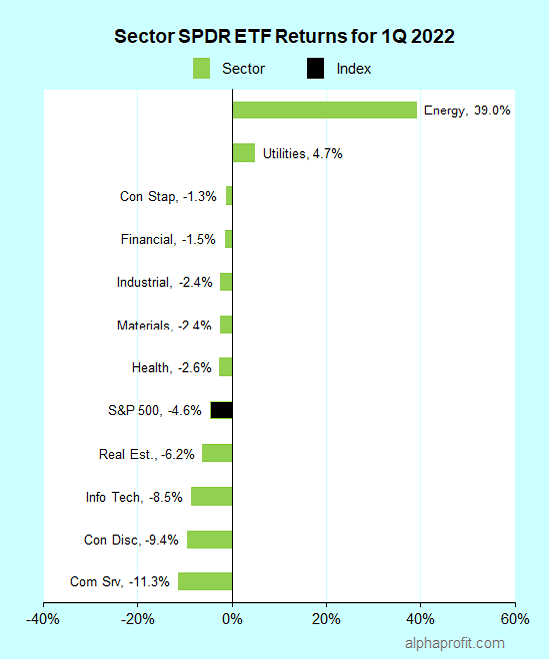
The Energy Select Sector SPDR took the top position. Select Sector SPDRs focusing on utilities and consumer staples followed. Invested gravitated towards defensive sectors in this uncertain investing backdrop.

  • Energy Select Sector SPDR, XLE       +39.0%
  • Utilities Select Sector SPDR, XLU       +4.7%
  • Consumer Staples Select Sector SPDR, XLP       -1.3%
Leading and lagging Select Sector SPDRs of 1Q 2022

Leading and lagging Select Sector SPDRs of 1Q 2022.

See: Best Sectors for 2022

Best Fidelity Funds of 1Q 2022

Commodity-oriented Fidelity funds clustered at the top of the performance table. The winners included Fidelity funds investing in energy, natural resources, and agriculture. With Russia cut off from the global economy, Latin American companies exposed to commodity markets boosted Fidelity Latin America.

  • Fidelity Select Energy Portfolio, FSENX       +40.2%
  • Fidelity Natural Resources Fund, FNARX       +32.3%
  • Fidelity Glb Commodity Stock Fund, FFGCX       +30.1%
  • Fidelity Latin America Fund, FLATX       +21.4%
  • Fidelity Agricultural Productivity Fund, FARMX      +19.4%

See: Best Fidelity funds for 2022

Best S&P 500 Stocks of 1Q 2022

Three of the top five winners for the quarter were oil & gas producers, Occidental Petroleum, APA Corp., and Marathon Oil. Fertilizer producer Mosaic and oil field service provider Halliburton rounded the list.

  • Occidental Petroleum, OXY       +96%
  • The Mosaic Company, MOS       +70%
  • Halliburton, HAL       +66%
  • APA Corp., APA       +54%
  • Marathon Oil, MRO       +53%

See: Best Sectors and Stocks for Strongest Growth in 2022

Looking ahead to 2Q 2022

Investors are looking to the Federal Reserve’s March meeting minutes for more information on the central bank’s plan to reduce its balance sheet. Investors’ fears of a recession grew last week after the yield curve. Investors will also keep an eye on oil prices and events surrounding the Ukraine war.

* The minutes of the Federal Reserve’s March interest rate policy meeting are a key event this week. The Fed releases these minutes on Wednesday. Investors expect to learn more about the Fed’s intentions to decrease its $9 trillion balance sheet in the minutes. The central bank intends to reduce its balance sheet as a further step toward tightening the interest rate policy. A few Fed officials, including Governor Brainard, are scheduled to speak this week.

* Interest rates and oil prices will remain on the top of investors’ minds. Last Friday, the 10-year Treasury note yielded 0.06% less than the 2-year note, inverting the yield curve. The inversion heightened recession worries since such a yield curve has often preceded recessions. Recession fears are likely to intensify if the yield curve stays inverted. Oil prices fell last week and closed below $100 a barrel last week after the U. S. announced plans to release barrels from the strategic petroleum reserve.

* The spotlight on corporate earnings switches to first-quarter results. Investors will be alert to corporate comments ahead of the first-quarter earnings reporting season starting the week of April 11. Among the S&P 500 companies reporting earnings this week are Conagra Brands, Constellation Brands, and Lamb Weston.

* The economic data calendar is light. The Institute of Supply Management reports its services activity index. Economists expect the index to rise to 58.5% in March from 56.5% in February.


Stay on top of the stock market with ‘Looking Back, Looking Forward’

Sign up free to receive Looking Back, Looking Forward in your Inbox.


Learn more:

How AlphaProfit's investment strategy minimizes your risk
How AlphaProfit keeps your fees and expenses low
Performance of model portfolios & recommendations in AlphaProfit's Premium Service investment newsletter
AlphaProfit's free and premium investment newsletters
Three Factors to Watch: Inflation, Yields, and Oil

U. S. stocks rose for a second straight week. Investors focused on comments from Fed Chairman Powell and developments in the Russia-Ukraine war. Bond yields surged while oil prices rose; the latter helped energy stocks lead the market. The 10-year Treasury yield surged to its highest level since May 2019.

Federal Reserve Chair Powell promised to take a tough stand against inflation and hinted at aggressive interest rate increases. Investors adjusted their expectations for the Fed to raise interest rates by 0.5% after its interest rate policy meetings in both May and June. The yield on the 10-year Treasury note jumped nearly 0.35% to 2.49%, the highest since May 2019.

U. S. oil prices surged 9% on the back of the Russia-Ukraine crisis and tensions in the Middle East. West Texas Intermediate crude closed the week at $113.90 per barrel.

NATO leaders met in Brussels to discuss increasing pressure on Russia. They agreed to increase military aid to Ukraine and tighten sanctions on Russia.

U. S. economic data reflected the strain of rising interest rates on home mortgages and high inflation. The National Association of Realtors said pending home sales fell 4.1% in February to their lowest since June 2020. The University of Michigan’s final consumer sentiment reading fell slightly in March to stay near an 11-year low.

Stocks in commodity-oriented sectors prospered the most.

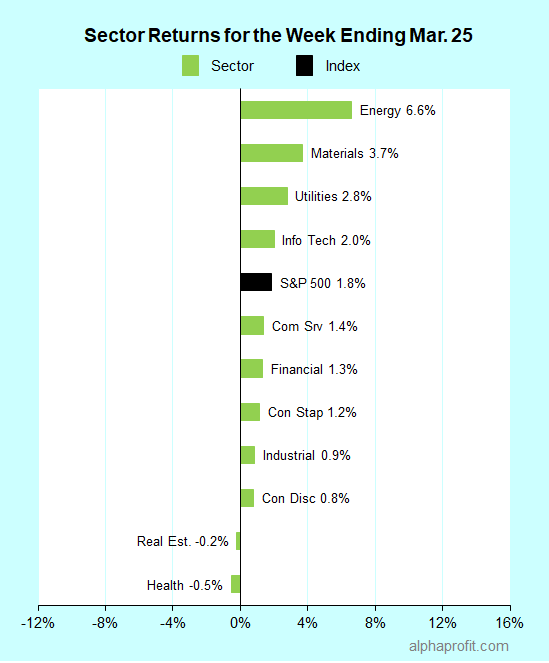
For the week ending March 25, the S&P 500 (SPY) rose 1.8%. Nine of the 11 sectors advanced.

Leading and lagging sectors as inflation, bond yields, and oil prices impact stocks – March 25, 2022

Leading and lagging sectors as inflation, bond yields, and oil prices impact stocks – March 25, 2022.

Market breadth was positive. The number of advancing stocks in the S&P 500 led the number of decliners by a 3-to-2 ratio.

Energy (XLE), materials (XLB), and utilities (XLU) led the S&P 500, gaining 2.8% or more.

Health care (XLV), real estate (XLRE), and consumer discretionary (XLY) lagged the S&P 500.

The S&P 500’s top 10 winners included the following:

1. Energy

Energy stocks fared well amidst the backdrop of higher oil prices. Oil rose on speculation of the European Union following the U. S. in blocking imports of Russian energy. Yemen’s Iran-backed Houthi rebels destroyed a Saudi Aramco oil facility in Jeddah with a missile strike, threatening supplies.

Coterra Energy (CTRA) +16% – Amidst the positive backdrop for energy stocks, Coterra Energy (CTRA) rose 16% to be the week’s top performer in the S&P 500. The added boost came after the U. S. and Europe agreed to a deal in principle to ensure Europe gets a steady stream of U. S. liquefied natural gas to help replace Russian gas.

The top 10 winners of the S&P 500 also included four more energy companies in Marathon Oil (MRO), Hess Corp. (HES), Diamondback Energy (FANG), and Schlumberger (SLB), each of which gained 10-13%.

2. Materials

Nucor Corp. (NUE) +16% – The steel maker gained after stating that it expects to report record earnings in the first quarter with EPS more than doubling to exceed $7.20 a share.

CF Industries (CF) +15% and The Mosaic Co. (MOS) +15% – The fertilizer producers rallied as analysts raised EPS forecasts for CF Industries and Mosaic on improving prospects for fertilizer prices to stay high through 2022.

3. Consumer Discretionary

Tesla (TSLA) +12% – The electric vehicle maker opened its long-awaited Gigafactory near Berlin, Germany, enhancing its position to deliver cars for the large European auto market. Tesla expects the plant to produce 500,000 vehicles annually when fully functional.

4. Consumer Staples

Archer-Daniels-Midland (ADM) +11% – The food processor and transporter soared as grain prices continued to spiral higher. Russia’s invasion of Ukraine threatens grain supplies from the breadbasket of Europe.

Top ETFs for the week

The following ETFs themes worked well: cannabis, oil & gas, oil services, Brazil, and metals & mining. The top ETFs for the week include:

  • ETFMG Alternative Harvest ETF (MJ) +15.2%
  • SPDR S&P Oil & Gas Exploration & Production ETF (XOP) +10.7%
  • VanEck Oil Services ETF (OIH) +9.0%
  • iShares MSCI Brazil ETF (EWZ) +8.8%
  • SPDR S&P Metals and Mining ETF (XME) +8.1%

Top Fidelity Fund for the week

  • Fidelity Select Energy (FSENX) +8.5%

Three Factors to Watch: Inflation, Yields, and Oil

The economic calendar this week is a busy one. The focal points include the March jobs report and a read on the Fed’s preferred inflation measure. Bond yields, oil prices, and developments in the war in Ukraine are likely to add to volatility.

* Investors will look to assess if the March job report and inflation data will encourage the Federal Reserve to raise interest rates by 0.5% when the central bank discusses interest rate policy in early May. Economists expect the Labor Department’s report to show the addition of 460,000 jobs in March, compared to 678,000 in February. They expect the unemployment rate to decline to 3.7% from 3.8% in February. As for inflation, economists expect the core personal consumption expenditures index to rise by 5.5% for the 12 months ending in February, up from 5.2% in January.

* Investors are watching the yield of the 10-year Treasury note to see if it can consolidate around 2.5% after surging last week. The U. S. Treasury’s auctions $151 billion in two-, five- and seven-year notes. The auction’s bid-to-cover ratio should provide insights on demand for bonds amidst high inflation. A low bid-to-cover ratio could spell more trouble for bonds.

* Oil is a wild card. It retraced part of its prior pullback last week. A continuing rise in oil towards its previous 2022 high of $130 per barrel is likely to be troublesome for stocks.

* The situation in Ukraine remains fluid, with talks between Russia and Ukraine not proving fruitful so far. While investors expect a resolution in the conflict, the path towards one remains unclear.

* The earnings reporting cycle is at its slow point. Investors will look to comments from Micron Technology for insights into the impact of the Ukraine war on the semiconductor industry. McCormick, Paychex, and Walgreens Boots Alliance report earnings this week.


Stay on top of the stock market with ‘Looking Back, Looking Forward’

Sign up free to receive Looking Back, Looking Forward in your Inbox.


Learn more:

How AlphaProfit's investment strategy minimizes your risk
How AlphaProfit keeps your fees and expenses low
Performance of model portfolios & recommendations in AlphaProfit's Premium Service investment newsletter
AlphaProfit's free and premium investment newsletters
Will Market Bottom Endure as Recession Risk Rises?

The S&P 500 rose 6.2% to record its highest weekly gain since November 2020. Investors sought bargains after the Fed provided clarity on interest rate policy. The lower-than-expected rise in the producer price index data and falling oil prices eased inflation concerns. Rising COVID cases in China and Europe added to uncertainties while the war in Ukraine continued.

The Federal Reserve raised its benchmark interest rate by 0.25% last week, the first increase since 2018. While the Fed acknowledged uncertainty from the Russia-Ukraine war, it said “ongoing increases” in the benchmark interest rate “will be appropriate” to curb the highest inflation in 40 years.

Fed Chairman Powell gave an optimistic view of the economy. The Fed forecast the benchmark interest rate would be 1.9% by year-end, implying the central bank would raise interest rates at each of the remaining meetings this year.

Investors received some relief on the inflation front. U. S. producer prices rose 0.8% in February, below economists’ 0.9% forecast. The core producer price index, which excludes food and energy components, rose just 0.2% compared to economists’ 0.6% forecast. Further, the price of oil retreated over 4% last week.

Rising daily COVID infections disrupted manufacturing activity in Shenzhen, a hub after China shut down nonessential businesses imposed city-wide testing. China’s promise to roll out more stimulus and keep markets stable helped offset investors’ fears of additional disruptions to global supply chains.

Fighting between Russia and Ukraine continued despite signs of potential progress in negotiations between the two countries. Hinting a compromise, Ukraine’s President Zelenskyy said he is prepared to accept security guarantees instead of membership in the NATO alliance membership. Russia also avoided a foreign currency debt default by paying $117 million in bond payments due.

Investors sought bargains in high-growth companies and names most punished in 2022.

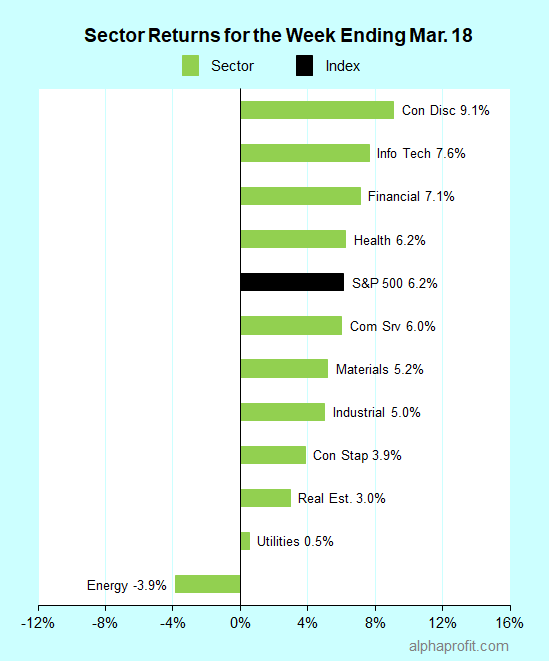
For the week ending March 18, the S&P 500 (SPY) rose 6.2%. Ten of the 11 sectors advanced, with energy being the exception.

Leading and lagging sectors as the market shows bottoming signs amidst rising recession risks – March 18, 2022

Leading and lagging sectors as the market shows bottoming signs amidst rising recession risks – March 18, 2022.

Market breadth was positive. The number of advancing stocks in the S&P 500 led the number of decliners by an 8-to-1 ratio.

Consumer discretionary (XLY), information technology (XLK), and financials (XLF) led the S&P 500, gaining 7.0% or more.

Energy (XLE), utilities (XLU), and real estate (XLRE) lagged the S&P 500.

The S&P 500’s top 10 winners included the following:

1. Information Technology

EPAM Systems (EPAM) +47% – Beaten-down shares of the information technology services provider rebounded on improving risk appetite. EPAM Systems, with large delivery centers in Belarus, Russia, and Ukraine, gained 47% to be the week’s top performer in the S&P 500.

PayPal (PYPL) +23% – The payment services provider gained after positive comments from Deutsche Bank and MoffettNathanson.

NVIDIA Corp. (NVDA) +20% – The semiconductor chipmaker rallied ahead of its flagship technical conference this week. Positive comments from Cowan added to investor enthusiasm.

2. Industrials

Nielsen Holdings (NLSN) +40% – The media ratings giant surged the Wall Street Journal reported on Elliott Investment Management and Brookfield Asset Management leading a consortium to buy Nielsen.

United Airlines (UAL) +21% and American Airlines (AAL) +19% – Major airlines boosted their current quarter revenue outlook, citing robust bookings from the recovery in travel demand.

3. Health Care

Moderna (MRNA) +29% – The COVID vaccine maker stock rallied after Moderna sought U. S. FDA approval for a second booster for adults 18 years or older. A surge in COVID cases in China’s Shenzhen region boosted Moderna shares.

Other Top 10 Winners
The S&P 500’s top 10 winners for the week also included:

  • Glucose monitoring device maker DexCom (DXCM) +20%
  • Online marketplace Etsy (ETSY) +22%
  • Payroll software solutions provider Paycom Software (PAYC) +18%

Top ETFs for the week

The following ETFs themes worked well: China Internet, fintech, Internet, e-commerce, innovation, and cloud computing. The top ETFs for the week include:

  • KraneShares CSI China Internet ETF (KWEB) +28.8%
  • ARK Fintech Innovation ETF (ARKF) +22.8%
  • EMQQ The Emerging Markets Internet & Ecommerce ETF (EMQQ) +21.3%
  • ARK Innovation ETF (ARKK) +18.3%
  • WisdomTree Cloud Computing Fund (WCLD) +15.4%

Top Fidelity Fund for the week

  • Fidelity Select Semiconductors (FSELX) +13.1%

Will Market Bottom Endure as Recession Risk Rises?

Stocks appeared to bottom last week after they embarked on a robust rally. The Federal Reserve’s first interest rate hike of this cycle is in place. Investors are worried about the rising odds of a recession due to the Fed’s plan for six more interest rate increases this year. Investors are now monitoring to see if this rally has more to go. The deterioration of the market’s technical picture, an increase in COVID cases in China and Europe, and the crisis in Ukraine add to investors’ concerns.

* Stocks made robust gains last week. Yet, the rally could not prevent the S&P 500 from forming a death cross. The S&P 500’s 50-day moving average (DMA) fell below its 200-DMA last week. Investors are waiting to see if stocks can extend last week’s rally into this week. If stocks can muster further gains, the S&P 500 could form a golden cross relatively soon. A cross of the 50-DMA back above the 200-DMA would provide relief to technically inclined investors.

* The backdrop of falling oil prices soothed investors last week as the yield on the 10-year Treasury bond rose 0.14%. Investors will continue to monitor oil prices and bond yields this week. A renewed surge in the price of oil can quickly undermine investor confidence.

* The headlines from the war in Ukraine and the renewed surge in COVID cases in China & Europe can continue to drive volatility this week.

* Nearly a dozen Fed officials speak this week. Fed Chairman Powell speaks at an economics conference on Monday and an international banking conference on Wednesday.

* Adobe, Cintas Corp., Colgate-Palmolive, General Mills, and Nike are among the S&P 500 members reporting earnings this week.


Stay on top of the stock market with ‘Looking Back, Looking Forward’

Sign up free to receive Looking Back, Looking Forward in your Inbox.


Learn more:

How AlphaProfit's investment strategy minimizes your risk
How AlphaProfit keeps your fees and expenses low
Performance of model portfolios & recommendations in AlphaProfit's Premium Service investment newsletter
AlphaProfit's free and premium investment newsletters

Top Fidelity Funds for February 2022

Fidelity funds focusing on defense & aerospace as well as commodity stocks such as gold, energy, and natural resources were top performers in February.

Top Fidelity Funds for February 2022

Excludes closed Fidelity funds

* Fidelity Select Gold Portfolio, FSAGX +12.0%

* Fidelity Select Defense and Aerospace Portfolio, FSDAX +10.8%

* Fidelity Global Commodity Stock Fund, FFGCX +10.4%

* Fidelity Select Energy Portfolio, FSENX +8.3%

* Fidelity Natural Resources Fund, FNARX +8.1%

Stocks contributing to the performance of the above Fidelity funds likely include Canadian Natural Resources Ltd. (CNQ), Chevron (CVX), Freeport-McMoRan (FCX), Franco-Nevada (FNV), Newmont (NEM), Northrop Grumman (NOC), Nutrien Ltd. (NTR), Raytheon Technologies (RTX), and Exxon Mobil (XOM).

Bottom performers for February include Fidelity Select IT Services Portfolio (FBSOX), Fidelity Emerging Asia Fund (FSEAX), Fidelity Nordic Fund (FNORX), Fidelity Select FinTech Portfolio (FSVLX), and Fidelity Total Emerging Markets Fund (FTEMX).


Stay on top of the stock market with ‘Looking Back, Looking Forward’

Sign up free to receive Looking Back, Looking Forward in your Inbox.


Learn more:

How AlphaProfit's investment strategy minimizes your risk
How AlphaProfit keeps your fees and expenses low
Performance of model portfolios & recommendations in AlphaProfit's Premium Service investment newsletter
AlphaProfit's free and premium investment newsletters
Will Ukraine and Oil Dominate the Fed – Mar. 13, 2022

Commodity prices continued to soar as the fighting in Ukraine continued for the third week, threatening to worsen inflation. Bonds yields resumed their uptrend while stocks suffered steep losses.

The fighting in Ukraine extended to the third week after Russia’s invasion. Peace talks between the two countries did not yield results.

The sanctions imposed by the U. S. and its allies on Russia continued to push commodity prices higher due to Russia’s standing as a dominant producer of several commodities.

Early last week, oil touched $130 a barrel, a level not seen since 2008 on worries over the impact of sanctions on Russian oil supplies. The U. S. and Western oil companies banned purchases of Russian oil. Oil pulled back to end the week below $110 a barrel. The nationwide average price of gasoline jumped by almost 50 cents a gallon last week to close at $4.33 a gallon.

While oil got most of the attention, the prices of other commodities such as wheat, fertilizers, nickel, and palladium also spiraled higher.

The Labor Department reported consumer prices surged 7.9% during the 12 months ending in February, the hottest inflation reading in forty years. Gasoline prices rose 6.6% in February, pushing the consumer price index (CPI) higher by 0.8% from January.

Bond yields, which had fallen earlier in the month on their safe-haven appeal, turned around due to fears of rising inflation and closed the week higher.

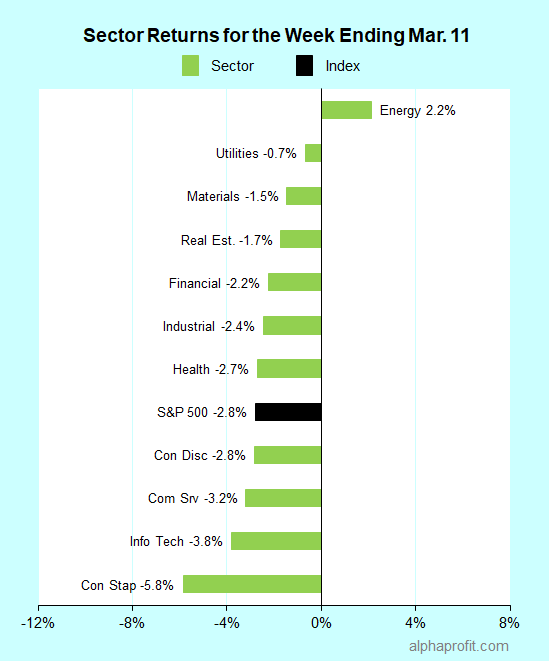
For the week ending March 11, the S&P 500 (SPY) fell 2.8%. Ten of the 11 sectors declined, with energy being the exception.

Leading and lagging sectors as Ukraine and oil threaten to dominate the Fed - March 11, 2022

Leading and lagging sectors as Ukraine and oil threaten to dominate the Fed – March 11, 2022.

Market breadth was negative. The number of advancing stocks in the S&P 500 lagged the number of decliners by a 1-to-4 ratio.

Energy (XLE), utilities (XLU), and materials (XLB) fared better than the S&P 500.

Consumer staples (XLP), information technology (XLK), and communication services (XLC) lagged the S&P 500, losing 3.2% or more.

The S&P 500’s top 10 winners included the following:

1. Energy

Oil service company shares fared well last week, bucking the decline in oil prices. U. S. government officials called on domestic and global producers to ramp up output. U. S. rig data showed drillers added 13 oil and natural gas rigs, bringing the total to 663, the ninth increase in 10 weeks.

Oil service firm Baker Hughes (BKR) rose 13% to be the week’s top performer in the S&P 500. Oil service heavyweights Schlumberger (SLB) and Halliburton (HAL) gained 10% each.

2. Industrials

Quanta Services (PWR) +13% – The construction services company gained as the energy costs continued to spiral higher. Quanta provides services to oil & gas firms and electrical grids. Quanta formed a new Renewable Energy segment in late February. The Renewable Energy segment services solar and wind projects.

3. Information Technology

SolarEdge Technologies (SEDG) +8% and Enphase Energy (ENPH) +8% – Solar energy-related technology stocks rose as higher oil prices make energy production from alternative sources more competitive.

Other Top 10 Winners
The S&P 500’s top 10 winners for the week also included:

  • Chemical manufacturer LyondellBasell Industries (LYB) +6%
  • Heavy Construction equipment maker Caterpillar (CAT) +10%
  • Integrated oil company Chevron (CVX) +8%
  • Oil refiner and marketer Valero Energy (VLO) +7%

Top ETFs for the week

The following ETFs themes worked well: uranium, carbon credits, oil services, solar energy, and clean energy. The top ETFs for the week include:

  • North Shore Global Uranium Mining ETF (URNM) +16.4%
  • KraneShares Global Carbon ETF (KRBN) +12.3%
  • VanEck Oil Services ETF (OIH) +9.9%
  • Invesco Solar ETF (TAN) +8.3%
  • iShares Global Clean Energy ETF (ICLN) +6.6%

Top Fidelity Fund for the week

  • Fidelity Select Gold (FSAGX) +3.3%

Will Ukraine and Oil Dominate the Fed?

The Federal Open Market Committee meets on March 15-16 to discuss interest rate policy. The FOMC meeting would usually be the most important event of the week. With the Fed’s decision to raise interest rates unlikely to surprise investors, the central bank’s comments on the outlook for interest rates, inflation, and the economy can still be a market mover. That said, events from the Russia-Ukraine war and their impact on oil and bond prices can overshadow the Fed. Earnings reports can provide insights into the state of the economy.

* Financial markets are likely to remain volatile, reflecting uncertainty from the war in Ukraine. Stocks are likely to take their cues from bonds and oil. The bond market has held its own until now, although bid-ask spreads have widened since Russia invaded Ukraine. Stocks could suffer if these spreads continue widening and counterparty credit risks increase.

* The drop in oil prices in the second half of last week was a good development for investors, as it alleviated inflation concerns. This week, the oil market will focus on estimates of Russian oil supply volumes impacted by sanctions. Oil’s return to $130 per barrel could pressure stocks.

* Investors may take the Federal Reserve’s first post-pandemic interest rate hike in stride. Investors expect the Federal Reserve to raise its target fed funds rate by 0.25% after the interest rate policy-setting Federal Market Committee Meets on March 15 and 16. The central bank’s interest rate, inflation, and economic growth forecasts, as well as comments on its plans for shrinking the $9 trillion balance sheet, are likely to move markets.

* Although the flow of earnings reports slows to trickle this week, investors stand to receive meaningful insights from those reporting. Investors will look to earnings reports from Accenture, Dollar General, and FedEx for comments on the impact of the war in Ukraine on IT spending, consumer spending, and transport volumes.


Stay on top of the stock market with ‘Looking Back, Looking Forward’

Sign up free to receive Looking Back, Looking Forward in your Inbox.


Learn more:

How AlphaProfit's investment strategy minimizes your risk
How AlphaProfit keeps your fees and expenses low
Performance of model portfolios & recommendations in AlphaProfit's Premium Service investment newsletter
AlphaProfit's free and premium investment newsletters
Top ETFs for February 2022

ETFs focusing on natural resources and precious metals were top performers in February.

Top ETFs for February 2022

Excludes ETFs leveraged or less than $500 million in assets

* SPDR S&P Metals and Mining ETF, XME +26.1%

* North Shore Global Uranium Mining ETF, URNM +17.6%

* Global X Copper Miners ETF, COPX +13.9%

* ETFMG Prime Junior Silver Miners ETF, SILJ +13.8%

* VanEck Gold Miners ETF, GDX +13.7%

Stocks contributing to the performance of the above ETFs likely include Alcoa Corp. (AA), Arch Resources (ARCH), Barrick Gold Corp. (GOLD), BHP Group Ltd. (BHP), Cameco Corp. (CCJ), First Majestic Silver Corp. (AG), Franco-Nevada Corp. (FNV), Freeport-McMoRan (FCX), Peabody Energy (BTU), and Teck Resources Ltd. (TECK).

ETFs focused on Russia, Internet, ecommerce, and Europe were among the big losers in February. Bottom performing ETFs include VanEck Russia ETF (RSX), The Emerging Markets Internet & Ecommerce ETF (EMQQ), Invesco NASDAQ Internet ETF (PNQI), KraneShares CSI China Internet ETF (KWEB), and iShares MSCI Sweden ETF (EWD).


Stay on top of the stock market with ‘Looking Back, Looking Forward’

Sign up free to receive Looking Back, Looking Forward in your Inbox.


Learn more:

How AlphaProfit's investment strategy minimizes your risk
How AlphaProfit keeps your fees and expenses low
Performance of model portfolios & recommendations in AlphaProfit's Premium Service investment newsletter
AlphaProfit's free and premium investment newsletters

Will Oil and Inflation Undo the Bond Rally – Mar. 6, 2022

Stocks declined in volatile trading as Russia solidified its position in Ukraine. Oil prices rose over 25% for the week. Although job creation in February exceeded economists’ forecasts, comments from Fed Chair Powell assuaged interest rate concerns. Investors sought safety in Treasuries, driving yields lower.

Fighting between Russia and Ukraine entered its second week. Russia entrenched its position in Ukraine, taking control of Europe’s largest nuclear power plant on Friday. The crisis in Ukraine continued to boost oil prices. Oil exceeded $115 a barrel for the first time since 2008. Although the U. S. and its allies did not overtly sanction Russian energy, the sanctions inhibited buyers, banks, and transporters from running afoul of sanctions on the Russian financial system.

The Labor Department’s employment report showed the economy added 678,000 jobs in February, compared to economists’ forecast of 440,000. The unemployment rate fell to 3.8%, the lowest since February 2020. Wages stayed essentially unchanged from January.

Federal Reserve Chair Powell’s testimony to Congress helped to calm investors. Powell said the Fed would proceed carefully, as it learns more on the implications of the Ukraine war on the U. S. economy. Powell said he is inclined to support a 0.25% increase in interest rates in March and is “prepared to move more aggressively” later if inflation does not cool as fast as expected. He also assured that the Fed would make progress but not finalize a plan to reduce its balance sheet.

The run-up in U. S. Treasury bond yields reversed after Powell’s comments. The yield on the 10-year Treasury note ended the week at 1.72%, a drop of 0.26% for the week.

The decline in bond yields supported stocks with higher growth expectations while weighing heavily on financials.

For the week ending March 4, the S&P 500 (SPY) fell 1.3%. Five of the 11 sectors advanced.
 

Leading and lagging sectors as oil and inflation threaten to undo the bond rally - March 4, 2022

Leading and lagging sectors as oil and inflation threaten to undo the bond rally – March 4, 2022.

Market breadth was negative. The number of advancing stocks in the S&P 500 lagged the number of decliners by a 4-to-5 ratio.

Energy (XLE), utilities (XLU), and real estate (XLRE) bucked the S&P 500, ending above the flatline.

Financials (XLF), information technology (XLK), and communication services (XLC) lagged the S&P 500, losing 3.0% or more.

The S&P 500’s top 10 winners included the following:

1. Energy

Occidental Petroleum (OXY) +45% – Oil surged 26% in price on worries of lower supplies from Russia as sanctions impact output. Energy stocks followed the rise in oil prices. Debt-laden oil producer Occidental Petroleum surged 45% to be the week’s top performer in the S&P 500. In late February, Occidental had raised its quarterly dividend and announced a new $3 billion share repurchase program.

APA Corp. (APA) +17% and Coterra Energy (CTRA) +17% – Both oil producers rallied as part of the leading energy group.

2. Consumer Staples

Kroger (KR) +27% – The grocery chain topped analysts’ fourth-quarter EPS forecast by 23%. Kroger committed to delivering shareholder returns of 8% to 11% over time.

3. Materials

The Mosaic Co. (MOS) +21% and CF Industries (CF) +15% – Fertilizer producers soared as the price of wheat and crop nutrients surged due to concerns of supplies from Ukraine and Russia. Russia is the largest wheat exporter.

Other Top 10 Winners
The S&P 500’s top 10 winners for the week also included:

  • Clean energy company Constellation Energy (CEG) +16%
  • Defense contractor Northrup Grumman (NOC) +14%
  • Defense technology company L3Harris Technologies (LHX) +14%
  • Global media & entertainment Paramount Communications (PARA) +15%

Top ETFs for the week

The following ETFs themes worked well: commodities, metal producers, mining stocks, volatility, oil & gas producers. The top ETFs for the week include:

  • iShares GSCI Commodity Dynamic Roll Strategy ETF (COMT) +18.6%
  • SPDR S&P Metals and Mining ETF (XME) +14.2%
  • iPath Series B S&P 500 VIX Short-Term Futures ETN (VXX) +14.2%
  • First Trust Natural Gas ETF (FCG) +13.1%
  • SPDR S&P Oil & Gas Exploration & Production ETF (XOP) +12.6%

Top Fidelity Fund for the week

  • Fidelity Select Energy (FSENX) +9.5%

Will Oil and Inflation Undo the Bond Rally?

Investors will focus their attention this week on the continued impact of the Ukraine invasion on oil prices and bond yields. New data on U. S. inflation are in store as well. The Federal Reserve and earnings reports turn quiet for a change.

* Events stemming from Russia’s invasion of Ukraine will continue to dominate financial markets in the week ahead. Investors’ attention will be on oil and gasoline prices. The national average gasoline price is approaching the $4 a gallon mark. A deal between the U. S. and Iran in exchange for an end to the latter’s nuclear programs could bring 1 million barrels of Iranian oil into the global market, partly filling the Russian shortfall.

* The consumer price index (CPI) is due on Thursday. Economists expect the CPI to show a sharp rise in inflation. According to Briefing.com, economists expect the Bureau of Labor Statistics to report a 0.8% increase in the CPI in February. The CPI rose from 0.6% in January. Economists forecast the CPI to rise to 7.8% on a year-over-year in February, up from 7.5% in January.

* The relentless rise in bond yields has paused due to events in Ukraine. Investors perceive the Federal Reserve will be less aggressive in raising interest rates in the near term. Progress towards peace in Ukraine and higher-than-expected inflation would cause this perception to change. Federal Reserve officials themselves will not speak publicly next week since they are in a quiet period ahead of their March 15-16 interest rate policy meeting. Ukraine and Russia may meet on Monday to discuss a cease-fire, potentially allowing civilians to evacuate.

* This week is a quiet one on the earnings front. Campbell Soup Co. and Ulta Beauty are among the S&P 500 members reporting this week.


Stay on top of the stock market with ‘Looking Back, Looking Forward’

Sign up free to receive Looking Back, Looking Forward in your Inbox.


Learn more:

How AlphaProfit's investment strategy minimizes your risk
How AlphaProfit keeps your fees and expenses low
Performance of model portfolios & recommendations in AlphaProfit's Premium Service investment newsletter
AlphaProfit's free and premium investment newsletters

Should I Invest in International Stocks in 2022?

Should I invest in international stocks in 2022? This is a common question in investors’ minds since international stocks are holding up better than U. S. stocks in 2022. In this post, I compare the valuation & growth prospects for U. S. stocks and international stocks. I also analyze the potential for changes in currency exchange rates impacting international stock returns and answer the question: Should you invest in international stocks in 2022?

U. S. stocks outperformed stocks in both developed international markets and emerging international markets for the fourth straight year in 2021.

The MSCI USA index designed to measure the performance of large-cap and mid-cap segments of the U. S. market rose 26.5%.

The MSCI EAFE index of developed market stocks gained 11.3% in U. S. dollar terms last year, while the MSCI Emerging Markets index of the namesake stocks lost 2.5%.

The tables have, however, flipped in 2022. International stocks are holding up better than U. S. stocks.

The MSCI USA index is down 8.5% year-to-date as of February 25, while the MSCI EAFE and MSCI Emerging Markets indexes have declined 6.8% and 4.9%, respectively.

Should I Invest in International Stocks in 2022: Valuation Perspective

Developed and emerging market stocks have lagged U. S. stocks over the past 5- and 10-year timespans ending in 2021.

The MSCI USA index is up a cumulative 130% from 2017 through 2021, compared to 58% and 60% for the MSCI EAFE Developed Market index and the MSCI Emerging Markets index, respectively.

Likewise, the MSCI USA index has risen 340% from 2012 through 2021. Comparatively, the MSCI EAFE index and the MSCI Emerging Markets index are up 117% and 71%, respectively.

The extended underperformance of international stocks vis-a-vis U. S. stocks has enhanced their appeal from a valuation perspective.

According to MSCI, stocks in the MSCI EAFE and MSCI Emerging Markets indexes trade at forward price-to-earnings ratios of 14.5 and 12.0, respectively.

In comparison, stocks in the MSCI USA index trade at a forward P/E ratio of 20.8.

Should I Invest in International Stocks in 2022: Growth Perspective

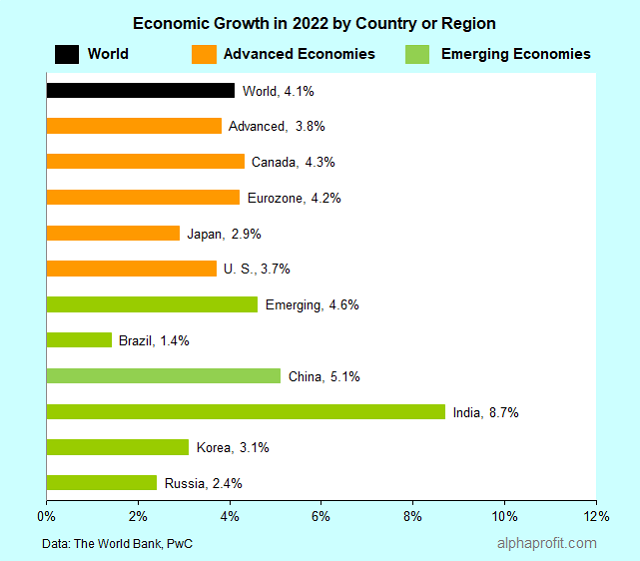
The World Bank expects continued COVID flare-ups, diminished fiscal support, and lingering supply bottlenecks to limit global economic growth to 4.1% in 2022 after expanding 5.5% in 2021.

The bank forecasts growth in advanced and emerging economies to slow to 3.8% and 4.6%, respectively, this year.

Should I Invest in International Stocks-Growth Perspective

The World Bank expects the world economy to grow 4.1% in 2022 compared to 5.5% in 2021. The bank forecasts slower growth in both advanced and emerging economies.

The resurgence of the pandemic from the omicron variant, widespread supply constraints, and rising inflation dampened the pace of recovery in advanced economies towards the end of 2021.

The World Bank expects growth to moderate further from the withdrawal of policy support and the depletion of pent-up demand.

The economic growth rate in the U. S. and the euro area are forecasted to decline to 3.7% and 4.2%, respectively, this year. Japan is a bright spot in contrast. The economic growth rate in Japan is forecasted to increase to 2.9%.

In emerging economies, the World Bank expects China’s growth rate to moderate to 5.1% in 2022 due to the lingering effects of the pandemic and tighter regulations on specific sectors of the economy.

Against the above backdrop, analysts expect corporate earnings growth in developed and emerging international markets and the U. S. to converge to a relatively narrow range.

According to Refinitiv, analysts expect corporate earnings in developed and emerging markets to grow 6.6% and 8.0%, respectively, compared to 7.9% in the U. S.

However, from a trend perspective, analysts have been raising their earnings growth estimates for developed and emerging markets companies while lowering their earnings growth estimates for U. S. companies.

Should I Invest in International Funds in 2022: Currency Conversion Perspective

Helped by strong economic growth in 2021 and prospects of higher interest rates in 2022, the U. S. dollar enjoyed a banner year versus developed market currencies last year.

According to data on TradingEconomics.com, the trade-weighted dollar index (DXY) gained 6.7% versus developed country currencies in 2021. The dollar gained 12.6% versus the Japanese yen and 7.4% versus the euro.

The dollar moved in a narrower range versus emerging market currencies. The Chinese yuan managed to rise 2.7% versus the dollar. The Indian rupee and the Mexican peso fell 2.0% and 3.1%, respectively, versus the dollar.

The Federal Reserve’s tough talk on inflation and rising geopolitical worries from Russia’s invasion of Ukraine has supported the dollar in 2022 despite its apparent over-valuation.

The CME Group currency futures show traders expect the dollar to decline fractionally versus developed market currencies in 2022. The quotes show the dollar falling 1.3% vis-a-vis the euro and 1.1% vis-à-vis the yen.

Traders, however, expect the dollar to gain versus emerging market currencies. The quotes show the dollar rising between 1% and 6% vis-à-vis the Chinese yuan, Indian rupee, and the Mexican peso.

Should I Invest in International Funds in 2022: Technical Perspective

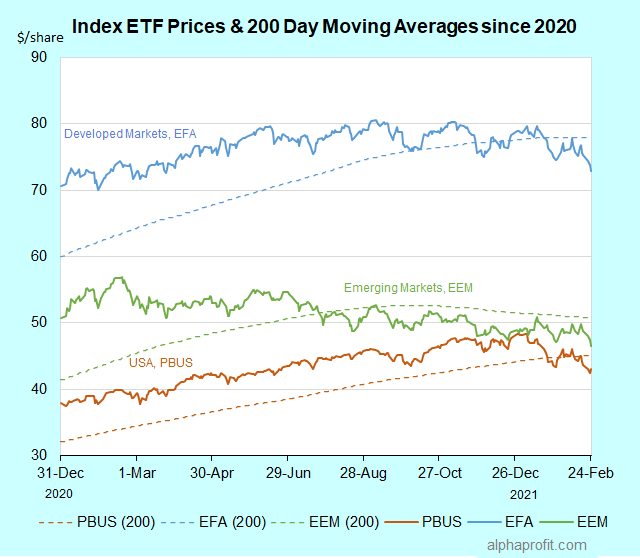
The ETFs tracking the MSCI USA, MSCI EAFE, and MSCI Emerging Markets indexes are trending lower. All of them have fallen below the 200-Day Moving Averages (DMA).

Should I Invest in International Stocks - Technical Perspective

Invesco MSCI USA (PBUS), iShares MSCI EAFE (EFA), and iShares MSCI Emerging Markets (EEM) are all in downtrends, having fallen below their corresponding 200-Day Moving Averages.

The iShares MSCI Emerging Markets ETF (EEM) was the first to lose its hold on its 200-DMA in 2021, falling below the trendline in the summer. The iShares MSCI EAFE ETF (EFA) followed suit in the fourth quarter.

While the Invesco PureBeta MSCI USA ETF (PBUS) held above its 200-DMA through 2021, its fall in 2022 has been swift. The Invesco PureBeta MSCI USA ETF has fallen more rapidly in 2022 than the iShares MSCI EAFE and iShares MSCI Emerging Markets ETFs.

Should I Invest in International Stocks in 2022: Bottom Line

Attractive valuation is one argument that supports the case for owning international stocks. Corporate earnings growth prospects also appear to be improving overseas. Currency translation effects can provide a tailwind for international stocks if the U. S. dollar loses some of its shine. There is not much to choose between the U. S. and international stocks from a technical perspective.

So, what will it take for international stocks to outperform U. S. stocks in 2022?

International stocks tend to be more sensitive to global growth than U. S. stocks. The likelihood of international stocks outperforming U. S. stocks should improve if forecasts for euro area economies growing faster than the U. S. in 2022 turn true.

So, should you invest in international stocks in 2022?

The answer is Yes.

Now is not the time to give up on international investing. If anything, it is time to increase allocation to international stocks and international funds.

International stocks are due to provide superior returns compared to U. S. stocks. Whether 2022 turns out to be such a year depends on whether global growth accelerates this year.