Are Bearish Charts Signaling More Losses – Feb. 20, 2022

Concerns of Russia invading Ukraine intensified towards the latter part of last week after President Biden said the probability of an attack in coming days remains high. Earlier in the week, Russia announced it had pulled some of its military units back from its border with Ukraine. Speculation about the Federal Reserve’s next interest rate move also weighed on equities.

Stocks moved up and then down last week in response to the buildup of Russian troops along the Ukraine border and comments from Russia.

On Tuesday, Russia said it had withdrawn part of its troops near the Ukraine border. The saber-rattling, however, continued with U. S. President Biden warning that the threat of Russia invading Ukraine is “very high.” In return, Russia accused Biden of stoking tensions and ignoring its security demands.

The credibility of Russia withdrawing its troops took a hit after Russia prepared to carry out more drills near Ukraine’s border on Friday. After the stock market closed for the week, President Biden said he is “convinced” Russia has decided to attack Ukraine in the coming days.

The tension between the U. S. and Russia pushed oil prices higher due to the possibility of U. S. imposing retaliatory sanctions against Russian oil. Oil futures rose above $95 per barrel for the first time in seven years. Reports of a deal between the U. S. and Iran allowing the latter to sell its oil in the global market stemmed the rise. Oil retreated to close the week at about $91 per barrel.

St. Louis Fed President Bullard continued to press for a 0.5% hike in the benchmark interest rate in March. Interest rate futures, however, failed to follow suit. They reflected a lower probability of a 0.5% hike. The Fed’s January meeting minutes did not unveil additional support for a 0.5% step-up in interest rates.

The yield on the 10-year Treasury note declined by 0.03% for the week to end at 1.93% on a lower probability of a 0.5% interest rate increase in March and flight to quality from rising tension in Ukraine.

For the week ending February 18, the S&P 500 (SPY) fell 1.4%. Ten of the 11 sectors declined.
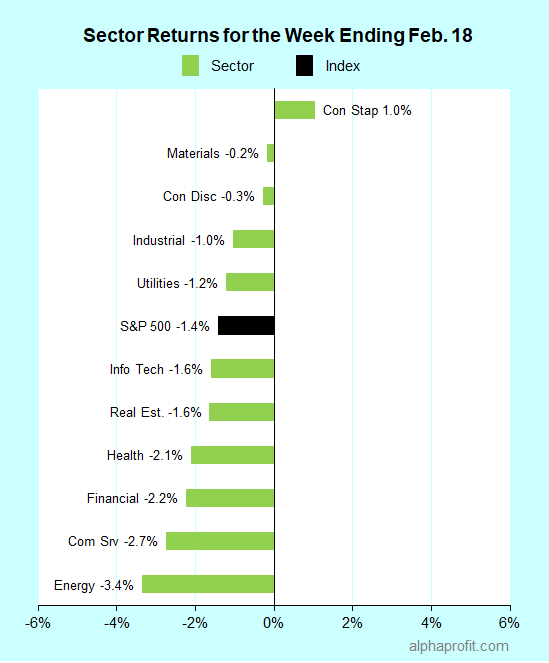
Leading and lagging sectors as charts turn bearish - February 18, 2022

Leading and lagging sectors as charts turn bearish – February 18, 2022.

Market breadth was negative. The number of advancing stocks in the S&P 500 lagged the number of decliners by a 2-to-3 ratio.

Consumer staples (XLP) bucked the S&P 500, ending above the flatline. Materials (XLB) and consumer discretionary (XLY) held up better than the S&P 500.

Energy (XLF), communication services (XLC), and financials (XLF) lagged the S&P 500, losing 2.2% or more.

The S&P 500’s top 10 winners included the following:

1. Consumer Staples

Kraft Heinz (KHC) +11% – The consumer goods company earned $0.79 a share in the fourth quarter, beating analysts’ forecasts by 25%. Kraft Heinz shares were the week’s top performer in the S&P 500.

2. Industrials

Westinghouse Air Brake Technologies (WAB) +10% – The transportation equipment provider gave an upbeat assessment of its future from growth in orders for its battery-electric locomotives. Westinghouse Air Brake raised its quarterly dividend by 25%.

3. Health Care

Henry Schein (HSIC) +10% – The dental supplies company topped analysts’ fourth-quarter EPS forecasts by 18% and raised its 2022 EPS guidance to imply 5-9% growth.

4. Consumer Discretionary

Expedia (EXPE) +9% – The online travel agency continued to rise after its upside EPS surprise from the prior week. Several brokers, including Goldman Sachs & Bank of America, raised their price targets on Expedia amidst positive vibes about the recovery in travel volumes from Marriott and Airbnb this week.

5. Materials

Sealed Air (SEE) +9% – A $0.01 per share shortfall in Sealed Air’s fourth-quarter EPS versus analysts’ forecasts did not deter investors from driving the share price higher after the packaging materials provider forecasted sales and EPS to grow 6% and 14%, respectively, in 2022.

Other Top 10 Winners

The S&P 500’s top 10 winners for the week also included:

  • Backup power generation equipment maker Generac (GNRC) +7%
  • Diversified consumer products company Newell Brands (NWL) +6%
  • Gold producer Newmont Mining (NEM) +6%
  • Networking & telecom equipment maker Cisco Systems (CSCO) +6%
  • Office property owner Vornado Realty (VNO) +8%

Top ETFs for the week

The following ETFs themes worked well: gold miners, platinum, Shanghai & Shenzhen listed Chinese A-shares and silver miners. The top ETFs for the week include:

  • VanEck Gold Miners ETF (GDX) +6.4%
  • Aberdeen Standard Physical Platinum Shares ETF (PPLT) +3.6%
  • VanEck Junior Gold Miners ETF (GDXJ) +3.2%
  • KraneShares Bosera MSCI China A 50 Connect Index ETF (KBA) +2.9%
  • Global X Silver Miners ETF (SIL) +2.5%

Top Fidelity Fund for the week

  • Fidelity Select Gold (FSAGX) +5.0%

Are Bearish Charts Signaling More Losses in the Week Ahead

The Presidents’ Day holiday shortens the trading week. Investors are keenly watching technical levels & patterns on key stocks and indexes as tensions between Russia & Ukraine remain in focus. In economic data, an update on the Fed’s preferred inflation measure is the highlight of the week. The earnings calendar includes a few high-profile retailing names.

* Investors expect tension in Ukraine and inflation data to make the Presidents’ Day shortened four-day trading week a volatile one. Their attention is on the NASDAQ Composite & the S&P 500 stock indexes, and bellwether Apple. The NASDAQ Composite Index has formed a death cross with its 50-Day Moving Average (DMA) falling below the 200-DMA. The S&P 500 has fallen below its 200-DMA, and a test of the 4,223 January low could be in the offing. Apple, the largest constituent of the NASDAQ Composite and the S&P 500 benchmarks, holds above its 200-DMA currently. Sharper declines could be in store for stock indexes if Apple fails to hold above its 200-DMA.

* A meeting between the U. S. Secretary of State Blinken and Russian Foreign Minister Lavrov seeking a diplomatic solution over Ukraine is likely to materialize in the latter part of the week if Russia does not invade Ukraine.

* The week includes a few economic reports. The Commerce Department’s report on Personal Consumption Expenditures (PCE) is the one investors most eagerly await. Economists surveyed by the Wall Street Journal expect the core PCE (excludes food and energy expenditures) to rise 0.5% in January, matching the rise in December. They expect the Core PCE to rise 5.2% on a 12-month basis, up from 4.9% in December.

* The earnings reporting season is winding down. Home improvement retailers Home Depot and Lowe’s feature prominently among the S&P 500 companies reporting this week. Online travel agency Booking Holdings, health care companies, Medtronic & Moderna, oil producer EOG Resources, and storage REIT Public Storage are among the other names reporting.


Stay on top of the stock market with ‘Looking Back, Looking Forward’

Sign up free to receive Looking Back, Looking Forward in your Inbox.


Learn more:

How AlphaProfit's investment strategy minimizes your risk
How AlphaProfit keeps your fees and expenses low
Performance of model portfolios & recommendations in AlphaProfit's Premium Service investment newsletter
AlphaProfit's free and premium investment newsletters
Inflation and Ukraine Threaten Stocks – Feb. 13, 2022

The surge in the consumer price index to a 40 year high rattled investors last week. Stock prices fell as the yield on the 10-year Treasury note topped 2%. The sell-off in stock prices worsened after the White House warned on the possibility of Russia invading Ukraine soon.

Stocks climbed gradually in the early part of the week from range-bound bond yields, robust earnings reports, and French President Macron’s positive comments about his meeting with Russian President Putin.

The calm ended when the U. S. Labor Department said the consumer price index (CPI) surged 7.5% during the 12 months ending in January. The annual rise in consumer prices topped economists’ 7.3% estimate, marking the highest annual increase in inflation in 40 years.

St. Louis Federal Reserve President Bullard surprised markets after the CPI data came out. He called for short-term benchmark interest rates to be 1% higher by July.

Weighed by rising inflation, the University of Michigan’s preliminary reading of consumer sentiment fell to 61.7 in February, the lowest reading since October of 2011.

Bonds sold off, pressuring stocks. The 10-year Treasury note yield climbed above the 2% mark, rising to a high of 2.06% on Friday.

Deeping the sell-off on Friday afternoon, the U. S. National Security Advisor Sullivan told a White House briefing that Russia could invade Ukraine during the Winter Olympics. The U. S. and U. K. advised their citizens to leave Ukraine as soon as possible.

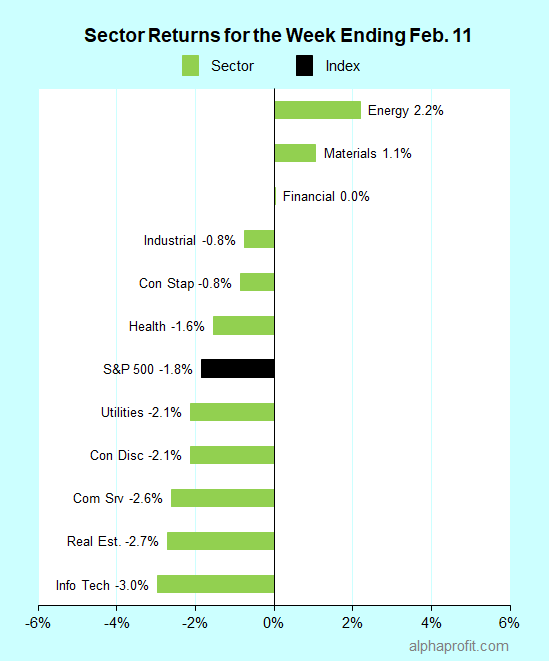
For the week ending February 11, the S&P 500 (SPY) fell 1.8%. The benchmark closed below the psychologically important 200-day moving average. Eight of the 11 sectors declined.

Leading and lagging sectors as inflation and Ukraine threaten stocks - February 11, 2022

Leading and lagging sectors as inflation and Ukraine threaten stocks – February 11, 2022.

Market breadth was negative. The number of advancing stocks in the S&P 500 lagged the number of decliners by a 3-to-4 ratio.

Energy (XLE), materials (XLB), and financials (XLF) led the S&P 500, ending above the flatline.

Information technology (XLK), real estate, and communication services (XLC) lagged the S&P 500, losing 2.6% or more.

The S&P 500’s top 10 winners included the following:

1. Consumer Discretionary

Newell Brands (NWL) +14% – The diversified consumer products company beat analysts’ fourth-quarter sales and EPS forecasts by 6% and 30%, respectively, to be the week’s top performer in the S&P 500.

Royal Caribbean (RCL) +11% and Carnival Corp. (CCL) +10% – Cruise operators rose after competitor Norwegian Cruise Line Holdings (NCLH) provided positive comments on booking volumes & pricing. Norwegian ended the requirement for all passengers to wear masks onboard its ships.

Penn National Gaming (PENN) +8% – The casino operator rose after competitor MGM Resorts International (MGM) gave an upbeat assessment of the recovery in gambling activity in Las Vegas.

2. Materials

Freeport-McMoRan (FCX) +11% – The U. S.-based copper producer rose on reports of copper inventories nearing ultra-low levels.

3. Consumer Staples

Tyson Foods (TSN) +11% – The meat producer reported a 24% increase in quarterly sales to $12.9 billion and a 48% increase in EPS to $2.87 after passing price increases for its products to customers. Tyson forecasts fiscal 2022 sales to grow 8% to $51 billion.

Other Top 10 Winners

The S&P 500’s top 10 winners for the week also included:

  • Air carrier United Airlines (UAL) +10%
  • Energy services & technologies company Baker Hughes (BKR) +10%
  • Marketing & corporate communications company Omnicom Group (OMC) +11%
  • Memory chipmaker Micron Technology (MU) +11%

Top ETFs for the week

The following ETFs themes worked well: metals including silver and gold, volatility, and cannabis. The top ETFs for the week include:

  • ETFMG Prime Junior Silver Miners ETF (SILJ) +10.9%
  • iPath Series B S&P 500 VIX Short-Term Futures ETN (VXX) +10.7%
  • AdvisorShares Pure US Cannabis ETF (MSOS) +9.5%
  • SPDR S&P Metals and Mining ETF (XME) +9.4%
  • VanEck Junior Gold Miners ETF (GDXJ) +8.5%

Top Fidelity Fund for the week

  • Fidelity Select Gold (FSAGX) +6.3%

Inflation and Ukraine Threaten Stocks in the Week Ahead

Debates over interest rates are likely to influence markets this week as investors seek clarity from Federal Reserve officials on the course of interest rates this year. Investors will get additional input on inflation. Rising worries of Russia invading Ukraine may continue to impact investor sentiment. Few high-profile earnings reports are in store as well.

* Investors are looking for clear communication from the Federal Reserve. Comments from St. Louis Fed Bank President Bullard about aggressive rate hikes rattled investor sentiment last week. Other Fed officials pushed back on Bullard’s reaction. This week brings the Fed’s current thinking into focus with Bullard and five more Fed officials, including New York Fed President Williams and Fed Governor Brainard, speaking at different forums.

* The Federal Reserve also releases minutes from its January 26-27 FOMC meeting on Wednesday. Investors will look to the minutes for insights on the Fed’s inflation outlook and plans to increase interest rates and shrink its balance sheet.

* Investors eagerly await data on inflation in wholesale prices. According to Briefing.com, economists expect the producer price index (PPI) to increase 0.5% in January compared to 0.2% in December. Stocks can see a relief rally if the PPI increases less than expected. Investors will also scrutinize data on January retail sales as rampant inflation caused consumer sentiment to fall last week.

* The U. S. estimates Russia has amassed more than 100,000 troops near Ukraine’s borders. Russia has created pressure points on three sides of Ukraine — Crimea to the south, Belarus to the north, and the Russian side of the Russia-Ukraine border. Investors will be alert to news on Russian troop movements to assess the situation.

* AIG, Cisco, Deere, Nvidia, and Walmart report earnings this week.


Stay on top of the stock market with ‘Looking Back, Looking Forward’

Sign up free to receive Looking Back, Looking Forward in your Inbox.


Learn more:

How AlphaProfit's investment strategy minimizes your risk
How AlphaProfit keeps your fees and expenses low
Performance of model portfolios & recommendations in AlphaProfit's Premium Service investment newsletter
AlphaProfit's free and premium investment newsletters
Top Fidelity Funds for January 2022

Fidelity funds focusing on commodity stocks including energy & natural resources, Latin America, and banks were top performers in January.

Top Fidelity Funds for January 2022

Excludes closed Fidelity funds

* Fidelity Select Energy Portfolio, FSENX +18.3%

* Fidelity Natural Resources Fund, FNARX +12.1%

* Fidelity Latin America Fund, FLATX +6.5%

* Fidelity Global Commodity Stock Fund, FFGCX +5.3%

* Fidelity Select Banking Portfolio, FSRBX +4.3%

Stocks contributing to the performance of the above Fidelity funds likely include Canadian Natural Resources Limited (CNQ), Exxon Mobil Corporation (XOM), ConocoPhillips (COP), Chevron Corporation (CVX), Wells Fargo & Company (WFC), Petrobras PN – Pfd Reg (PBR), Qualitas Controlado SAB de CV (Q.MX), and Hypera SA (HYPE3.SA).

Bottom performers for January include Fidelity Select Biotechnology Portfolio (FBIOX), Fidelity Disruptive Medicine Fund (FMEDX), Fidelity Growth Strategies Fund (FDEGX), Fidelity Select Medical Technology and Devices Portfolio (FSMEX), and Fidelity Select Semiconductors Portfolio (FSELX).


Stay on top of the stock market with ‘Looking Back, Looking Forward’

Sign up free to receive Looking Back, Looking Forward in your Inbox.


Learn more:

How AlphaProfit's investment strategy minimizes your risk
How AlphaProfit keeps your fees and expenses low
Performance of model portfolios & recommendations in AlphaProfit's Premium Service investment newsletter
AlphaProfit's free and premium investment newsletters
Inflation and Earnings to Fuel Volatility – Feb. 6, 2022

U. S. stocks swung by a wide margin as investors reacted to earnings reports. Facebook set a U. S. record for the highest one-day loss in market capitalization. A day later, Amazon created a U. S. record for the highest one-day increase in market capitalization. Job creation in January exceeded economists’ forecast by a wide margin. The 10-year bond yield surged to pre-pandemic levels.

The Labor Department reported the economy added 467,000 jobs in January. The number significantly exceeded economists’ estimate of 150,000. Economists had expected the omicron variant to impact job creation. Surprisingly, wages grew 5.7% year-over-year, exceeding economists’ 5.2% forecast.

The January jobs report and comments on inflation from the Bank of England and the European Central Bank boosted bond yields. The yield on the 10-year Treasury note increased 0.15% for the week. It closed at 1.93%, a level last seen before the pandemic in 2019.

Stock prices swung by a wide margin. Facebook parent Meta Platforms fell over 26% in a single day after posting disappointing quarterly results and forecasts. The decline wiped out more than $200 billion off Meta Platform’s market capitalization, the highest one-day loss in the value of a U. S. company.

On the brighter side, a robust quarterly report from Amazon helped its shares to a one-day gain of 14%. Amazon’s market capitalization increased by nearly $190 billion, the highest single-day increase in the value of a U. S. company.

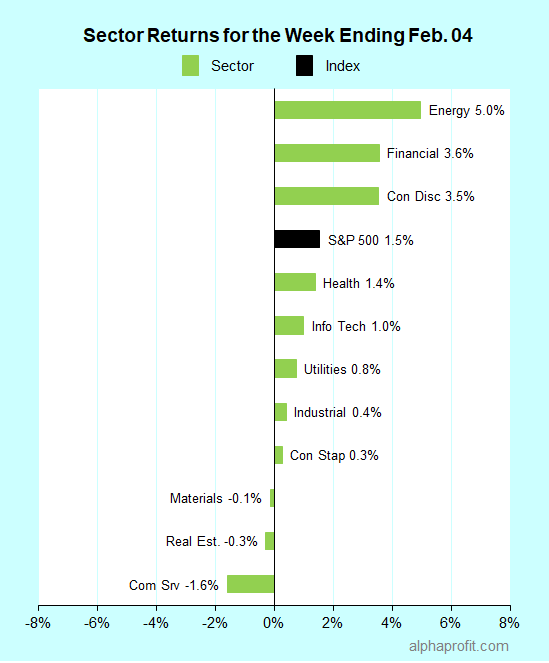
For the week ending February 04, the S&P 500 (SPY) rose 1.5%. The benchmark closed above the psychologically important 4,500 mark, regaining its hold on its 200-day moving average. Eight of the 11 sectors gained.

Inflation and Earnings to Fuel Volatility – Feb. 6, 2022

Leaders and laggards for the week ending February 04, 2022.

Market breadth was positive. The number of advancing stocks in the S&P 500 exceeded the number of decliners by a 2-to-1 ratio.

Energy (XLE), financials (XLF), and consumer discretionary (XLY) led the S&P 500, rising 3.5% or more.

Communication services (XLC), real estate (XLRE), and materials (XLB) lost ground.

The S&P 500’s top 10 winners included six information technology companies. One company from the communication services, health care, industrial, and materials sectors accounted for the remaining four.

1. Information Technology

Value-priced shares of DXC Technology (DXC) surged 21% to be the week’s top performer in the S&P 500. The IT services company reported $0.92 in quarterly EPS, a penny above analysts’ estimate. DXC also reaffirmed its fiscal year 2024 revenue growth and EPS forecasts.

Semiconductor chip makers Advanced Micro Devices (AMD) and Xilinx (XLNX) rose 17% each. AMD reported blowout revenues and EPS that beat analysts’ forecasts by 7% and 21%, respectively. The company also forecasted revenue to grow 31% in 2022. With AMD is in the process of buying Xilinx in stock, the latter’s shares rode the rally in the former.

Enphase Energy (ENPH) up 14%, SolarEdge Technologies (SEDG) up 12%, and Fortinet (FTNT) up 11% were the other three winners.

2. Industrials

United Parcel Service (UPS) + 13% – The logistics and freight titan topped analysts’ quarterly revenue and sales estimates by 3% and 16%, respectively. UPS also upped its quarterly dividend by 48% to $1.52 a share.

3. Health Care

Bio-Techne Corp. (TECH) +12% – The life sciences research instruments and reagents provider life sciences topped analysts’ EPS forecast by 5%. Bio-Techne also approved a new $400 million share buyback program.

4. Materials

Nucor (NUE) +11% – The steel maker’s shares continued their advance from the previous week when Nucor reported robust earnings. Stellar earnings from competitor Steel Dynamics (STLD) extended the rally in Nucor shares this week.

5. Communication Services

T-Mobile (TMUS) +11% – The wireless services provider posted $0.34 in quarterly EPS versus analysts $0.13 forecast. Analysts appeared unfazed with T-Mobile’s revenues and 2022 forecasts lagging expectations.

Top ETFs for the week

The following ETFs themes worked well: cannabis, carbon credits, bitcoin, blockchain, and metals. The top ETFs for the week include:

  • AdvisorShares Pure US Cannabis ETF (MSOS) +10.6%
  • KraneShares Global Carbon ETF (KRBN) +8.3%
  • ProShares Bitcoin Strategy ETF (BITO) +7.5%
  • Amplify Transformational Data Sharing ETF (BLOK) +7.1%
  • SPDR S&P Metals and Mining ETF (XME) +7.0%

Top Fidelity Fund for the week

  • Fidelity Select Energy (FSENX) +5.3%

Inflation and Earnings to Fuel Volatility in the week of February 7

Investors brace for more volatility this week with inflation data in focus. Earnings reports from nearly a sixth of the S&P 500 companies are due this week.

* Investors’ attention turns to inflation data this week after job creation in January surprised to the upside, leading to the possibility of the Federal Reserve aggressively raising interest rates.

* The Labor Department reports the consumer price index on Thursday. According to Briefing.com, economists expect the headline CPI to rise 0.5% in January, matching the December tally. Economists expect the CPI to rise 0.5% in January, excluding food and energy costs. In December, CPI rose 0.6%, excluding food and energy costs. The economic calendar also includes the reading from the University of Michigan’s consumer sentiment survey.

* The earnings calendar includes reports from about 80 S&P 500 members. They include Amgen, CVS Health & Pfizer from health care, Disney from communication services, and Coca-Cola, PepsiCo & Philip Morris International from consumer staples.


Stay on top of the stock market with ‘Looking Back, Looking Forward’

Sign up free to receive Looking Back, Looking Forward in your Inbox.


Learn more:

How AlphaProfit's investment strategy minimizes your risk
How AlphaProfit keeps your fees and expenses low
Performance of model portfolios & recommendations in AlphaProfit's Premium Service investment newsletter
AlphaProfit's free and premium investment newsletters
Top ETFs for January 2022

ETFs focusing on natural gas and energy stocks were top performers in January.

Top ETFs for January 2022

Excludes ETFs leveraged or less than $500 million in assets

* United States Natural Gas Fund, UNG +36.2%

* VanEck Oil Services ETF, OIH +22.2%

* Energy Select Sector SPDR Fund, XLE +18.8%

* Vanguard Energy Index ETF, VDE +17.5%

* Fidelity MSCI Energy Index ETF, FENY +17.4%

Stocks contributing to the performance of the above ETFs likely include Halliburton (HAL), Schlumberger (SLB), Occidental Petroleum (OXY), EOG Resources (EOG), and ExxonMobil (XOM).

Bottom performers for January include Grayscale Ethereum Trust (ETHE), Invesco WilderHill Clean Energy ETF (PBW), ARK Fintech Innovation ETF (ARKF), ARK Innovation ETF (ARKK), and ARK Next Generation Internet ETF (ARKW).


Stay on top of the stock market with ‘Looking Back, Looking Forward’

Sign up free to receive Looking Back, Looking Forward in your Inbox.


Learn more:

How AlphaProfit's investment strategy minimizes your risk
How AlphaProfit keeps your fees and expenses low
Performance of model portfolios & recommendations in AlphaProfit's Premium Service investment newsletter
AlphaProfit's free and premium investment newsletters
Will the Stock Market Go Up in 2022?

Investors want to know the answer to ‘Will the Stock Market Go Up in 2022?’ after stocks have quickly lost 7% this year. This decline has taken a bite out of the 29% gain stocks enjoyed in 2021. Investors worry about the Federal Reserve aggressively tightening interest rate policy in response to high inflation. Will the stock market go up in 2022?

Investors could not have had a better year in the market than 2021 in many ways.

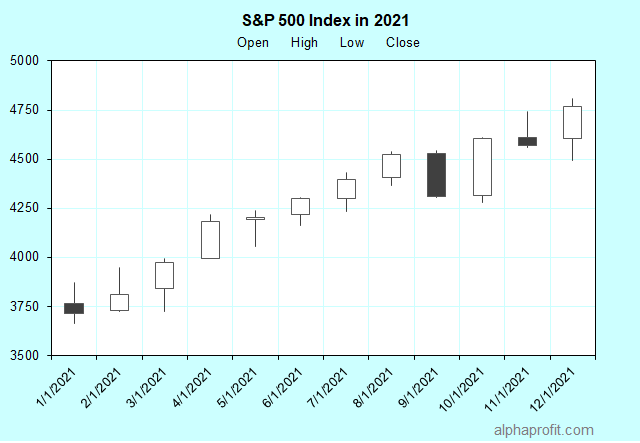
The S&P 500 advanced nearly 29%, ending the year within 1% of its record daily close.

The benchmark index recorded 70 new highs through 2021, the second-most in a calendar year ever.

These gains came with little volatility, with the year’s highest drawdown being a mere 5%.

Stocks rose in 2020 while earnings declined. Will the stock market go up in 2021?

Stocks lost ground in January, September, and November of 2021. They made significant gains in the first, second, and fourth quarters, helping the S&P 500 close the year within 1% of its record daily close. Register now to receive AlphaProfit investment ideas, tips, and analyses in your inbox.

The Federal Reserve continued to support the economy through 2021 with near-zero interest rates and bond purchases implemented in response to the pandemic in 2020.

The economy showed robust growth in the first-half of 2021. U. S. gross domestic product (GDP) expanded at annualized rates of 6.3% and 6.7% in the first and second quarter, respectively.

The emergence of the delta coronavirus variant pressured GDP growth in the third quarter to 2.3% before rebounding to grow at a 6.9% annualized rate in the fourth.

Robust year-over-year earnings growth supported the advance in stock prices in 2021.

According to FactSet, S&P 500 members are on track to grow per-share earnings (EPS) by 45.5% in 2021. They grew EPS by 47%, 87%, and 24%, respectively, in the first three quarters of 2021. Analysts currently expect S&P 500 members to grow EPS by 24.3% in the fourth quarter.

Key factors likely to influence stock market performance in 2022 include inflation & interest rates, earnings growth, valuation, political events, and COVID developments.

Will the Stock Market Go Up in 2022? – Inflation and Interest Rate Impact

Year-over-year increases in inflation measures generally worsened through 2021 due to supply chain disruptions and labor shortages.

On January 28, 2022, the U. S. Bureau of Economic Analysis reported the core personal consumption expenditures index (core PCE), the Federal Reserve’s preferred inflation measure, rose 4.9% in 2021, the highest 12-month increase since September 1983.

After holding its first interest rate policy meeting in 2022 on January 25-26, the Federal Reserve warned inflation remains above its long-run goal and supply problems are larger & more long-lasting than previously thought.

Chairman Powell said there is significant room to raise interest rates without hurting the labor market, virtually assuring an interest rate hike after the Fed meets next in March.

The Fed also indicated that it would begin shrinking its $9 trillion balance sheet after implementing its first interest rate increase in 2022.

Curtailing inflation without halting an economic expansion requires a deft touch. The Federal Reserve needs to follow a balancing act in 2022.

With growth and inflation already set to slow this year, investors fear the central bank’s aggressive stance on inflation could tip the economy into another recession. These worries have caused stocks to sell off this month

Will the Stock Market Go Up in 2022? – Earnings Growth Impact

Stock prices are likely to face headwinds in 2022 from earnings growth and valuation perspectives.

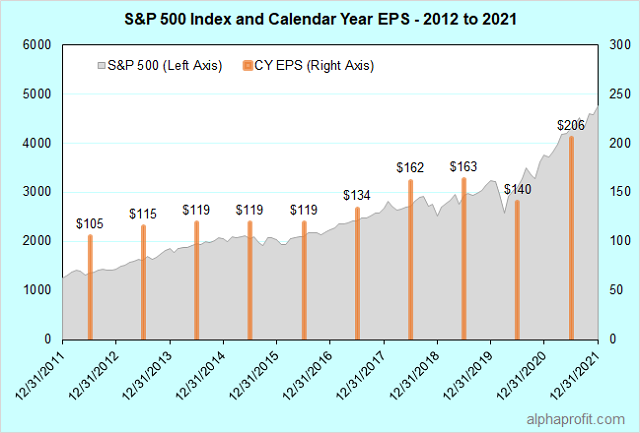
According to FactSet, analysts expect S&P 500 members to grow their earnings by 9.5% in 2022, faster than 7.7% averaged from 2012 through 2021.

Yet, this 2022 earnings growth forecast is a significant slowdown from the 45.5% growth in earnings expected in 2021.

History shows stocks have trouble making headway when earnings growth slows.

Learn more: Which sectors are likely to fare well this year?

Will the Stock Market Go Up in 2022? – Valuation Impact

The S&P 500 has gained at a 14.3% annualized rate, excluding dividends from 2012 to 2021. Meanwhile, earnings have grown at a 7.7% annualized rate.

Gains in stock prices have exceeded earnings growth due to an expansion in the price-to-earnings (P/E) ratio valuation metric.

The Federal Reserve’s near-zero interest rate policy has supported the increase in the P/E ratio.

Excluding dividends, the S&P 500 has returned 12.3% annualized since 2010. Will the stock market go up in 2022?

Excluding dividends, the S&P 500 returned 14.3% annualized since 2012, while aggregate EPS for the S&P 500 members has grown 7.7% annualized. Register now to receive AlphaProfit investment ideas, tips, and analyses in your inbox.

The members of the S&P 500 now trade at 19.2-times analysts’ 12-month earnings forecast, compared to this metric’s 10-year average of 16.7.

Interest rates are poised to rise in 2022 since the Fed’s focus is on inflation.

Rising interest rates cause the P/E ratio to decline since earnings in future years become less worth when discounted at higher interest rates.

As such, some compression in the P/E ratio is likely as long as the Fed is in an inflation-fighting mode.

Learn more: What are the best growth stocks to buy now in the top sectors?

Will the Stock Market Go Up in 2022? – Impact of Political Events

The tension in Ukraine has attracted worldwide attention since the start of the year. Concerns of Russia planning to invade Ukraine are up. U. S. troops are on alert due to the buildup of Russian forces along the Ukraine border.

Likewise, tensions between the U. S. & China are up over the future of Taiwan.

The year also includes the U. S. mid-term elections in November. If Republicans gain control of either the U. S. House or Senate, a split Congress can be good news for investors.

Historically, stocks have returned the most under Democratic presidents kept in check by a split or Republican-controlled Congress.

Will the Stock Market Go Up in 2022? – COVID Impact

The surge in COVID cases in late 2021 from the omicron coronavirus variant and the emergence of the omicron subvariant BA.2 in 2022 raises uncertainty. The new variants can potentially disrupt supply chains further and exacerbate inflation.

The World Health Organization warns the next coronavirus variant will be more transmissible. The major unknown is whether or not future variants will be more or less severe.

The transmissibility of the new virus variants and the severity of the illness they cause will impact how the economy performs in 2022. The economy can fare well if new virus variants are more transmissible and milder.

While this would be great for humanity, the implications for investors may not be favorable as this would remove the reason for the Federal Reserve to limit interest rates increases.

So, what does all this mean? Will the stock market go up in 2022?

Will the Stock Market Go Up in 2022? – The Bottom Line

We look at two scenarios to assess the range of reasonable outcomes.

On January 28, the S&P 500 closed at 4,431.85, implying a trailing P/E ratio of 21.6 based on analysts’ 2021 EPS estimate of $205.51.

The trailing P/E ratio has ranged between 13.0 and 35.0 from 2012 through 2021, averaging 23.0 over these 10 years.

The S&P 500 would close 2022 at 5,151 if S&P 500 members earn $223.94 a share in 2022, as analysts currently expect, and the trailing P/E ratio returns to its 23.0 average. This close would imply a 2022 year-end forward P/E ratio of 20.9, assuming analysts’ 2023 S&P 500 EPS forecast stays at $246.52.

In this scenario, the S&P 500 would rise 16% from its January 28 close to gain 8% in 2022.

The above scenario can materialize if the Federal Reserve does not drastically tighten interest rate policy, helping the trailing P/E ratio return to its long-term average and S&P 500 company aggregate EPS in 2022 to meet or exceed current expectations.

How low can stocks reasonably drop if inflation does not moderate and the Federal Reserve raises interest rates multiple times in 2022?

In this case, reasonable assumptions include weaker economic growth, lower P/E ratio, and lower 2023 S&P 500 EPS forecast.

Assuming no growth in earnings between 2022 and 2023, S&P 500 companies would earn $223.94 a share in 2023, the same as in 2022.

If the forward P/E ratio returns to its 5-year average of 18.5, the S&P 500 will end 2022 at 4,143. The S&P 500 will end 2022 6.5% below its January 28 close, declining 13% for the year.

If the forward P/E ratio returns to its 10-year average of 16.7, the S&P 500 will end 2022 at 3,740, losing 22% for the year.

In sum, the Federal Reserve’s focus on reducing inflation to its 2% target is a significant risk for stocks. Economic growth already appears to be slowing. The worst for inflation may be passing right now. The Fed may be less inclined to raise interest rates if data confirm slowing growth and inflation in the coming months. The bull market can extend its longevity if the Fed takes its foot off the interest rate pedal.

So, Will the Stock Market Go Up in 2022? Investors need to weigh the reward potential and risk rather than seek a Yes or No answer to this question.

Stocks can provide a single-digit gain in 2022 if all goes well. The downside risk to stock prices, however, exceeds the upside potential. Investors are likely to be better off leaving rallies alone in 2022. Instead, using weakness in stock prices akin to the one in January to build long-term positions can prove rewarding.


Stay on top of the stock market with ‘Looking Back, Looking Forward’

Sign up free to receive Looking Back, Looking Forward in your Inbox.


Learn more:

How AlphaProfit's investment strategy minimizes your risk
How AlphaProfit keeps your fees and expenses low
Performance of model portfolios & recommendations in AlphaProfit's Premium Service investment newsletter
AlphaProfit's free and premium investment newsletters
Stocks Await a Defining Week Ahead – Jan. 23, 2022

U. S. stocks lost further ground as they continued to struggle for their first weekly gain in 2022. Investors worried about the Fed aggressively tightening interest rate policy in response to high inflation. The S&P 500 fell below its 200-day moving average, hampered by the sharp rise in bond yields, disappointing earnings reports, and tepid economic data.

Worries of the Federal Reserve responding aggressively to stem inflation spilled over into this holiday-shortened trading week on hawkish comments from Federal Reserve officials. Investors reflected on U. S. consumer prices showing the highest annual rise in nearly four decades In December.

The yield on the 10-year Treasury note spiked quickly by 0.1% to 1.87% after starting the week at 1.77%, marking its highest level since December 2019.

Earnings reports gave investors angst. Earnings at Goldman Sachs and Netflix fell short of expectations. The cautious 2022 outlook provided by banks sapped analyst’s enthusiasm to raise earnings expectations for the coming quarters. Upward earnings revisions fell below 59% in January from 72% last month.

Increasing investor angst, the uptick in weekly jobless claims, and disappointing existing home sales suggested the economy is losing momentum due to the omicron coronavirus variant.

Stocks had trouble holding up against the above negatives. Attempts to rally met with sizeable sell orders. The S&P 500 lost its hold on the 4,500 mark while the NASDAQ Composite fell below 14,000. The S&P 500 joined the NASDAQ Composite in falling below its psychologically important 200-day moving average.

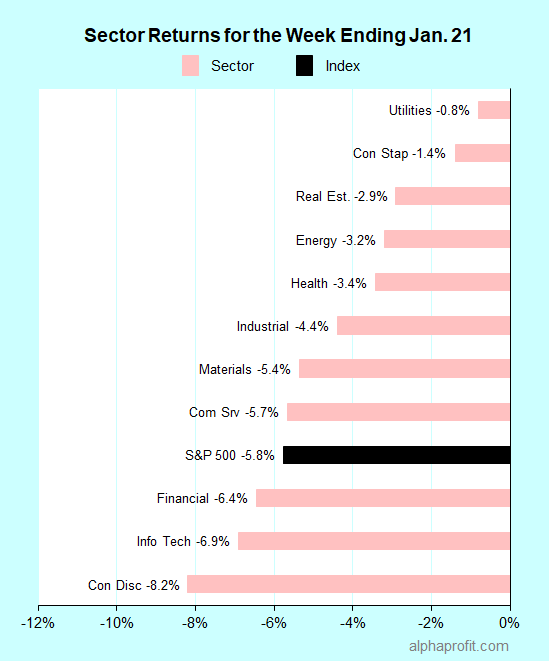
For the week ending January 21, the S&P 500 (SPY) fell 5.8%. None of the 11 sectors gained.
 

Sector returns for the week ending January 21, 2022

Leaders and laggards for the week ending January 21, 2022.

Market breadth was overwhelmingly negative. The number of declining stocks in the S&P 500 exceeded the number of advancers by nearly 20-to-1.

Defensive sectors utilities (XLU), consumer staples (XLP), and real estate (XLRE) held up better than the S&P 500, losing 2.9% or less.

Consumer discretionary (XLY), information technology (XLK), and financials (XLF) lagged the S&P 500, losing 6.4% or more.

The S&P 500’s top 10 winners included three communication services companies. The remaining seven winners were split evenly across seven sectors.

1. Communication Services

Activision Blizzard (ATVI) surged 24%, becoming the top performer in the S&P 500 for the week after Microsoft offered $69 billion for the gaming software maker. Other gaming software makers, Take-Two Interactive Software (TTWO) and Electronic Arts (EA), rose 8% and 7%, respectively, on the possibility of attracting buyout offers.

2. Information Technology

Citrix Systems (CTXS) +6% – The enterprise software firm jumped 6% after Bloomberg reported Elliott Investment Management and Vista Equity Partners are in advanced talks to buy Citrix.

3. Materials

Newmont Mining (NEM) +2% – The gold miner gained after gold rose 0.8% for the week, and competitor Barrick Gold reported production in line with forecasts incurring lower than expected costs.

4. Consumer Discretionary

Las Vegas Sands (LVS) +2% – The casino resort operator extended its gains from the previous week, ending the week 2% higher. UBS upped the stock’s rating from Neutral to Buy, citing a better outlook for casinos in Macau.

5. Real Estate

Prologis (PLD) +2% – The industrial REIT reported 18% growth in its funds from operations in the fourth quarter of 2021 and forecasted above-average growth for the future.

Other Top 10 Winners
The S&P 500’s top 10 winners for the week included:

  • Consumer staples giant Procter & Gamble (PG) +2%
  • Futures and options exchange CME Group (CME) +1%
  • Medical technology company Hologic (HOLX) +1%

Top ETFs for the week

The following ETFs themes worked well: volatility, platinum, silver, precious metals, and Brazil. The top ETFs for the week include:

  • iPath Series B S&P 500 VIX Short-Term Futures ETN (VXX) +25.7%
  • Aberdeen Standard Physical Platinum Shares ETF (PPLT) +6.2%
  • iShares Silver Trust (SLV) +5.6%
  • Aberdeen Standard Physical Precious Metals Basket Shares ETF (GLTR) +3.7%
  • iShares MSCI Brazil ETF (EWZ) +2.8%

Top Fidelity Fund for the week

  • Fidelity Select Gold (FSAGX) +2.0%

Looking ahead to the week of January 24

Having fallen below its 200-day moving average, the S&P 500 can either fall further or redeem itself from events this week. The week’s key event is the Federal Reserve’s two-day interest rate policy meeting. A big week awaits investors on the earnings front too. Investors also get an early read into the economy’s growth in the fourth quarter and an update on inflation.

* Last week, the S&P 500 broke its 200-day moving average when it fell below 4,430 last Friday to close the week at 4,398. Investors are now waiting to see if the benchmark sinks further or finds enough buying interest to rebound above this trendline. As described below, many events can impact the outcome this week.

* The Federal Reserve meets on Tuesday and Wednesday to discuss interest rate policy. This meeting is the focal event of the week. Economists do not expect the Fed to raise interest rates or change policy at this meeting. Investors are looking for more guidance on the central bank’s plan to tighten interest rate policy, including the magnitude of the interest rate increase in March and plans to shrink the Fed’s $9 trillion balance sheet.

* The fourth-quarter earnings season steps into a higher gear this week. Two trillion-dollar companies in Apple and Microsoft report this week. Other notable names reporting earnings include Chevron, Johnson & Johnson, Mastercard, Tesla, and Visa.

* The Commerce Department’s Bureau of Economic Analysis releases its preliminary reading on U. S. economy growth in the fourth quarter. Briefing.com shows economists’ consensus estimate for the economy to grow at a 5.6% annualized rate in the fourth quarter, up from 2.3% in the third. The Bureau also reports the December personal consumption expenditures index, the Fed’s preferred inflation measure. Economists expect the core-PCE excluding food & energy prices to increase 0.4% in December, down from 0.5% in November.


Stay on top of the stock market with ‘Looking Back, Looking Forward’

Sign up free to receive Looking Back, Looking Forward in your Inbox.


Learn more:

How AlphaProfit's investment strategy minimizes your risk
How AlphaProfit keeps your fees and expenses low
Performance of model portfolios & recommendations in AlphaProfit's Premium Service investment newsletter
AlphaProfit's free and premium investment newsletters

Will 4Q21 Earnings Extend the Rally in Value Stocks?

U. S. stocks extended their decline from the first week of 2022. Bank earnings disappointed investors. In economic data, retail sales and consumer sentiment declined. Inflation remained high. Investors questioned the strength of the economy to get through the omicron risk.

U. S. stocks fell for a second consecutive week. Bank stocks, which had been rising in recent weeks against the backdrop of rising interest rates, dropped as their earnings reports underwhelmed investors. JPMorgan guided profits to fall short of targets due to higher expenses, the threat of the omicron virus variant, and lower trading revenues.

In economic data, retail sales fell 1.9% in December, more than the 0.1% decline expected by economists surveyed by Dow Jones. Shortage of goods and a steep increase in omicron-related infections impacted retail sales.

The University of Michigan’s preliminary January consumer sentiment reading fell 1.8 points in January to 68.8. The decline in consumer sentiment reflected the pain lower-income Americans face from inflation.

Inflation stayed high and generally in line with economists’ expectations. The consumer price index showed a year-over-year increase of 7%, the highest in four decades, while the producer price index report reflected a rise of 9.7% over the same period.

The above data raised doubts on the economy having enough strength to overcome the pressure from the omicron virus while the Federal Reserve tapers monetary stimulus to counter inflation.

By the end of the week, investors rotated out of cyclical value stocks and sought bargains in out-of-favor large-cap growth stocks.

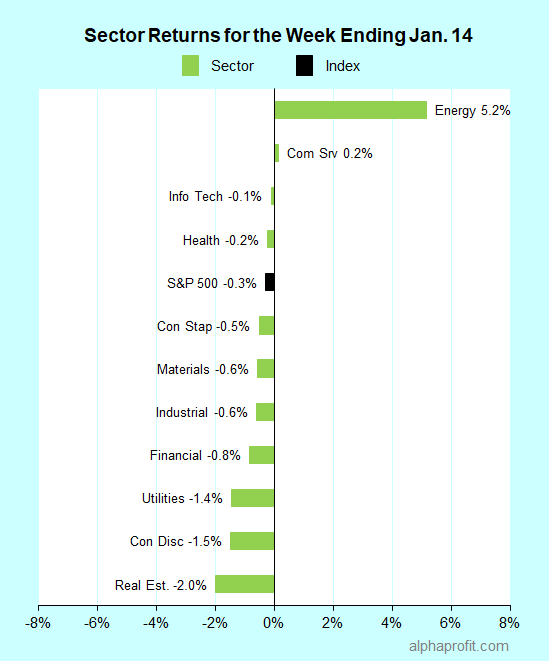
For the week ending January 14, the S&P 500 (SPY) fell 0.3%. Two of the 11 sectors gained.

Sector returns for the week ending January 14, 2022

Leaders and laggards for the week ending January 14, 2022.

Market breadth was neutral, with the number of advancing stocks in the S&P 500 almost equaling the number of decliners.

Energy (XLE) and communication services (XLC) ended above the flat line.

Real estate (XLRE), consumer discretionary (XLY), and utilities (XLU) lagged the S&P 500, losing 1.4% or more.

The S&P 500’s top 10 winners included consumer discretionary, energy, health care, and information technology companies.

1. Consumer Discretionary

Gaining 13%, Las Vegas Sands (LVS) was the top performer in the S&P 500 for the week. Sand’s competitor Wynn Resorts (WYNN) rose 8%. Casino stocks rose after the Macau government clarified the number of casinos allowed to operate there would remain limited to six.

Robust quarterly results & forecasts and comments on firm pricing & rising margins from non-S&P 500 index homebuilder KB Home lifted share prices across this group. Index member PulteGroup (PHM) ended 9% higher for the week.

2. Energy

APA Corp. (APA), Halliburton (HAL), Pioneer Natural Resources (PXD), and Phillips 66 (PSX) rose 8-12% each, following oils 6% gain for the week. Oil rose on a weaker U. S. dollar and escalating supply concerns, spurred by the tension between the U. S. and Russia vis-à-vis Ukraine.

3. Information Technology

Semiconductor capital equipment makers Applied Materials (AMAT) and Lam Research (LRCX) rose 11% and 9%, respectively, after semiconductor chipmaker Taiwan Semiconductor said it intends to spend over $40 billion expanding and upgrading capacity in 2022 due to unprecedented chip shortage.

4. Health care

Illumina (ILMN) shares rose 9% after the gene-sequencing technology company upped its 2022 revenue forecast and announced new partnerships with four healthcare companies.

Top ETFs for the week

The following ETFs themes worked well: oil services, Brazil, oil & gas, copper mining, and Saudi Arabia. The top ETFs for the week include:

  • VanEck Oil Services ETF (OIH) +7.7%
  • iShares MSCI Brazil ETF (EWZ) +6.7%
  • SPDR S&P Oil & Gas Exploration & Production ETF (XOP) +6.0%
  • Global X Copper Miners ETF (COPX) +5.8%
  • iShares MSCI Saudi Arabia ETF (KSA) +5.6%

Top Fidelity Fund for the week

  • Fidelity Select Energy Portfolio (FSENX) +5.7%

Looking ahead to the week of January 17

With things quiet on the bond front during this four-day trading week, investors will shift their focus to fourth-quarter earnings. Investors will get insights on what companies expect in 2022 and how they are coping with inflation as earnings reports broaden beyond financials to other sectors. The extension of the rally in cyclical stocks hinges on what economically sensitive businesses say. Data on manufacturing and housing are also in store.

* Investors will focus on fourth-quarter earnings reports during this trading week, shortened by the observance of Martin Luther King Jr. Day. For one, the bond market could provide some calm following the completion of Treasury auctions last week. Federal Reserve officials are also in a “quiet period” ahead of their January 25-26 interest rate policy meeting.

* Fourth-quarter earnings reports pick up steam this week, with good representation from sectors other than information technology. The reporting companies include Bank of America, Netflix, Procter & Gamble, PPG Industries, Prologis, Schlumberger, Union Pacific, and UnitedHealth Group. Commentary from economically sensitive businesses on the outlook for 2022 earnings and inflation can either extend or curtail the rally in value stocks.

* The economic calendar includes manufacturing surveys from the New York & Philadelphia Federal Reserve, housing starts, and existing home sales.


Stay on top of the stock market with ‘Looking Back, Looking Forward’

Sign up free to receive Looking Back, Looking Forward in your Inbox.


Learn more:

How AlphaProfit's investment strategy minimizes your risk
How AlphaProfit keeps your fees and expenses low
Performance of model portfolios & recommendations in AlphaProfit's Premium Service investment newsletter
AlphaProfit's free and premium investment newsletters

Another Week of Growth Stocks Down and Value Up? – Jan. 8

U. S. stocks started the new year with a decline. Investors feared the Federal Reserve would tighten interest rate policy quickly in 2022. As bond yields surged and the yield curve steepened, growth stocks swooned while value stocks gained.

Fears of the Federal Reserve aggressively tightening monetary conditions escalated after the minutes of the December 14-15 Federal Open Market Committee (FOMC) meeting came out last week.

The minutes showed the FOMC officials viewed the labor market as “very tight.” They also indicated their readiness to end pandemic-era stimulus, shrink the balance sheet, and raise interest rates.

The U. S. economy added just 199,000 jobs in December, short of the 422,000 forecasted by economists. The sub-par job creation, however, did not quell interest rate fears.

Investors saw the larger-than-expected 0.6% increase in average hourly earnings and a bigger-than-expected drop in the unemployment rate to a pandemic era low of 3.9%, encouraging the Fed to tighten.

Traders raised the odds of the Fed raising the short-term benchmark federal funds rate in March to 90% from 63% at the start of 2022. Somewhat surprisingly, the yield on the longer-dated 10-year Treasury soared 0.26% to a two-year high of 1.77%.

The yield curve steepened as the yield on longer-dated Treasury notes rose more than the yield on the shorter-term Treasury bills.

Rising bond yields took a toll on growth stock prices that trade on cash flows expected far off in the future. Value stocks fared better as investors bet on economically sensitive companies performing better in a rising rate environment.

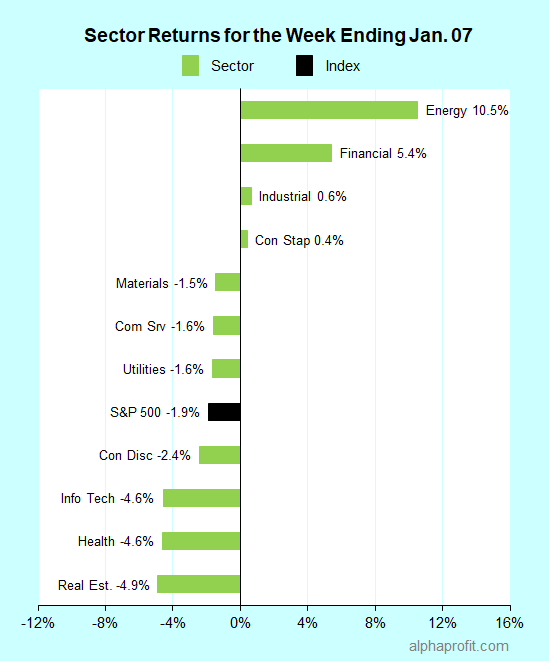
For the week ending January 7, the S&P 500 (SPY) fell 1.9%. Four of the 11 sectors gained..

Sector returns for the week ending January 07, 2022

Leaders and laggards for the week ending January 07, 2022.

Market breadth was neutral, with the number of advancing stocks in the S&P 500 almost equal to the number of decliners.

Energy (XLE), financials (XLF), and industrials (XLI) led the S&P 500.

Real estate (XLRE), health care (XLV), and information technology (XLK) lagged the benchmark losing 4.6% or more.

The S&P 500’s top 10 winners included communication services, consumer discretionary, energy, and financial companies.

1. Communication Services

Surging 28%, Discovery, Inc. (DISCK, DISCA) was the top performer in the S&P 500 for the week. Bank of America raised the media company to Buy, expecting its pending merger with Warner Media to create a dynamic rival to Netflix and Disney+ in the streaming space.

Share of media giant ViacomCBS (VIAC) gained 17% after the Wall Street Journal reported AT&T-owned WarnerMedia and ViacomCBS are exploring a possible sale of a significant stake or all of the CW Network, which they jointly own.

2. Consumer Discretionary

Automaker Ford Motor (F) gained 18% after announcing that it will nearly double the production of its all-electric F-150 Lightning pickup to 150,000 units annually due to strong customer demand.

3. Energy

Energy companies Hess (HES) and Schlumberger (SLB) rose 17% each, while Occidental Petroleum (OXY) rose 15%, following the 5% rally in the price of oil in the opening week of 2022 on supply concerns. Investors doubted if OPEC & Russia could deliver on their agreement to increase output by 400,000 barrels per day (BPD) in February after Reuters reported OPEC increased production by only 70,000 in December from November, short of the 253,000 BPD increase allowed under the supply deal.

4. Financials

Regional bank Regions Financial (RF), M&T Bank (MTB), Citizens Financial Group (CFG), and People’s United Financial (PBCT) rose 14-15%. The difference in yield between 10-year Treasury notes and 3-month Treasury bills, also called the yield curve, rose by 0.2% last week to 1.66%. A steeper yield curve expands the net interest margin for banks and increases lending profits.

Top ETFs for the week

The following ETFs themes worked well: oil services and energy, banks, energy master limited partnerships, and uranium. The top ETFs for the week include:

  • VanEck Oil Services ETF (OIH) +14.6%
  • Energy Select Sector SPDR Fund (XLE) +10.5%
  • Invesco KBW Bank ETF (KBWB) +10.1%
  • Alerian MLP ETF (AMLP) +7.1%
  • Global X Uranium ETF (URA) +6.1%

Top Fidelity Fund for the week

  • Fidelity Select Energy Portfolio (FSENX) +10.8%

Looking ahead to the week of January 10

Investors will focus their attention on the bond market again this week, seeking clarity on whether last week’s steepening of the yield curve was an aberration. Investors will also receive inputs from Fed Chairman Powell and data on inflation. The fourth-quarter earnings reporting season starts at the end of the week.

* Last week, blue-chip companies rushed to issue bonds and lock lower borrowing costs. The yields on longer-dated income securities rose more than the yields on shorter-dated income securities on account of these corporate bond sales. Treasury auctions this week can bring clarity on the likelihood of the yield curve flattening when corporate bond sales subside. Value stocks can come under pressure if the yield curve flattens.

* Federal Reserve Chairman Powell testifies at his nomination hearing before a Senate panel this week. Investors are keenly waiting for his tone and comments in light of the tightening plans evident in the Fed minutes released last week. This week also includes the nomination hearing to confirm Fed Governor Brainard’s to the post of the vice-chair.

* The economic calendar includes inflation data at the consumer and producer level. Briefing.com shows economists forecasting the core consumer price index to rise 0.5% in December, matching November’s tally. They expect the increase in the core producer price index to moderate to 0.5% in December from 0.7% in November.

* The week also marks the start of the fourth-quarter earnings season, with the nation’s top banks, JPMorgan Chase, Citigroup, and Wells Fargo, reporting on Friday. Investors will also get insight into the state of the semiconductor and airline industries when Taiwan Semiconductor and Delta Air Lines report ahead of the banks.


Stay on top of the stock market with ‘Looking Back, Looking Forward’

Sign up free to receive Looking Back, Looking Forward in your Inbox.


Learn more:

How AlphaProfit's investment strategy minimizes your risk
How AlphaProfit keeps your fees and expenses low
Performance of model portfolios & recommendations in AlphaProfit's Premium Service investment newsletter
AlphaProfit's free and premium investment newsletters

Best ETFs, Funds, and Stocks of 2021. A Preview to 2022.

Large-cap stocks showed solid gains in 2021, backed by robust year-over-year earnings growth. The Federal Reserve remained accommodative to support economic growth. Inflation and virus variants became the topmost worries for investors. The top-performing ETFs, Fidelity funds, and S&P 500 members advanced in this milieu. Niche ETFs and selected S&P 500 winners gained double- and triple digits. Here is a list of the best, along with what to look forward to in 2022.

The large-cap S&P 500 index had a remarkable 2021, gaining 28.6%. The benchmark recorded at least one new record close every month of the year. The S&P 500 registered 70 record high closes in total through the year, the most in a year since 77 in 1995.

The S&P 500 also outperformed other large-cap benchmarks such as the Dow Jones Industrial Average (DJIA) and NASDAQ Composite, which gained 20.9% and 22.2%, respectively.

The average stock did not fare as well. The small-cap Russell 2000 index gained 14.8% in 2021.

Robust growth in corporate earnings in the face of new COVID-19 variants, labor shortages, and disrupted supply chains drove the U.S. stock market’s impressive performance in 2021.

According to FactSet data, S&P 500 companies increased their earnings in the first three quarters of 2021 by 47.0%, 86.9%, and 36.7%, respectively. Analysts expect earnings to grow 21.2% in the fourth quarter, with EPS growth for all of 2021 amounting to 45.1%.

The Federal Reserve supported the economy through the year with near-zero interest rates and $120 billion in monthly bond purchases before outlining steps to cut back pandemic era stimulus in December.

As 2021 ended, the U. S. economy portrayed a healthy picture. Investors were concerned more about inflation than recession.

The omicron coronavirus variant continued to strain the health care system. Investors, however, stayed composed, focusing on indications of the omicron variant being milder than other virus variants. The omicron virus variant also raised hopes of accelerating the end of the pandemic.

Here, we look at what ETFs, Select SPDRs, Fidelity funds, and S&P 500 stocks returned the most in 2021.

Best ETFs of 2021

Ethereum, carbon credits, rare earth metals, uranium, and oil & gas were themes that worked well in the ETF world.

  • Grayscale Ethereum Classic Trust, ETC       +145.1%
  • KraneShares Global Carbon ETF, KRBN       +106.7%
  • VanEck Rare Earth/Strategic Metals ETF, REMX       +80.2%
  • North Shore Global Uranium Mining ETF, URNM       +78.7%
  • First Trust Nasdaq Oil & Gas ETF, FTXN       +69.2%

Best Select Sector SPDR ETFs of 2021

The Energy Select Sector SPDR took the top position. Oil surged 55% in 2021 as demand increased from easing of COVID restrictions while OPEC & Russia limited production.

  • Energy Select Sector SPDR, XLE       +53.3%
  • Real Estate Select Sector SPDR, XLRE       +46.1%
  • Financial Select Sector SPDR, XLF       +34.8%
  • Technology Select Sector SPDR, XLK       +34.7%
  • Consumer Discretionary Select Sector SPDR, XLY       +27.9%

See: Best Sectors for 2022

Best Fidelity Funds of 2021

Fidelity funds focused on semiconductors, housing, energy, and real estate claimed top honors. The shortage of semiconductor chips that started in early 2020 has continued through 2021, boosting share prices in this industry.

  • Fidelity Select Semiconductors Portfolio, FSELX       +59.2%
  • Fidelity Select Construction and Housing Portfolio, FSHOX       +57.6%
  • Fidelity Select Energy Portfolio, FSENX       +55.4%
  • Fidelity Real Estate Investment Portfolio, FRESX       +42.4%
  • Fidelity Real Estate Index Fund, FSRNX      +40.7%

See: Best Fidelity funds for 2022

Best S&P 500 Stocks of 2021

Two of the top five winners for the year were oil & gas producers, Devon Energy and Marathon Oil. COVID vaccine developer Moderna followed its five-fold increase in 2020 with another 143% in 2021. Other winners included cybersecurity solutions provider Fortinet and automaker Ford Motor.

  • Devon Energy, DVN       +191.1%
  • Marathon Oil, MRO       +148.9%
  • Moderna, Inc., MRNA       +143.1%
  • Fortinet, Inc., FTNT       +142.0%
  • Ford Motor Co., F       +137.4%

See: Best Sectors and Stocks for Strongest Growth in 2022

Looking ahead to 2022

The course of the stock market in 2022 is likely to be determined more by earnings growth than by support from the Federal Reserve’s interest rate policy. Investors will focus on the December jobs report and the FOMC December meeting minutes in the near term. Democrats are working to revive the President’s stalled Build Back Better bill in January.

* Stock prices have risen from an increase in the price-to-earnings ratio valuation metric and growth in earnings. Stocks are likely to receive less help from valuation-metric expansion in 2022. Although analysts expect S&P 500 company earnings growth to slow in 2022 compared to 2021, stocks can gain in 2022 if earnings growth exceeds current expectations.

* The December jobs report, due this Friday, is the focal event of the week. According to Dow Jones, economists predict the economy to add 405,000 jobs in the final month of 2021, up from 210,000 in November. They forecast the unemployment rate to drop to 4.1% from 4.2% in November.

* The Federal Reserve releases the minutes of the FOMC’s December 14-15 meeting on Wednesday. Investors will look for details to assess when the Fed may be inclined to raise interest rates. The FOMC announced its plan to taper monthly bond purchases after this meeting.

* Senate Democrats headed by Senator Schumer look forward to reviving President Biden’s Build Back Better bill this month. Conservative Democrat Senator Manchin is open to restarting negotiations after opposing it in December on cost grounds.

* The earnings calendar is quiet before it picks up steam from fourth-quarter reports in the latter part of January. Few companies from the defensive consumer staples and healthcare sectors report this week. The reporting companies include Constellation Brands, Conagra Brands, Lamb Weston, and Walgreens Boots Alliance.


Stay on top of the stock market with ‘Looking Back, Looking Forward’

Sign up free to receive Looking Back, Looking Forward in your Inbox.


Learn more:

How AlphaProfit's investment strategy minimizes your risk
How AlphaProfit keeps your fees and expenses low
Performance of model portfolios & recommendations in AlphaProfit's Premium Service investment newsletter
AlphaProfit's free and premium investment newsletters