Best ETFs, Funds, and Stocks of 2022. A Preview to 2023.

In 2022, high inflation and rising bond yields emerged as headwinds for stocks. The S&P 500 declined by over 18%, marking its worst yearly showing since 2008. After being late to recognize inflation, the Federal Reserve raised interest rates sharply. The disruptions from the war in Ukraine and trading restrictions on Russia helped energy and other commodity-related assets flourish. Top-performing ETFs and S&P 500 winners gained double digits. Here is a list of the best and what to expect in 2023.

U.S. stocks suffered their highest yearly loss since 2008 in 2022. The large-cap S&P 500 index fell 18.1%, while the small-cap Russell 2000 index declined 20.4%.

Stubborn inflation and rising bond yields weighed on stock prices. The Federal Reserve raised its federal funds benchmark interest rate by 4.0% through 2022 to the 4.25-4.50% range, the highest in 15 years.

Quick relief on inflation proved elusive. The year-over-year increase in core personal consumption expenditures, the Federal Reserve’s preferred inflation measure, averaged 5% in 2022 after peaking at 5.4% in March.

The 10-year Treasury bond ended the year with a yield of 3.9% after starting the year with a yield of 1.5%.

The stocks in the S&P 500 index collectively lost $8.2 trillion in market value. Stocks in the information technology, consumer discretionary, and communication services sectors suffered the most. Apple, Microsoft, Amazon, Alphabet, Meta, and Tesla alone accounted for over $5 trillion in lost market capitalization.

As 2022 ended, investors worried about the Fed’s focus on achieving its 2% long-term inflation goal in the context of a relatively robust job market. Investors feared that a healthy job market would give the Fed room to hike interest rates further and raise the chances of a recession.

Here, we look at which ETFs, Select SPDRs, Fidelity funds, and S&P 500 stocks returned the most in 2022.

Best ETFs of 2022

Energy-related ETFs topped the performance charts by a wide margin. They claimed the top five spots.

  • VanEck Oil Services ETF, OIH       +66.2%
  • Energy Select Sector SPDR Fund, XLE       +64.2%
  • Fidelity MSCI Energy Index ETF, FENY       +63.1%
  • Vanguard Energy Index Fund ETF Shares, VDE       +62.9%
  • iShares U.S. Energy ETF, IYE       +60.3%

Best Select Sector SPDR ETFs of 2022

The Energy Select Sector SPDR took the top position. The only other sector to close above the flat line was utilities.

  • Energy Select Sector SPDR, XLE       +64.2%
  • Utilities Select Sector SPDR, XLU       +1.4%
  • Consumer Staples Select Sector SPDR, XLP       -0.8%
  • Health Care Sector SPDR, XLV       -2.1%
  • Industrial Select Sector SPDR, XLI       -5.6%
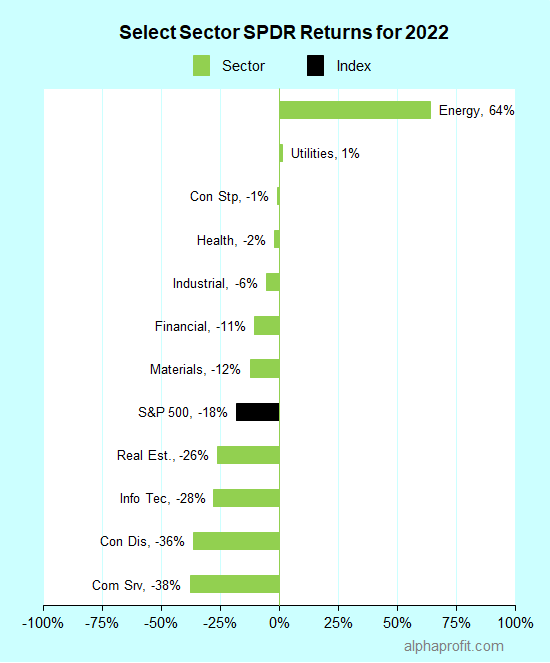
Select Sector SPDR Returns for 2022

Select Sector SPDR Returns for 2022

See: Best Sectors for 2023

Best Fidelity Funds of 2022

Fidelity funds focusing on commodity stocks climbed to the top of the performance table. Fidelity Select Insurance was the sole non-commodity fund in the top five; it claimed the fifth spot as insurance stocks fared well in this rising interest rate environment.

  • Fidelity Select Energy Portfolio, FSENX       +63.0%
  • Fidelity Natural Resources Fund, FNARX       +41.0%
  • Fidelity Global Commodity Stock Fund, FFGCX       +20.7%
  • Fidelity Agricultural Productivity Fund, FARMX       +13.7%
  • Fidelity Select Insurance Portfolio, FSPCX      +7.8%

See: Best Fidelity funds for 2023

Best S&P 500 Stocks of 2022

Energy companies in the S&P 500 took the top five spots, gaining over 80% each. Oil & gas exploration and production companies Occidental Petroleum and Hess Corp. claimed the top two spots. Spots three and four were claimed by refiner Marathon Petroleum and integrated oil giant Exxon Mobil, respectively. Energy services provider Schlumberger was the fifth-best performer.

  • Occidental Petroleum, OXY       +119.1%
  • Hess Corp., HES       +93.6%
  • Marathon Petroleum, MPC       +85.8%
  • Exxon Mobil, XOM       +86.1%
  • Schlumberger Ltd., SLB       +80.7%

See: Best Sectors and Stocks for Strongest Growth in 2023

Looking ahead to 2023

Stocks have started 2023 on a positive note. The S&P 500 rose 1.5% in the first week of the new year, breaking a four-week losing streak. Stocks rallied sharply after the Labor Department showed wage gains slowed last December.

The Labor Department reported that the economy added 223,000 jobs. The unemployment rate fell to 3.5%. Average hourly earnings rose 0.3%, less than the 0.4% economists had forecast in a Dow Jones survey. Average hourly earnings were up 4.6% in December on a 12-month basis. The monthly and yearly changes in average hourly earnings declined from 0.6% and 5.1%, respectively, in November.

Investors saw the moderation in the rate of increase in average hourly earnings as a sign of easing inflation. Federal Reserve officials, however, downplayed the data in the jobs report, saying inflation remains far too high and the Fed has more work to do.

In other economic data, the Institute for Supply Management’s manufacturing and services sector indexes both fell below 50.0% for the first time in over 30 months, suggesting contraction.

U.S. Treasury yields declined across the board last week. The 10-year Treasury ended the week yielding 3.6%, 0.3% lower than its start this year.

Investors’ focus is now on the December consumer price index data due this Thursday. Economists surveyed by Dow Jones forecast the core CPI (which excludes food and energy prices) to increase by 5.7% on a year-over-year basis.

This week also marks the start of the fourth quarter earnings reporting season. Top banks, including Bank of America, JPMorgan Chase, and Wells Fargo, report earnings. Asset manager Blackrock, Taiwan Semiconductor, health insurer UnitedHealth Group, and Delta Airlines also report.

The CPI data and fourth-quarter earnings reports will impact stock prices this week.

The year 2023, in total, need not be a bad one for stocks after a dismal 2022. If inflation continues to trend lower, the Fed stops raising the federal funds rate around 5%, and the economy avoids a recession, stock prices can gain double digits in 2023.


Stay on top of the stock market with ‘Looking Back, Looking Forward’

Sign up free to receive Looking Back, Looking Forward in your Inbox.


Learn more:

How AlphaProfit's investment strategy minimizes your risk
How AlphaProfit keeps your fees and expenses low
Performance of model portfolios & recommendations in AlphaProfit's Premium Service investment newsletter
AlphaProfit's free and premium investment newsletters
AlphaProfit 2022 Premium Service Performance Update

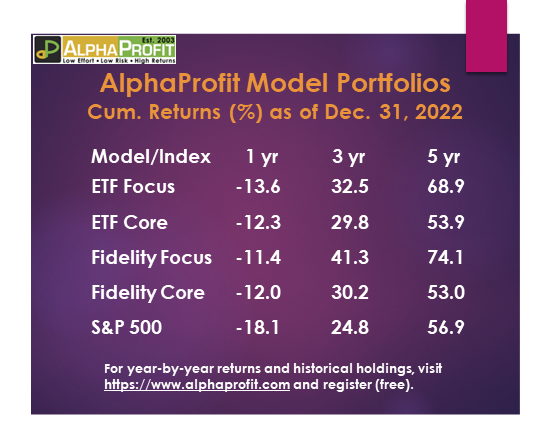
Here are the recent cumulative returns for the ETF and Fidelity model portfolios as of December 31, 2022:

core-focus short-term performance

AlphaProfit Core & Focus model portfolio returns as of Dec. 31, 2022.

The AlphaProfit Core and Focus model portfolios outperformed the S&P 500 in 2022. They have also outperformed the benchmark over the past three years.

Over the past five years, two of the AlphaProfit model portfolios have beaten the S&P 500.

AlphaProfit analyzes sectors based on valuation, momentum, and news quality to select sector ETFs and thematic ETFs for the AlphaProfit ETF and Fidelity Core & Focus model portfolios.

AlphaProfit uses a similar process to choose Fidelity Select funds, Fidelity Sector funds, and Fidelity Thematic funds for the AlphaProfit Fidelity Core & Focus model portfolios.

A dollar invested in this selection process in 1994 is now worth $108.04, while a comparable investment in the S&P 500 is worth just $14.38.

In other words, AlphaProfit’s sector selection process has earned a 17.5% compound annual return, including the COVID crisis, the Great Recession, and the dot-com bust.

AlphaProfit Premium Service subscribers have THREE additional ways to make money in addition to the Core and Focus model portfolios.

1. Stock Recommendations

AlphaProfit features attractively valued stocks with favorable near-term prospects on the 12th of each month. The stock recommendations enable Premium Service subscribers to profit from short-term opportunities.

During the past 12 months, volatility created by inflation and interest rate concerns has provided several profit opportunities.

Here are the gains scored by AlphaProfit subscribers in 2022.

  • Chemours (CC) +18.3%
  • EOG Resources (EOG) +18.2%
  • KB Home (KBH) +18.5%
  • Lithia Motors (LAD) +19.4%
  • Steel Dynamics (STLD) +17.9%
  • Chemours (CC) * +20.4%
  • TotalEnergies (TTE) +11.5%
  • FedEx Corp (FDX) +18.3%
  • United Rentals (URI) +22.4%
  • Marriott Intl. (MAR) +19.0%
  • Owens Corning (OC) +23.7%
  • Diamondback Energy (FANG) +29.4%
  • Reins Grp of America (RGA) +11.5%
  • AGCO Corp. (AGCO) +20.9%
  • Coterra Energy (CTRA) +19.5%
  • Paccar (PCAR) +14.6%
  • United Rentals (URI) * +16.2%
  • Fortune Brands H&S (FBHS) +16.5%
  • Marriott Intl. (MAR) * +13.7%
  • Broadcom (AVGO) +13.2%

* New recommendation after the previous sale

Additional details, including the recommendation date, buy date, buy price, sell date, and sell price, are available to registered users. Registration is free.

AlphaProfit stock recommendations have returned 4.8% a month on average since 2009, with a 91% win rate.

2. Domestic, Foreign, and Specialty Fund Recommendations

Since March 2009, the NL-NTF Growth model portfolio has helped AlphaProfit subscribers quadruple their money.

As of December 18, the NL-NTF Growth model portfolio is up 314.5%, well in excess of the 233.2% return of its benchmark consisting of broad domestic and foreign stock indexes.

The NL-NTF Growth Model portfolio has consistently outperformed its benchmark over the 3-year, 5-year, and 10-year periods.

3. Income Recommendations

AlphaProfit provides a list of ETFs and no-load, no-transaction-fee mutual funds for capital preservation and income objectives.


Stay on top of the stock market with ‘Looking Back, Looking Forward’

Sign up free to receive Looking Back, Looking Forward in your Inbox.


Learn more:

Sector ETF model portfolios from AlphaProfit
Performance of AlphaProfit's ETF model portfolios
How AlphaProfit helps you invest in the best sector ETF consistently
How AlphaProfit's investment strategy minimizes your risk
How AlphaProfit keeps your fees and expenses low
AlphaProfit's free and premium investment newsletters

Fidelity Select Funds: Best Fidelity Select Funds for 2023

Each year, best Fidelity Select Sector funds, on average, beat the S&P 500 by 42%, that is 4,200 basis points. Fidelity Select Energy leads the performance table in 2022 with a year-to-date return of 62%. The Fidelity 500 Index Fund is down 17% in comparison. Which funds will stake their claim as the best Fidelity Select Sector Funds in 2023?

Worries of high inflation and rising interest rates have weighed on stocks through 2022.

The core personal consumption expenditures price index, the Federal Reserve’s preferred inflation measure, has averaged an annual gain of 5.0% this year. That is over twice the Fed’s long-term inflation goal of 2%.

After being late in recognizing the non-transient forces driving inflation, the Fed changed its interest rate policy this year.

The central bank rapidly ramped up its federal funds benchmark interest rate from close to 0% at the start of 2022 to the 4.25-4.50% range by year-end.

Financial assets lost value as the central bank tightened interest policy and drained liquidity.

As of December 21, the Fidelity 500 Index Fund (FXAIX), which tracks the S&P 500 index ($SPX), is down 17% for the year.

According to Bespoke Investment Group, the U.S. stock market has lost nearly $12 trillion in market capitalization from its January 3 high. The mega-cap club members Alphabet (GOOGL), Amazon (AMZN), Apple (AAPL), Meta (META), Microsoft (MSFT), and Tesla (TSLA) account for nearly $5 trillion of these losses.

Best Fidelity Select Funds of 2022

Funds focused on commodity-oriented sectors dominate the list of top performers among Fidelity sector funds, including Fidelity Select Funds and Fidelity Thematic Funds.

Fidelity Select Energy (FSENX) leads the performance table with a year-to-date return of 62%. Oil prices and energy stocks surged over 60% in the first five months of 2022. Energy stocks managed to hold on to these gains even though oil prices retreated in the last seven months of the year.

Funds owning commodity stocks, Fidelity Natural Resources Fund (FNARX), Fidelity Global Commodity Stock Fund (FFGCX), and Fidelity Agricultural Productivity Fund (FARMX), take spots two through four with gains of 40%, 22%, and 15%, respectively.

Fidelity Select Insurance (FSPCX) is the sole non-commodity fund to rank among the top five. It claims the fifth spot with a gain of 8%.

Only 11 of the 47 Fidelity sector and thematic funds are in the black for the year.

Fidelity Select Funds: Best Fidelity Select Funds for 2023

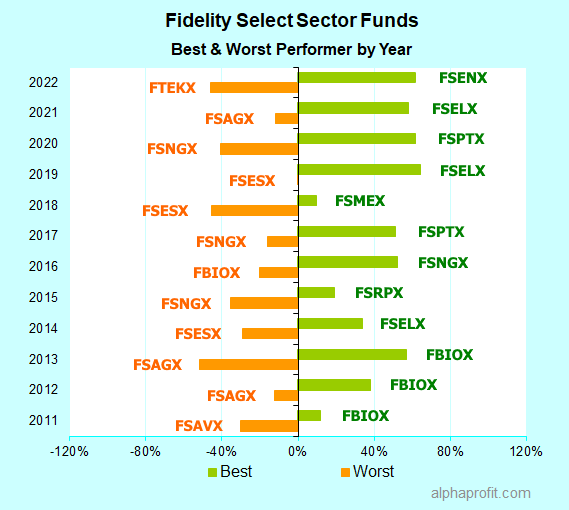
Stubborn inflation and rising interest rates have raised fears of a recession. Investors’ appetite for owning stocks diminished in 2022. Thirty-six of the 47 Fidelity sector and thematic funds are in the red this year. Fidelity Select Energy (FSENX) leads the pack with a 62% gain, while Fidelity Disruptive Technology Fund (FTEKX) is the biggest loser.
Get timely market insights by signing up for the Fidelity Newsletter

Story stocks, or stocks of companies offering the promise of large profits far into the future, have suffered the most. Rising interest rates have lowered the present value of profits well into the future.

The funds that own such companies, Fidelity Disruptive Technology Fund (FTEKX), Fidelity Disruptive Communications Fund (FNETX), and Fidelity Select Communication Services (FBMPX) are at the bottom of the return table after losing 46%, 39%, and 38%, respectively.

Fidelity Select Funds: The Market Milieu in 2023

Inflation remains stubbornly high. In December, the year-over-year change in the core PCE was 4.7%, compared to the high of 5.4% set in March.

Fed Chair Powell acknowledged this fact, saying recent signs of inflation are not enough to convince the central bank that the battle against rising prices is over.

In December, the Fed’s interest rate policy committee forecasted the federal funds rate to rise above 5% in 2023.

The Fed’s focus on bringing inflation down to 2% has investors worried. Many investors believe the Fed is overdoing interest rate increases to tame inflation and could start a new U.S. recession.

Several economic indicators signal a recession. They include the steeply inverted bond yield curve, 10 straight months of decline in existing home sales, and 9 consecutive months of drop in the Conference Board’s U.S. Leading Economic Index.

Although job creation has stayed strong, giving hope that the economy will avoid a recession, investors fear the Fed will raise interest rates even more if the job market remains robust.

As the odds of a recession rise, investors have turned more pessimistic about earnings growth prospects in 2023.

Analysts have whittled down earnings forecasts for the S&P 500 members. They now expect S&P 500 companies to grow earnings by 5.3% in 2023, lower than their forecasts for 8.2% and 9.4% growth on September 30 and June 30, respectively.

There are a few positives worth noting amidst this gloom.

First, China is looking to increase its growth rate by easing COVID restrictions and boosting its real estate sector. Global economic growth should get a lift if China succeeds in this effort.

Second, headwinds to U.S. company earnings from a rising dollar should ease in 2023 if the peak in inflation has passed and the economy weakens.

Best Sectors for 2023

AlphaProfit uses its multi-dimensional sector evaluation and selection process to select industries and sectors with superior return potential. These selections help subscribers to protect and grow their assets with low volatility.

See Fidelity Select Funds: Choose the Best Fidelity Sector Fund Consistently.

The consumer discretionary and healthcare sectors rank high in AlphaProfit’s sector evaluation and selection process.

Consumer Discretionary Sector: The year 2022 was challenging for many companies in the consumer discretionary sector. The consumer discretionary stocks in the S&P 500 are down 35%, nearly twice as much as the S&P 500.

High inflation and falling real wages sapped consumer spending. Retailers bore the brunt as inventories bulged and forced stores to discount merchandise. Travel-related businesses fared better as consumers preferred spending on services and experiences over goods.

Consumer discretionary stocks are attractively valued. A challenging 2022 also sets up easy year-over-year profit comparisons. Although prolonged inflation and a deep recession can hurt consumer discretionary stocks further, they can be among the leaders when inflation moderates and the Fed pivots to cut interest rates.

Healthcare Sector: Consumer demand for healthcare products and services tends to be resilient to economic vagaries. Healthcare stocks stayed true to their promise of being a defensive play in 2022. Healthcare stocks in the S&P 500 have held up much better than the broad benchmark, losing just 2%.

Healthcare companies have a few things going for them in 2023. One, healthcare companies are consolidating as mature ones with robust cash flow look to acquire smaller companies with innovative technologies and higher growth potential. Second, the U.S. Food & Drug Administration is approving promising therapies at an accelerated rate. Third, a divided Congress and the recent extension of healthcare subsidies through the Inflation Reduction Act mitigate legislative risk.

At a minimum, the above factors should help healthcare stocks outperform the broad market until investors’ risk appetite improves.

Best Fidelity Select Funds for 2023

Investors can invest in Fidelity Select funds with the latitude to invest across the entire sector, such as Fidelity Select Consumer Discretionary (FSCPX) and Fidelity Select Health Care (FSPHX), to profit from the above trends.

However, investors can earn higher returns with lower volatility by targeting specific consumer discretionary and healthcare industries.

On December 30, AlphaProfit will reconstitute its Fidelity Core and Fidelity Focus model portfolios with a mix of Fidelity Select funds and Fidelity Thematic funds to help Premium Service subscribers protect and grow their assets.

To get timely recommendations of best Fidelity funds in AlphaProfit’s Fidelity Core and Fidelity Focus model portfolios, subscribe to AlphaProfit Premium Service now.

More Selling or Santa Rally this Week? – Dec 18, 2022

The Federal Reserve raised its benchmark federal funds rate by 0.5% last week and signaled interest rates would rise further next year. Investors worried that the Fed’s focus on driving inflation to its 2% long-term goal would lead to a recession. The S&P 500 fell below its 50-day moving average. The update on the Fed’s preferred inflation gauge is the highlight of this week. Housing industry data could move markets as well.

The Federal Reserve raised its federal funds benchmark interest rate by 0.5% last week to the 4.25-4.50% range, the highest in 15 years. The Fed also forecasted the rate to rise by another 0.75% by the end of 2023.

Speaking at the press conference after the Fed’s decision, Chairman Powell said recent inflation data are not enough to convince the Fed that its fight against rising prices is over.

Powell dispelled thoughts of cutting interest rates anytime soon. He said the central bank remains focused on keeping interest rate policy restrictive enough to push inflation down to its 2% goal.

The European Central Bank and the Bank of England also raised interest rates last week.

Investors feared that the Federal Reserve’s resolve to tame inflation using steep interest rate increases would lead to a recession. The Fed shared its economic projections that showed unemployment would rise and economic growth would slow in 2023.

Retail sales fell more than expected in November, adding to recession fears. Retail sales fell 0.6% compared to economists’ 0.3% estimate.

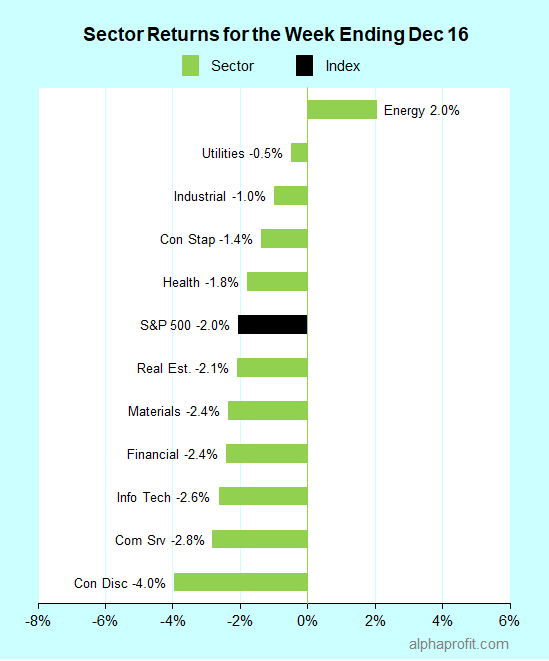
For the week ending December 16, the S&P 500 (SPY) fell 2.0%. Ten of the 11 sectors declined. Energy (XLE) was the only sector to gain, while consumer discretionary (XLY) lost the most.

Sector returns for the week ending December 16, 2022

Leading and lagging sectors for the week ending December 16, 2022.

The S&P 500’s top 10 winners included the following:

1. Health Care Sector

  • Moderna, (MRNA) +9% – The week’s top performer in the S&P 500.
  • Universal Health Services (UHS) +7%
  • Align Technology (ALGN) +5%

2. Energy Sector

  • Halliburton (HAL) +9%
  • Schlumberger (SLB) +5%
  • Baker Hughes (BKR) +5%
  • APA Corp. (APA) +5%
  • EOG Resources (EOG) +5%

3. Consumer Discretionary Sector

  • PulteGroup (PHM) +5%
  • D.R. Horton (DHI) +5%

Top ETFs for the week

The following ETF themes worked well: energy, oil, natural gas, oil & gas exploration & production, and energy services. The top ETFs for the week include:

  • VanEck Oil Services ETF (OIH) 5.6%
  • United States Natural Gas Fund (UNG) 4.4%
  • SPDR S&P Oil & Gas Exploration & Production ETF (XOP) 3.7%
  • United States Oil Fund (USO) 3.3%
  • Invesco S&P 500 Equal Weight Energy ETF (RYE) 2.8%

More Selling or Santa Rally this Week?

* The S&P 500 and the NASDAQ Composite indexes fell below their 50-day moving averages late last week. Trading from the simultaneous expiration of stock options, stock index futures, and index option contracts contributed to last Friday’s decline. Traders are watching to see if stocks can attract enough buying interest for the benchmarks to rise above their 50-day moving average.

* The November update of the Personal Consumption Expenditures (PCE) Price Index from the Bureau of Economic Analysis is this week’s highlight. The PCE price index is the Federal Reserve’s preferred inflation measure. TradingEconomics.com forecasts the PCE to increase by 0.3% in November, matching October’s tally. Economists expect the PCE to continue falling on a year-over-year basis. TradingEconomics.com projects the annual change in the PCE to decline to 5.5% in November from 6.0% in October.

* Data on the state of the U.S. housing market are due. The reports include November housing starts, building permits, sales of new homes, and sales of existing homes.

* CarMax, FedEx, General Mills, Micron Technology, and Nike are among the S&P 500 member companies reporting earnings this week.


Stay on top of the stock market with ‘Looking Back, Looking Forward’

Sign up free to receive Looking Back, Looking Forward in your Inbox.


Learn more:

How AlphaProfit's investment strategy minimizes your risk
How AlphaProfit keeps your fees and expenses low
Performance of model portfolios & recommendations in AlphaProfit's Premium Service investment newsletter
AlphaProfit's free and premium investment newsletters
Will Powell Allow Santa on Wall Street?

U.S. stocks gave back some of the gains made in the past two weeks. Investors feared the Fed would push interest rates high enough to cause a recession. Data pointing to growth in the service segment of the economy and stickiness in wholesale price inflation drove these fears. Wall Street is focused on two events this week: the November consumer price index data and the Fed’s last interest rate policy meeting of 2022.

Investors worried that a robust economy would drive the Federal Reserve to raise interest rates higher to lower inflation and push the economy into recession.

The Institute of Supply Management’s services activity index gained in November to stoke such concerns. The index rose by 2.1% from October to 56.5%, topping economists’ forecast of 53.7% in a Dow Jones survey. The employment component of the index rebounded, suggesting momentum in the economy.

Somber comments from the CEOs of JPMorgan Chase and Bank of America also unnerved investors. They said inflation is eroding consumer spending power and raising the odds of two-to-three quarters of economic contraction next year.

Investors received an update on wholesale price inflation from the Bureau of Labor Statistics (BLS). The report suggested inflation may be sticky and slow to retreat.

The BLS reported that the producer price index rose 0.3% in November as the cost of services increased. Economists surveyed by Dow Jones forecast the PPI to rise by 0.2% in November. The PPI rose 7.4% from a year ago. Excluding food and energy costs, the core PPI rose 0.4% last month and 6.2% from a year ago.

China eased its “zero-COVID” policy. The Chinese government said people would no longer be required to show negative virus tests or health codes to travel within the country.

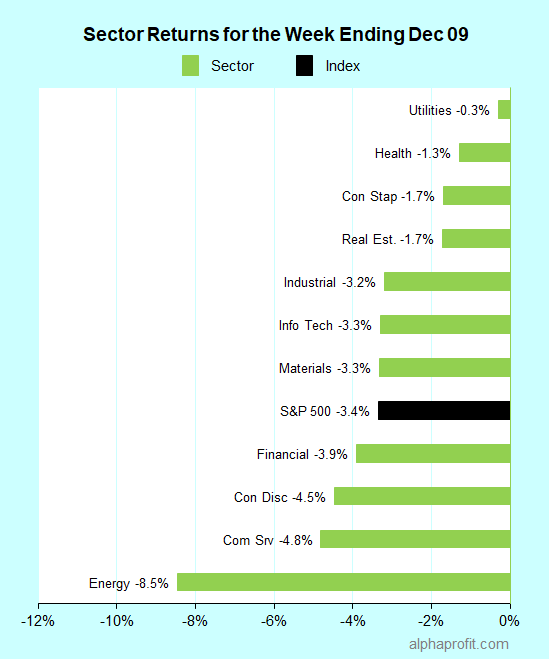
For the week ending December 09, the S&P 500 (SPY) fell 3.4%. All of the 11 sectors declined.

Utilities (XLU) lost the least, while energy (XLE) lost the most.

Sector returns for the week ending December 09, 2022

Leading and lagging sectors for the week ending December 09, 2022.

The S&P 500’s top 10 winners included the following:

1. Utilities Sector

  • Evergy, (EVRG) +7% – The week’s top performer in the S&P 500.
  • CMS Energy (CMS) +3%
  • DTE Energy (DTE) +2%

2. Consumer Staples Sector

  • Newell Brands (NWL) +3%
  • Campbell Soup (CPB) +3%

3. Real Estate Sector

  • Realty Income (O) +2%

4. Information Technology Sector

  • Seagate Technology (STX) +2%
  • SolarEdge Technologies (SEDG) +2%

5. Health Care Sector

  • Molina Healthcare (MOH) +2%
  • Teleflex (TFX) +2%

Top ETFs for the week

The following ETF themes worked well: China, Hong Kong, silver, and Japan. The top ETFs for the week include:

  • KraneShares CSI China Internet ETF (KWEB) 4.0%
  • iShares MSCI Hong Kong ETF (EWH) 3.9%
  • iShares MSCI China ETF (MCHI) 2.1%
  • iShares Silver Trust (SLV) 1.3%
  • WisdomTree Japan Hedged Equity Fund (DXJ) 1.3%

Will Powell Allow Santa on Wall Street This Year?

* The Bureau of Labor Statistics (BLS) reports data on inflation at the retail level this week after reporting data on wholesale price inflation last Friday. On Tuesday, the BLS updates the November reading for the consumer price index (CPI). TradingEconomics.com forecasts the CPI to show a 7.6% increase for the 12 months ending in November, down a tad from 7.7% in October. Core inflation, which excludes food and energy costs, is expected to fall to 6.2% from 6.3% in October.

* The Federal Open Market Committee meets on Tuesday and Wednesday this week to discuss interest rate policy. Market participants expect the Fed to raise the federal funds rate by 0.50% to the 4.25–4.50% range. In light of the continued strength shown by the labor market and stickiness in inflation, investors are eager to hear what the Fed has to say on the terminal interest rate and the outlook for the economy.

* A handful of S&P 500 member companies, including Accenture, Darden Restaurants, Lennar, Nordson, and Oracle, are due to report earnings this week.


Stay on top of the stock market with ‘Looking Back, Looking Forward’

Sign up free to receive Looking Back, Looking Forward in your Inbox.


Learn more:

How AlphaProfit's investment strategy minimizes your risk
How AlphaProfit keeps your fees and expenses low
Performance of model portfolios & recommendations in AlphaProfit's Premium Service investment newsletter
AlphaProfit's free and premium investment newsletters
Top Performing Fidelity Funds for November 2022

Fidelity funds focusing on China, emerging Asia, emerging markets, semiconductors, and gold were top performers in November.

Top Fidelity Funds for November 2022

Excludes closed Fidelity funds

* Fidelity China Region Fund, FHKCX +30.1%

* Fidelity Emerging Asia Fund, FSEAX +20.3%

* Fidelity Select Semiconductors Portfolio, FSELX +20.2%

* Fidelity Sustainable Emerging Markets Equity Fund, FSYJX +18.5%

* Fidelity Select Gold Portfolio, FSAGX +18.4%

Stocks contributing to the performance of the above Fidelity funds likely include Advanced Micro Devices (AMD), Agnico Eagle Mines (AEM), Alamos Gold (AGI), Alibaba Group (BABA), Franco-Nevada (FNV), Microchip Technology (MCHP), Newmont (NEM), NVIDIA (NVDA), ON Semiconductor (ON), Orla Mining (ORLA), Osisko Gold Royalties (OR), Pinduoduo (PDD), Taiwan Semiconductor (TSM), and Wheaton Precious Metals (WPM).


Stay on top of the stock market with ‘Looking Back, Looking Forward’

Sign up free to receive Looking Back, Looking Forward in your Inbox.


Learn more:

How AlphaProfit's investment strategy minimizes your risk
How AlphaProfit keeps your fees and expenses low
Performance of model portfolios & recommendations in AlphaProfit's Premium Service investment newsletter
AlphaProfit's free and premium investment newsletters
Top Performing ETFs for November 2022

ETFs focusing on Chinese stocks and emerging market internet stocks were top performers in November.

Top Performing ETFs for November 2022

Excludes ETFs leveraged or less than $500 million in assets

* KraneShares CSI China Internet ETF, KWEB +48.0%

* iShares China Large-Cap ETF, FXI +34.4%

* iShares MSCI China ETF, MCHI +32.1%

* EMQQ The Emerging Markets Internet & Ecommerce ETF, EMQQ +29.9%

* WisdomTree China ex-State-Owned Enterprises Fund, CXSE +28.9%

Stocks contributing to the performance of the above ETFs likely include Alibaba Group (BABA), Baidu (BIDU), Full Truck Alliance Co (YMM), JD Health International (JDHIF), JD.com Class A (JD), KE Holdings (BEKE), Meituan Class B (MPNGY), NetEase (NTES), Pinduoduo (PDD), Tencent Holdings (TCEHY), and Trip.com Group (TCOM).


Stay on top of the stock market with ‘Looking Back, Looking Forward’

Sign up free to receive Looking Back, Looking Forward in your Inbox.


Learn more:

How AlphaProfit's investment strategy minimizes your risk
How AlphaProfit keeps your fees and expenses low
Performance of model portfolios & recommendations in AlphaProfit's Premium Service investment newsletter
AlphaProfit's free and premium investment newsletters
Can Stocks Buck the Rising Odds of a Recession?

The S&P 500 rose 1.1% and ended the week above its 200-day moving average. Fed Chair Powell spurred a strong rally in stocks on Wednesday, saying interest rates could rise less in December compared to their increase in November. Investors will have plenty to ponder this week. Economic data providing updates on inflation, the health of the services economy, and consumer sentiment are due.

U.S. stocks gained for the week after they surged on Wednesday in response to Federal Reserve Chair Powell’s speech at the Brookings Institution.

Powell said the central bank’s pace of interest-rate increases could slow as soon as its December 13-14 meeting. Traders raised the odds of a 0.50% increase in the federal fund’s interest rate after this meeting as the odds of a 0.75% increase fell.

The Labor Department showed payrolls rose by 263,000 in November, exceeding economists’ forecast of 200,000 in a Dow Jones survey. The unemployment rate was unchanged at 3.7%. Average hourly earnings rose 0.6%, exceeding economists’ 0.3% forecast.

Although stocks fell immediately after this stronger-than-expected jobs report hit the wires, they quickly resumed their uptrend. Interest rate fears were at bay in light of Powell’s outlook for interest rates.

Economic data suggested that the Fed’s policy of cutting inflation by raising interest rates is working. The Fed’s preferred inflation measure, the core personal consumption expenditures (PCE) price index, which excludes food and energy prices, rose 0.2%, less than economists’ 0.3% forecast. The core PCE was up 5% from a year ago, in line with economists’ forecasts.

According to the Institute of Supply Management, manufacturing activity in the United States fell in November for the first time in two and a half years as higher borrowing costs weighed on demand for goods.

Longer-dated Treasury bond yields fell. The 10-year note yielded 3.51% at the end of the week, 0.18% lower than a week ago. The rally in stocks lifted the S&P 500 above its 200-day moving average.

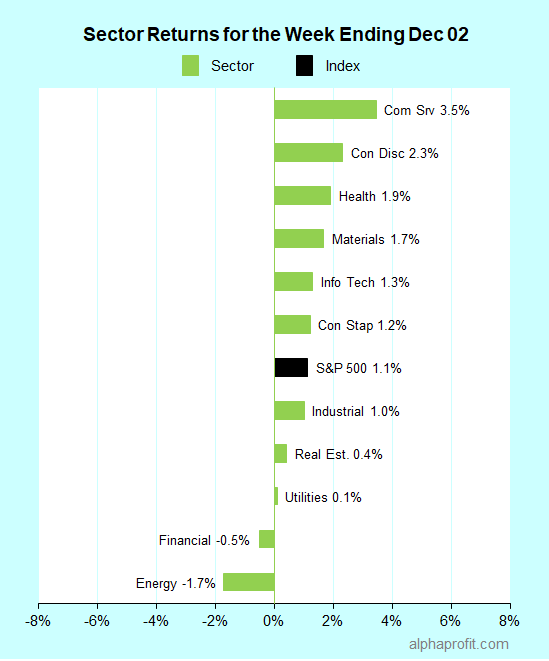
For the week ending December 02, the S&P 500 (SPY) rose 1.1%. Nine of the 11 sectors advanced.

Communication services (XLC) gained the most, while energy (XLE) lost the most.

Sector returns for the week ending December 02, 2022

Leading and lagging sectors for the week ending December 02, 2022.

The S&P 500’s top 10 winners included the following:

1. Health Care Sector

  • Catalent, Inc (CTLT) +26% – The week’s top performer in the S&P 500.

2. Consumer Discretionary Sector

  • Etsy, Inc. (ETSY) +17%
  • PVH Corp. (PVH) +15%
  • Wynn Resorts, Limited (WYNN) +14%
  • Las Vegas Sands Corp. (LVS) +11%
  • Bath & Body Works, Inc. (BBWI) +9%

3. Information Technology Sector

  • Fidelity National Information Services, Inc. (FIS) +12%

4. Communication Services Sector

  • Netflix, Inc. (NFLX) +12%
  • Meta Platforms, Inc. (META) +11%

5. Financial Sector

  • MarketAxess Holdings Inc. (MKTX) +9%

Top ETFs for the week

The following ETF themes worked well: China, cannabis, carbon credits, and silver. The top ETFs for the week include:

  • KraneShares CSI China Internet ETF (KWEB) 24.4%
  • iShares MSCI China ETF (MCHI) 12.2%
  • AdvisorShares Pure US Cannabis ETF (MSOS) 9.1%
  • KraneShares Global Carbon ETFF (KRBN) 8.5%
  • iShares Silver Trust (SLV) 8.0%

Can Stocks Buck the Rising Odds of a Recession?

* Although stocks rose last week, the yield curve steepened further, implying an increase in the odds of a recession. The difference in yield between 10-year and 2-year Treasury notes widened to 0.77%. Meanwhile, analysts continued to lower their 2023 earnings growth estimates. Can stocks continue to buck the rising odds of a recession?

* The main economic data point for the week is the November producer price index (PPI) data. The Bureau of Labor Statistics releases the PPI on Friday. The PPI tracks inflation from a wholesale price perspective. Economists surveyed by Dow Jones expect the PPI to increase by 0.2% in November, matching the tally from October. They expect the annual increase in the PPI to moderate to 7.2% in November from 8.0% in October.

* The University of Michigan’s preliminary December reading of its Consumer Sentiment Index is due on Friday too. This report will include an update on consumers’ inflation expectations.

* Investors will also get insights into the state of the services economy when the Institute for Supply Management updates its services index for November. Economists expect the index to decline to 53.7 from 54.4 in October, suggesting slower expansion.

* A handful of S&P 500 member companies, including Autozone, Broadcom, Brown-Forman, Campbell Soup, and Costco, are due to report earnings this week.


Stay on top of the stock market with ‘Looking Back, Looking Forward’

Sign up free to receive Looking Back, Looking Forward in your Inbox.


Learn more:

How AlphaProfit's investment strategy minimizes your risk
How AlphaProfit keeps your fees and expenses low
Performance of model portfolios & recommendations in AlphaProfit's Premium Service investment newsletter
AlphaProfit's free and premium investment newsletters
Will Black Friday Push the S&P 500 Over its 200DMA?

U.S. stocks reversed the rally spurred by inflation data. Fed officials dispelled hopes that the central bank would moderate interest rate increases. Worries of a recession also increased, as reflected by a steeping yield curve. Trading this week is a three-and-a-half-day affair on account of the Thanksgiving holiday. Shopping activity on Black Friday will be in focus on the heels of mixed third-quarter earnings reports from retailers. Minutes from the November Fed meeting can also move markets.

Last week, stocks tried to build on the momentum from the prior week’s broad rally spurred by a lower-than-expected increase in the consumer price index. The producer price index data helped the cause as the 0.2% increase in October lagged economists’ 0.4% forecast.

Walmart’s earnings report also lifted stock prices after the retailer beat analysts’ third-quarter sales and EPS estimates and boosted full-year guidance.

The rally, however, lost steam after Federal Reserve officials pressed the case for higher interest rates. St. Louis Fed President Bullard said interest rate increases have so far “had only limited effects on observed inflation.” Boston Fed President Collins said there is little evidence that “price pressures are waning.”

Investors’ recession concerns also rose, as evidenced by the steepening inversion in the yield curve. The yield on the 2-year Treasury note rose by 0.18% to 4.51%, while the 10-year Treasury note yield rose 0.01% to 3.82%. The 0.69% yield difference marked the deepest inversion in over 40 years.

Target added to recession fears by forecasting a drop in holiday quarter sales. The retailer cited the impact of inflation on consumer spending. The Conference Board’s U.S. leading economic index fell for the eighth straight month in October. Existing-home sales fell for the ninth consecutive month in October.

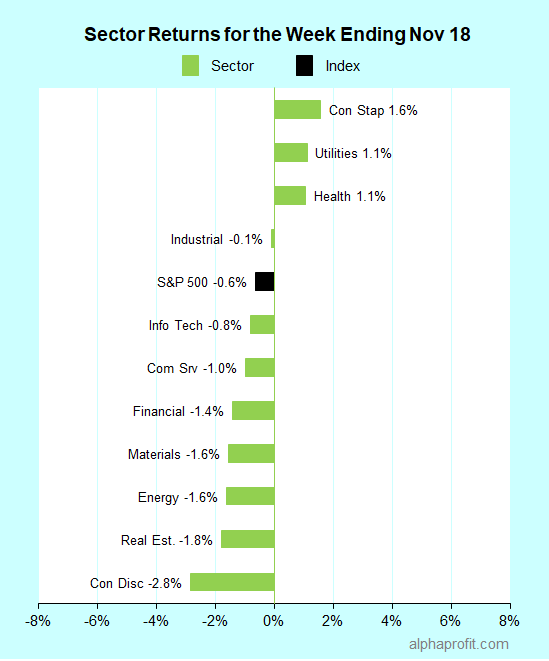
For the week ending November 18, the S&P 500 (SPY) fell 0.6%. Three of the 11 sectors advanced.

Consumer staples (XLP) gained the most, while consumer discretionary (XLY) lost the most.

Sector returns for the week ending November 18, 2022

Leading and lagging sectors for the week ending November 18, 2022.

The S&P 500’s top 10 winners included the following:

1. Consumer Discretionary Sector

  • Ross Stores (ROST) +12% – The week’s top performer in the S&P 500.
  • Bath & Body Works (BBWI) +6%

2. Information Technology Sector

  • Jack Henry & Associates (JKHY) +7%
  • Enphase Energy (ENPH) +7%
  • Cisco Systems (CSCO) +7%
  • SolarEdge Technologies (SEDG) +6%

3. Financial Sector

  • Lincoln National (LNC) +7%

4. Health Care Sector

  • Merck & Co. (MRK) +6%
  • Moderna (MRNA) +6%
  • AmerisourceBergen (ABC) +6%

Top ETFs for the week

The following ETF themes worked well: China, natural gas, bitcoin, and long duration bonds. The top ETFs for the week include:

  • KraneShares CSI China Internet ETF (KWEB) 7.6%
  • United States Natural Gas Fund (UNG) 7.3%
  • ProShares Bitcoin Strategy ETF (BITO) 3.7%
  • PIMCO 25+ Year Zero Coupon U.S. Treasury Index ETF (ZROZ) 3.1%
  • iShares MSCI China ETF (MCHI) 2.8%

Will Black Friday Push the S&P 500 Over its 200DMA?

* Investors have their eyes on the S&P 500 and its 200-day moving average after the index approached this trendline last week only to turn away. Investors will watch to see if the benchmark can gain enough momentum to surpass its 200-day moving average during this short trading week.

* Black Friday kicks off the holiday shopping season this week amid stubborn inflation. Consumers are contending with rising interest rates, while retailers are coping with supply-chain disruptions and excess inventories. Third-quarter earnings reports from retailers indicate a growing performance gap between the big box and specialty retailers. Black Friday shopping reports can move markets as they set expectations for consumer spending and retailer performance.

* The Federal Reserve will release the minutes from its November interest rate policy meeting. The transcript could provide insights into the Fed’s interest rate plan. The University of Michigan will publish data on inflation expectations in its November Consumer Sentiment report. The Fed transcript and the update on inflation expectations have the potential to move the market.

* A handful of S&P 500 member companies, including Deere & Company, Medtronic, Analog Devices, Autodesk, Agilent Technologies, and Dollar Tree, are due to report earnings this week.


Stay on top of the stock market with ‘Looking Back, Looking Forward’

Sign up free to receive Looking Back, Looking Forward in your Inbox.


Learn more:

How AlphaProfit's investment strategy minimizes your risk
How AlphaProfit keeps your fees and expenses low
Performance of model portfolios & recommendations in AlphaProfit's Premium Service investment newsletter
AlphaProfit's free and premium investment newsletters

Will Retailers Keep the Rally Going – Nov. 13, 2022

U.S. stocks closed last week on a strong note after a lower-than-expected rise in the consumer price index led investors to lower their expectations for peak interest rates. The midterm elections failed to provide immediate answers about congressional control. The focus shifts to the consumer this week as leading retailers report earnings. Data on retail sales and the housing industry are due too.

The Labor Department reported last Thursday that the annual change in the consumer price index (CPI) fell below 8% for the first time in October after January. The CPI rose 0.4% in October to print a 7.7% increase for the year compared to 8.2% in September.

Excluding food and energy costs, the core CPI rose 0.3% for the month and 6.3% for the year, trailing economists’ forecasts for increases of 0.5% and 6.5%, respectively.

Earlier last week, stocks rose ahead of Tuesday’s midterm elections on expectations the Republicans would make significant inroads into the balance of power in Congress.

The Republican wave, however, failed to materialize, and certain races were too close to call. Stocks fell sharply on Wednesday as the reality of a drawn-out midterm election outcome sunk in.

The week was a bad one for cryptocurrencies. The FTX crypto exchange declared bankruptcy after its contemplated merger with its larger rival, Binance, failed to move forward. Cryptocurrency prices fell sharply.

The sharp rally in stock and bond prices after Thursday’s CPI report helped both assets close the week with gains. Technology stocks, battered by rising interest rates in 2022, led the way. The U.S. dollar fell in value versus foreign currencies.

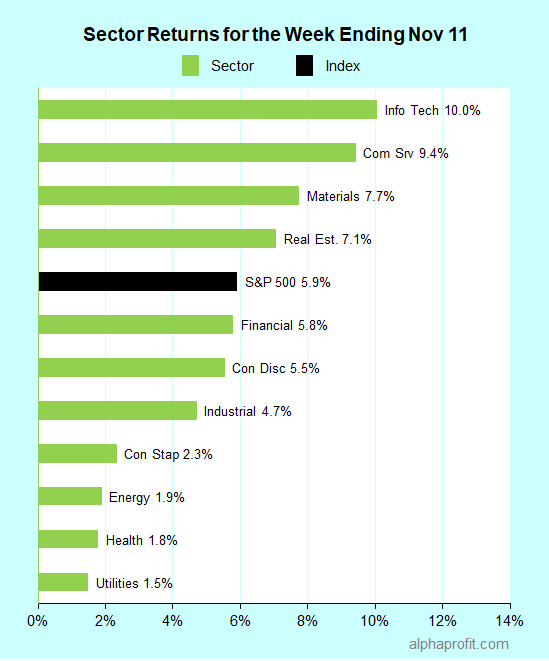
For the week ending November 11, the S&P 500 (SPY) rose 5.9%. All of the 11 sectors advanced.

Information technology (XLK) gained the most, while utilities (XLU) gained the least.

Sector returns for the week ending November 11, 2022

Leading and lagging sectors for the week ending November 11, 2022.

The S&P 500’s top 10 winners included the following:

1. Information Technology Sector

  • SolarEdge Technologies (SEDG) +32% – The week’s top performer in the S&P 500.

2. Financial Sector

  • T. Rowe Price (TROW) +30%
  • Invesco (IVZ) +26%
  • PayPal (PYPL) +21%
  • MarketAxess (MKTX) +21%

3. Communication Services Sector

  • DISH Network (DISH) +27%
  • Meta Platforms (META) +24%

4. Consumer Discretionary Sector

  • Caesars Entertainment (CZR) +22%
  • Mohawk Industries (MHK) +22%

5. Health Care Sector

  • Align Technology (ALGN) +21%

Top ETFs for the week

The following ETF themes worked well: cloud computing, semiconductors, gold mining, Korea, and home building. The top ETFs for the week include:

  • WisdomTree Cloud Computing (WCLD) 15.9%
  • VanEck Semiconductor ETF (SMH) 15.4%
  • VanEck Gold Miners ETF (GDX) 13.4%
  • iShares MSCI South Korea ETF (EWY) 12.6%
  • SPDR S&P Homebuilders ETF (XHB) 12.1%

Will Retailers Keep the Rally Going?

* Leading retailers are in the spotlight this week. Walmart, Target, Home Depot, Lowe’s, and several specialty retailers report earnings. The earnings calendar includes reports from three large technology companies: Applied Materials, Cisco Systems, and NVIDIA.

* The Census Bureau reports October retail sales, providing a consumer pulse. Economists surveyed by Dow Jones expect retail sales to rise by 1.2% in October after remaining flat in September.

* Investors will get updates on the state of the housing market, where demand for homes has plummeted due to surging mortgage rates. The U.S. Census Bureau releases data on October building permits and housing starts. Data on existing home sales in October are due from the National Association of Realtors. Economists expect all housing industry measures to decline.

* The Conference Board updates its Leading Economic Index (LEI) for the U.S. Economists expect the LEI to fall 0.4% in October, matching the September tally. The impact of the LEI reading on stock prices has increased recently as recession fears have become a top-of-mind issue for investors. Continued declines in the LEI can escalate such worries.


Stay on top of the stock market with ‘Looking Back, Looking Forward’

Sign up free to receive Looking Back, Looking Forward in your Inbox.


Learn more:

How AlphaProfit's investment strategy minimizes your risk
How AlphaProfit keeps your fees and expenses low
Performance of model portfolios & recommendations in AlphaProfit's Premium Service investment newsletter
AlphaProfit's free and premium investment newsletters